- Статьи
- Science and technology
- Celestial bodies: observation of 3I/ATLAS provided knowledge about substances from other galaxies

Celestial bodies: observation of 3I/ATLAS provided knowledge about substances from other galaxies

Russian scientists have obtained unique data on the chemical composition of the 3I/ATLAS interstellar object, which has been flying from the far corners of the universe for 7-8 billion years and will get as close to Earth as possible on December 19. This celestial body entered the Solar System from interstellar space, so studying it allows us to understand what substances may prevail in other worlds that are inaccessible to humanity for hundreds of years. Most experts agree that the comet. However, American astrophysicist Avi Loeb discovered about 15 anomalies in the behavior of 3I/ATLAS, which, in his opinion, may indicate the artificial origin of the object. He exclusively told Izvestia about why one of the world's leading astronomers allows a version about a spaceship.
What is 3I/ATLAS and why does it have an anti-tail?
Studying the optical properties of the 3I/ATLAS object has already provided scientists with invaluable data on the features of remote worlds to which they do not have access. It turned out that the comet contains the same substances as in our near space, but in different proportions, Russian astronomers said.

— The peculiarity of this comet is that it moves along a highly elongated hyperbolic trajectory. That is, it does not have a closed orbit. This means that she does not come from the Solar system, but from another star system. And for billions of years, it has been traveling from one star to another and has now reached us. First of all, we are interested in its chemical composition. It can be used to find out what substances are contained in other star systems. It consists of water, carbon dioxide, iron, nickel. These are the same compounds as in the Solar System, but in a different proportion," Stanislav Korotky, head of scientific work at the Ka—Dar Observatory near Moscow, as well as the TAU astronomical station in Nizhny Arkhyz, told Izvestia.
On December 19, at about 07:00 Moscow time, the interstellar object 3I/ATLAS passed at a minimum distance from Earth. This cosmic body was discovered by astronomers in July. Most experts agree that we are talking about a comet moving in a highly elongated orbit from outside the Solar system. This is the third interstellar object recorded in the entire history of observations, and the fastest known: its speed reaches about 200 thousand km/h.
The 3I/ATLAS gained special fame thanks to Harvard astrophysicist Avi Loeb. Based on the unusual properties of the object, he hypothesized about its artificial origin, even suggesting that it could be a giant alien ship. In support of his version, the scientist pointed out about a dozen and a half anomalies in the behavior of the celestial body, which distinguish it from all known natural objects. Among them are the radio signals that emanated from it, as well as the direction of the tail towards the Sun, and not away from it, as with most comets. Such a rare phenomenon is called the "anti-tail".
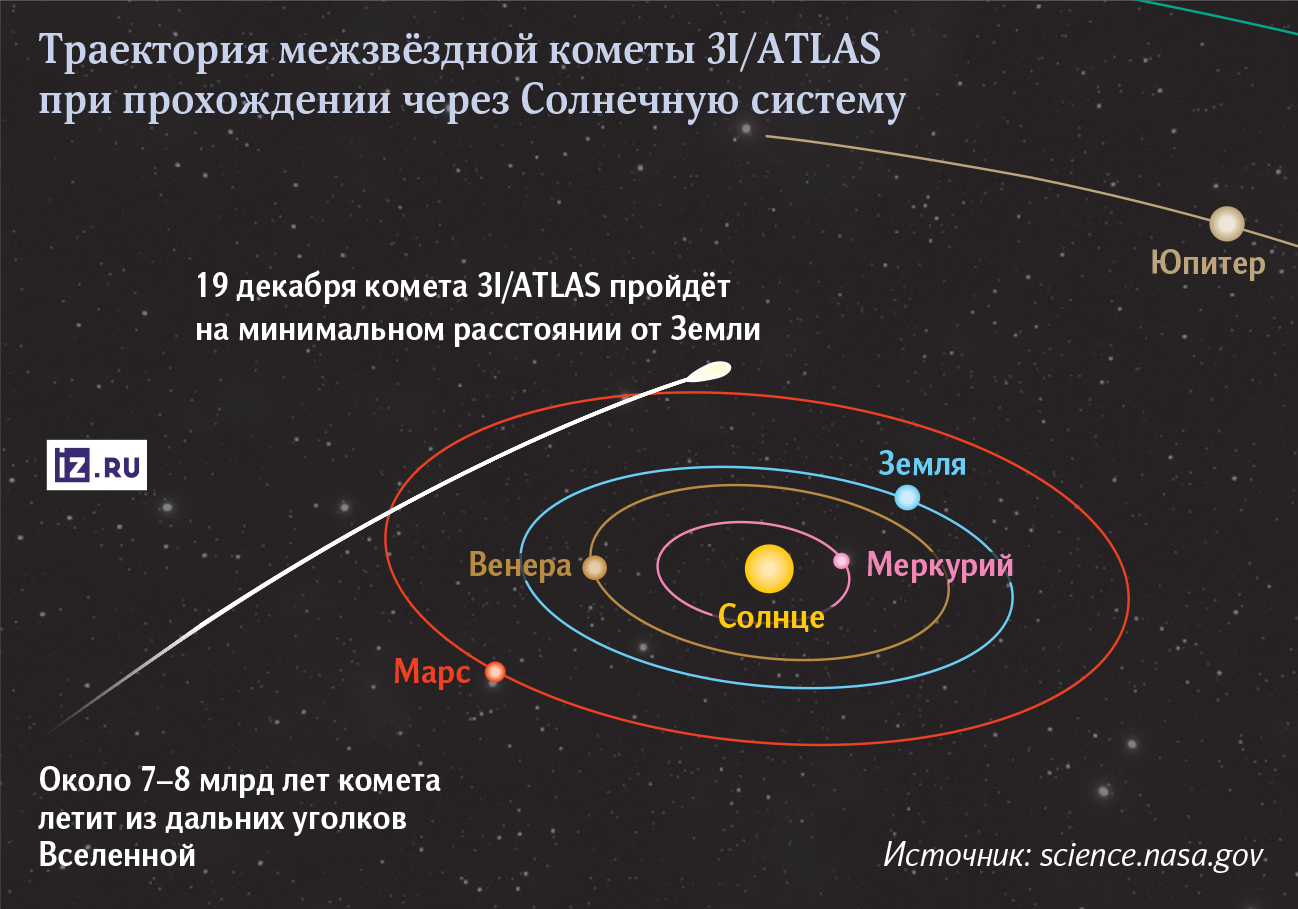
— 3I/ATLAS is unusual in that its trajectory lies in the plane of motion of the planets around the Sun with an accuracy of up to five degrees. And the chance that this will happen by accident is one in 500. This raises the possibility that its trajectory was designed by some kind of extraterrestrial intelligence. He shoots a jet in the direction of the Sun. It goes about 1 million km in the direction of our star. Comets usually have a tail pointing away from the Sun, but here it's the other way around," Harvard University professor Avi Loeb told Izvestia.
This tail can be created by a technological propulsion system. And there are so many amazing coincidences in the "route" of a cosmic body through the Solar System that they suggest that it was laid intentionally, the scientist said.
— On December 19, 3I/ATLAS will approach the Earth at a distance of about 269 million km. There will also be a new moon that night, which will allow us to observe the object without much moonlight pollution. I hope that hundreds of observatories around the World, as well as space telescopes, will look at it," the scientist said.
According to him, there is no indication that the object can maneuver and arrive on Earth. However, in March it will be close to Jupiter and may turn out to be a mothership that will place its vehicles next to the planet. But if 3I/ATLAS turns out to be just a comet, it will be possible to breathe a sigh of relief, because meeting with an alien intelligence poses a threat to all mankind, the American expert is sure.

However, according to astronomer Leonid Elenin, all these anomalies can be scientifically explained.
— Indeed, 3I/ATLAS has an anti-tail, but it has been observed in dozens more comets. And in the same way, there were dozens of cases when radio signals emanated from comets," said the Russian specialist.
His colleague Stanislav Korotky agrees with this.
— The fact is that the anti-tail is observed in a significant part of comets. Can we say on this basis that they are all alien ships? — He said.

What are comets made of and how to determine their age?
According to the expert, 3I/ATLAS, like most comets, consists mainly of ice. And the difference in the proportions of substances in its composition reflects that other star systems may have different ratios of chemical elements. So older stars are characterized by lighter compounds. And if a supernova flare occurred near the body, it, on the contrary, saturates it with heavier substances.
— This comet spent a long period of time in interstellar space. Its age is most likely greater than the age of the entire solar system. It has been around for 5 billion years, and 3I/ATLAS is probably 7-8 billion years old," said Stanislav Korotky.

3I/ATLAS
However, according to Leonid Elenin, it is not easy to accurately determine the age of 3I/ATLAS. Just like the place in the universe where he came from. There are models that say that the more straightened and different from the hyperbola of the orbit, the more often the comet approached the stars. Over billions of years of flight, every star in the path has influenced its natural gravitational maneuver. Therefore, the more of them there were, the older the comet. It is believed that 3I/ATLAS is from 3 to 7 billion years old. But scientists do not know the exact time of his flight and therefore cannot say for sure where he came from.
— This is a unique object and a huge discovery for science, because flights to other planetary systems will not be available for hundreds of years. And here, a piece of a distant world has approached us. Since he was born in a different system, he has a different proportion of chemical elements. For example, if we find out that the Solar System is richer in water than others, we can explain why life originated on Earth and not on other planets," said Leonid Elenin.
There are currently three known interstellar objects that have visited the Solar System.: These are Oumuamua, Comet Borisov and 3I/ATLAS, Vladimir Tselmovich, head researcher at the Borok Geophysical Observatory, a branch of the Institute of Physics of the Earth of the Russian Academy of Sciences, explained to Izvestia. The identification of such formations became possible with the advent of new techniques and methods of cognition of nature. Studying them is useful not only from a fundamental, but also from a practical point of view. For example, they can suggest materials unknown on Earth that can withstand interstellar travel. This knowledge will be in demand when creating a new generation of spacecraft.

Artistic image of the asteroid "Oumuamua"
— For example, one of the recent discoveries is the detection of atomic nickel vapor in the tails of comets. Which was surprising, since this metal turns into a gas at very high temperatures, which are not expected so far from the Sun. Initially, this effect was studied by observing Comet Borisov. Then nickel vapors began to be found on other similar objects. This element was also detected in the tail of 3I/ATLAS. At the same time, pure native nickel is not found in terrestrial conditions," the scientist said.
According to Avi Loeb, the concentration of nickel in 3I/ATLAS also indicates its artificial origin.
— We see nickel with a very small amount of iron, which flies out of the object into the surrounding gas plume. The only place where such a composition is found is in the industrial production of nickel alloys used in the aerospace industry. Therefore, there is a possibility that the surface, the wall of this object was manufactured technologically," he said.

The composition of 3I/ATLAS has also been studied in detail by Russian researcher Maria Gritsevich from Ural Federal University.
In March 2026, the comet will fly near Jupiter, where there are terrestrial research stations that may provide scientists with additional information about the interstellar traveler.
Переведено сервисом «Яндекс Переводчик»
