
Fuel season: the fuel crisis in the regions is gaining momentum

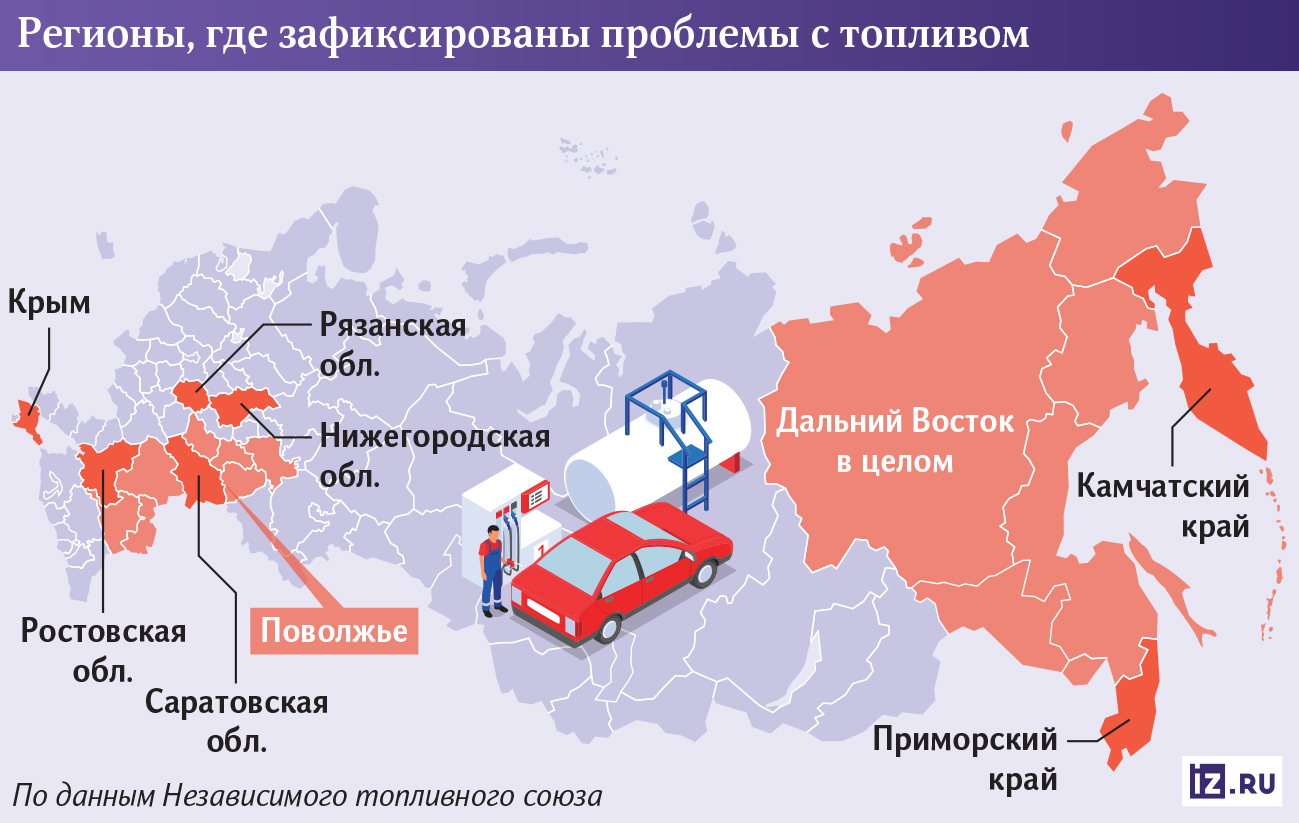
More and more regions of Russia are facing gasoline shortages — fuel supply disruptions have already been recorded in more than 10 regions. If earlier problems were noted in the Far East and in the Saratov region, now shortages and the forced suspension of independent gas stations are reported in the Nizhny Novgorod, Rostov, Ryazan regions and in the Crimea. The owners of local chains say that some refineries have not shipped 92nd and 95th gasoline for several weeks. The main reason is the seasonal increase in fuel demand and the growth of tourism activity. The situation is also negatively affected by rising gasoline prices in the wholesale sector, experts say. Izvestia investigated what is happening in the Russian fuel market.
In which regions are gas stations suspended
In a number of Russian regions, gasoline shortages have already led to the forced suspension of some independent gas stations. This is reported to Izvestia by market participants.
— Indeed, there are certain difficulties in the Russian fuel market. First of all, there is a shortage of high-octane gasoline, which is caused by a systemic imbalance between production capacity and existing demand, seasonality, and a number of other reasons. Information is being received about supply disruptions at gas stations in a number of regions, which may lead, among other things, to the closure of gas stations," Pavel Bazhenov, president of the Independent Fuel Union (NTS), told Izvestia.

According to him, this primarily concerns Central Russia, the south of the country, the Volga region and the Far East. Cases of local gasoline shortages were recorded in more than 10 regions of the Russian Federation, the NTS noted.
— We and our colleagues have experienced disruptions in the supply of 92nd and 95th gasoline. This even led to the temporary suspension of a number of gas stations. Someone is not working "from tanker truck to tanker truck", someone has been "winding up pistols" for a long time. In general, for several weeks now, a number of gas stations have been unable to receive shipments from oil refineries. Problems with fuel supplies are being reported by market participants in an increasing number of regions," said Ekaterina Savkina, member of the Russian Fuel Union (RTS), managing partner of the GP Vympel gas station network.

There are cases of gas station shutdowns in Crimea, German Kolotov, CEO of Mosregiongaz, said in a conversation with Izvestia. According to him, fuel supply disruptions are especially relevant for urban gas stations with small storage volumes.
Izvestia was informed about the fuel shortage and the suspension of gas stations by interlocutors in the Rostov and Nizhny Novgorod regions.

In addition, residents of the Ryazan region also complained about restrictions on the sale of gasoline and diesel fuel at gas stations. The Ministry of Economic Development of the region explained that the situation is due to seasonal factors.

Primorye and other regions of the Far East are facing a growing shortage of gasoline. The reason for this lies in the fact that by the end of August, the region was faced with a doubling in the flow of tourists. The supply of the macroregion was also affected by the reduction in output by oil refineries located in the Far Eastern Federal District.

— Initially, the problem of fuel shortage was local, but now we can say that the geography is expanding: more and more regions of Russia are facing shortages, — said Dmitry Tortev, a member of the expert council of the State Duma Committee for the Protection of Competition.
This trend started from the southern and most remote regions, gradually spreading across the European part of the country, he added.
Izvestia sent a request to the Ministry of Energy with a request to comment on the current situation.
The exchange price of gasoline
At the same time, it should be understood that the problem of fuel shortages at gas stations, and even more so the suspension of their work, concerns independent gas stations — that is, we are talking about those that do not have access to their own production facilities and storage facilities, like vertically integrated oil companies (VICS), Dmitry Tortev noted. Such networks are forced to buy fuel on the stock exchange and, in addition to its availability, the rising prices of gasoline in the wholesale market negatively affect the situation, the expert explained. As a result, it is simply unprofitable for retailers to buy fuel on the stock exchange and then sell it at a disadvantage.
As Izvestia reported, on August 21, the Primorsky Fuel Union sent an appeal to Deputy Prime Minister Alexander Novak and the Federal Antimonopoly Service of Russia, expressing concern about the disparity in wholesale and retail prices for AI-92 and AI-95 gasoline in the fuel market of the region, as well as a significant reduction in sales of these fuels from refineries located on the territory. The Far East and Eastern Siberia.
The reasons for the aggravated fuel crisis in the Far East were the lack of sufficient processing capacity and expensive logistics. The exchange price of AI-95 gasoline in Primorye has increased by 30% since the beginning of June, exceeding 100 thousand rubles per ton. At the same time, the volume of exchange sales from two refineries, where the main gasoline supplies to the region come from, Komsomolsky and Angarsky, decreased by 25-57% during the same time.
 In early September, the price of 95 gasoline on the stock exchange reached a historic high. According to the results of trading on September 3, the price of AI-95 for delivery to the European part of Russia reached a record 82.3 thousand rubles per ton. The AI-92 brand has reached a price of more than 70.6 thousand rubles. As of September 9, AI-95 was trading at 79 thousand, AI-92 at 71.8 thousand rubles, respectively, according to data from the St. Petersburg International Mercantile Exchange (SPIMEX).
At the same time, as noted by a source of Izvestia in the industry, the current model of exchange trading provokes price increases. There are more than a thousand people willing to buy fuel on the stock exchange, and the volumes offered on individual bases are extremely small. Today, the standard for oil workers is 15% of gasoline from the total production volume. As a result, all shipments are sold out instantly, and only a few are bought, the source notes. It is often more profitable for oil companies to sell their goods abroad, so the idea of raising the standards of support for large businesses does not cause, the source said.
To curb prices on the domestic market in July, the government decided to temporarily limit gasoline exports to producers of petroleum products until August 31, 2025, and later the measure was extended to September.
Izvestia sent inquiries to the largest WINCs, as well as to independent gas station networks.
What is the reason for the problems in the fuel market?
In some regions, disruptions in the supply of gasoline may indeed occur. The main reason is a combination of a decrease in production and the continuing high demand season, Sergey Kaufman, an analyst at Finam Financial Group, told Izvestia.
In August-September, there is traditionally a seasonal increase in fuel demand: due to the peak of vacations, active car trips and agricultural work, gasoline consumption increases, Dmitry Tortev explained.

In early September, at the Eastern Economic Forum (EEF), Energy Minister Sergei Tsivilev announced that the ministry, together with oil companies, had changed the schedule of scheduled refinery repairs in order to increase gasoline supplies to the country's domestic market.
— The fuel shortage in Russia's regions has complex causes. The seasonal increase in demand — the holiday period and agricultural work — did add pressure to the market, but attacks on Russian refineries also became an additional factor," said Andrey Loboda, a top financial communications manager.

There are only two ways to solve the shortage: increase supply or reduce demand, noted Sergey Kaufman.
— Demand will naturally begin to decline by the end of September due to the seasonal factor. At the same time, the supply in the domestic market can be increased by activating imports or promptly repairing affected refineries, since the export ban is already in effect, the specialist believes.

A preferential interest rate on loans for both refineries and retail chains could be a measure to support the fuel business in order to avoid a crisis, Dmitry Gusev, Deputy Chairman of the Supervisory Board of the Reliable Partner Association, believes.

Gradual modernization of production and adaptation to the new needs of the car fleet will allow balancing supply and demand, but this process will take several years, Pavel Bazhenov noted. An increase in fuel trading volumes on the stock exchange, the formation of additional reserves in the regions, and the creation of favorable conditions for the development of high-octane gasoline production through blending could have a faster effect, the expert concluded.
Переведено сервисом «Яндекс Переводчик»
