- Статьи
- Economy
- On the count of two: in the Russian Federation, they propose to abandon the indexation of the maternity capital for the firstborn

On the count of two: in the Russian Federation, they propose to abandon the indexation of the maternity capital for the firstborn

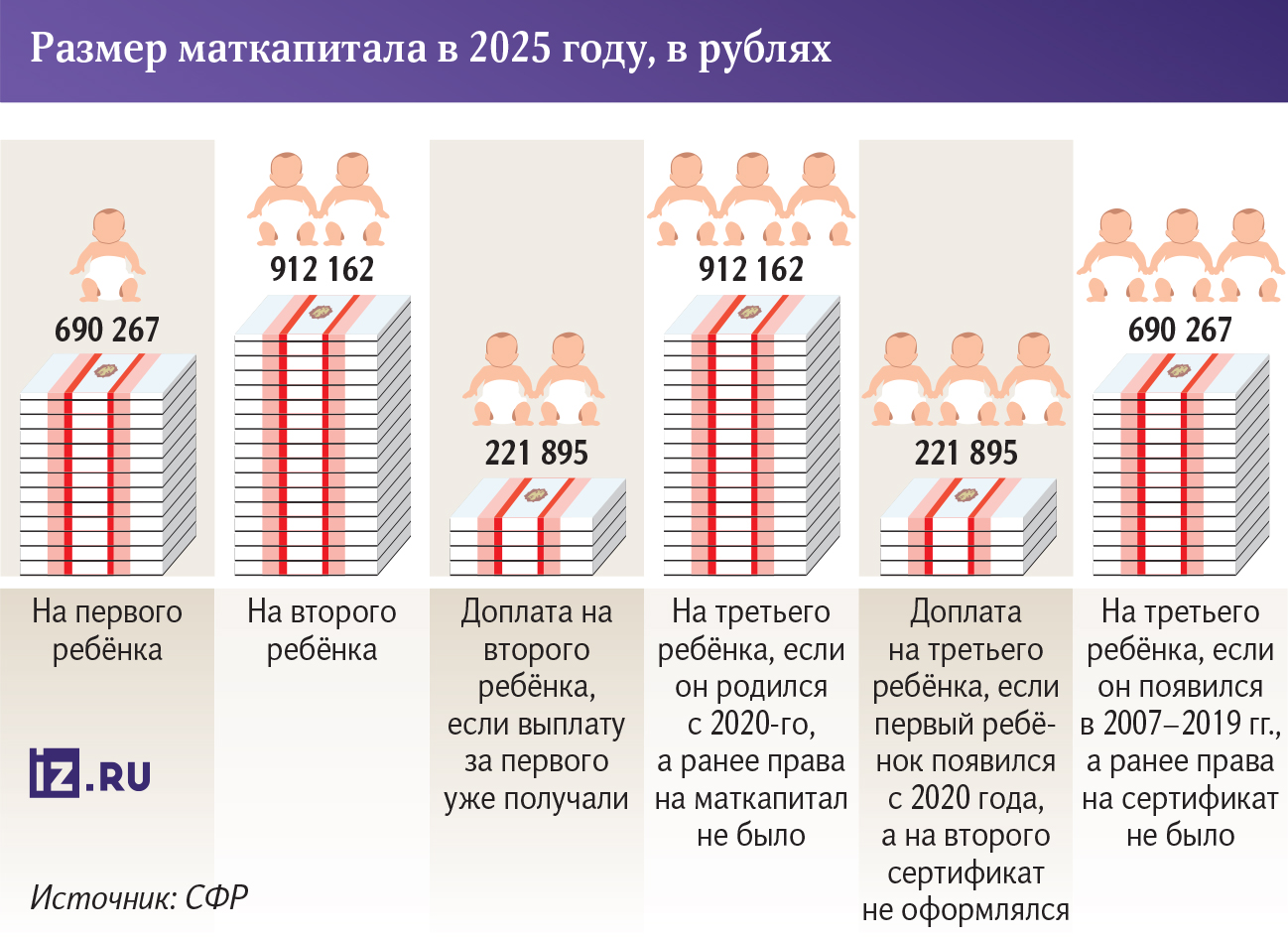
In Russia, they propose to direct all future indexation of the maternity capital to payments for the second and subsequent children. This will reduce the gap between support for the birth of the first child (690 thousand rubles) and the second child (222 thousand). The initiative was launched by the Center for Macroeconomic Analysis and Short-term Forecasting (CMACP). They explain that the current ratio does not stimulate fertility. A family's first child is usually born anyway, and financial incentives only accelerate this step. But financial support more often becomes a decisive factor in the appearance of the next children. Whether this will help change the situation with the record low birth rate and what other measures can work is in the Izvestia article.
The size of the maternity capital for the first and second child
In Russia, until 2020, maternity capital was provided only at the birth of the second and subsequent children. Then the program was expanded to include the firstborn, who now accounts for most of the payout. This allowed many families to decide on a child earlier, but people usually have one baby anyway — financial support only accelerates this step. But with subsequent children, the effect of financial assistance is higher. At the same time, there are no significant financial incentives to have a second child.

Therefore, it would be more effective to redistribute support so that the bulk of the funds fall on the second and next children, according to the CMACP report "Thirteen Theses on Economics. Demographic crisis". Now, in order to reduce the difference between payments, the CMACP is proposing to direct the entire indexation of the maternity capital budgeted for additional payments for the second and subsequent children, Ekaterina Sabelnikova, the author of the report, clarified for Izvestia.
Now, at the birth of their first child, parents receive maternity capital in the amount of 690 thousand rubles. And the next child is entitled to an additional payment of only 222 thousand (but if no assistance was provided for the eldest, then 912 thousand are allocated for the youngest). At the same time, such support applies to the third child only if it has not been received at all before.

According to the report, the total fertility rate of second children (that is, how many second children per woman are born on average) is decreasing. And this may partly be due to the transfer of maternity capital to the first child.
As of August 2025, more than 443 thousand certificates have been issued, of which 311 thousand are for first-born children, the press service of the Ministry of Labor shared with Izvestia. At the same time, in recent years, more than half of all maternity capitals are associated with the second and subsequent children, and their share has remained stable — about 55-59%, the department added.

The CMACP's proposal looks reasonable, says Igor Golubchenko, Associate Professor of the Department of Foreign Regional Studies and International Cooperation at the IGSU Presidential Academy. According to him, if payments for the first child are maintained, but support for the birth of the second and subsequent ones is significantly strengthened, this will help maintain a positive background for the appearance of first-born children and give an incentive to increase the number of second children. After all, if the first one is born most often as a realization of the need of motherhood, then the decision on the next one is made already in the presence of material conditions.
— In Russia, it can be expected that with an increase in the maternity capital, especially for the second and subsequent children, and the preservation of other support measures, the total fertility rate will increase over 10-15 years from the current 1.42–1.44 to 1.6–1.7 and even slightly higher, — the expert expects.
The optimal distribution could provide for a basic payment for the first child — about 50% of the current amount to support the family at the start, and a significant increase — up to 70-80% — for the second and subsequent children to encourage large families, said Vladimir Chernov, analyst at Freedom Finance Global. And, according to him, it would not require additional budget funds.

However, there is a risk of a drop in motivation for the birth of the first child, which may force young families to postpone plans for children, the expert added.
What will help to increase the birth rate in Russia
Matkapital has played an important role in stimulating fertility and supporting families, said Yulia Dolzhenkova, a professor at the Financial University under the Government of the Russian Federation. According to her, it is especially important for the low-income, as it helps to solve housing issues, pay for education and treatment for sick children. However, if resources were available, it would be worthwhile to increase the amount of payments: in large cities, the current amount is not enough even for a down payment on a mortgage, while improving housing conditions today plays a key role in supporting demography, the expert is sure.

— Although Russia has a number of measures in place to support families with children, it is unlikely that we will see a sharp increase in the birth rate in the coming years.: The "demographic pit" of the 1990s, a decrease in the number of women of childbearing age, economic difficulties, low incomes and postponing the birth of children for the sake of professional and financial stability are affecting, the professor believes.

The birth rate in Russia has been declining in recent years and is reaching historical lows. In the first quarter of 2025, about 289 thousand children were born, which is 4% less than in the same period last year, according to the latest data from Rosstat.
The family and demographic policy strategy approved until 2036 provides for a whole range of initiatives: expanding the availability of kindergartens and schools, supporting young and large families, Yulia Dolzhenkova listed. In particular, it is planned to create duty groups in kindergartens to synchronize their work with the schedule of parents, as well as to develop flexible working hours, remote and individual employment formats for pregnant women and employees with underage children.

Supporting health, especially reproductive health, for future parents will also help to increase the birth rate, Igor Golubchenko from the Presidential Academy is sure. According to him, systematic work with the population is also needed to strengthen traditional values, including the institution of a large family.
As the expert noted, such measures will not give a sharp jump, but something else is more important for Russia — a gradual and steady increase in the birth rate.
Переведено сервисом «Яндекс Переводчик»
