
Departure task: airlines are preparing outbound flights from the Middle East
Almost two thousand Russians have been blocked in the United Arab Emirates amid the conflict between Israel and Iran, the Russian Union of Travel Industry (PCT) reported. Now airlines have increased the number of flights to take passengers out. At the same time, the tourist flow to the Middle East against the background of the Iranian-Israeli conflict will decrease by 20-40% and return to normal only by July, experts believe. For more information, see the Izvestia article.
How Russians can leave the Middle East
About 1,9 thousand Russians are waiting for outbound flights from the UAE, the Russian Union of Travel Industry told Izvestia. They cannot take off due to the conflict between Iran and Israel and the closure of the airspace over these countries.
— The most difficult situation was on June 13-14. At that time, there were 5-10 thousand passengers who were waiting for their flights to be adjusted or canceled due to the closure of airspace," said Dmitry Gorin, Vice President of the PCT. — Now the airlines have entered the schedule, most tourists have already flown either their own airline or an alternative one. As of today, 1,9 thousand organized tourists have not flown away.

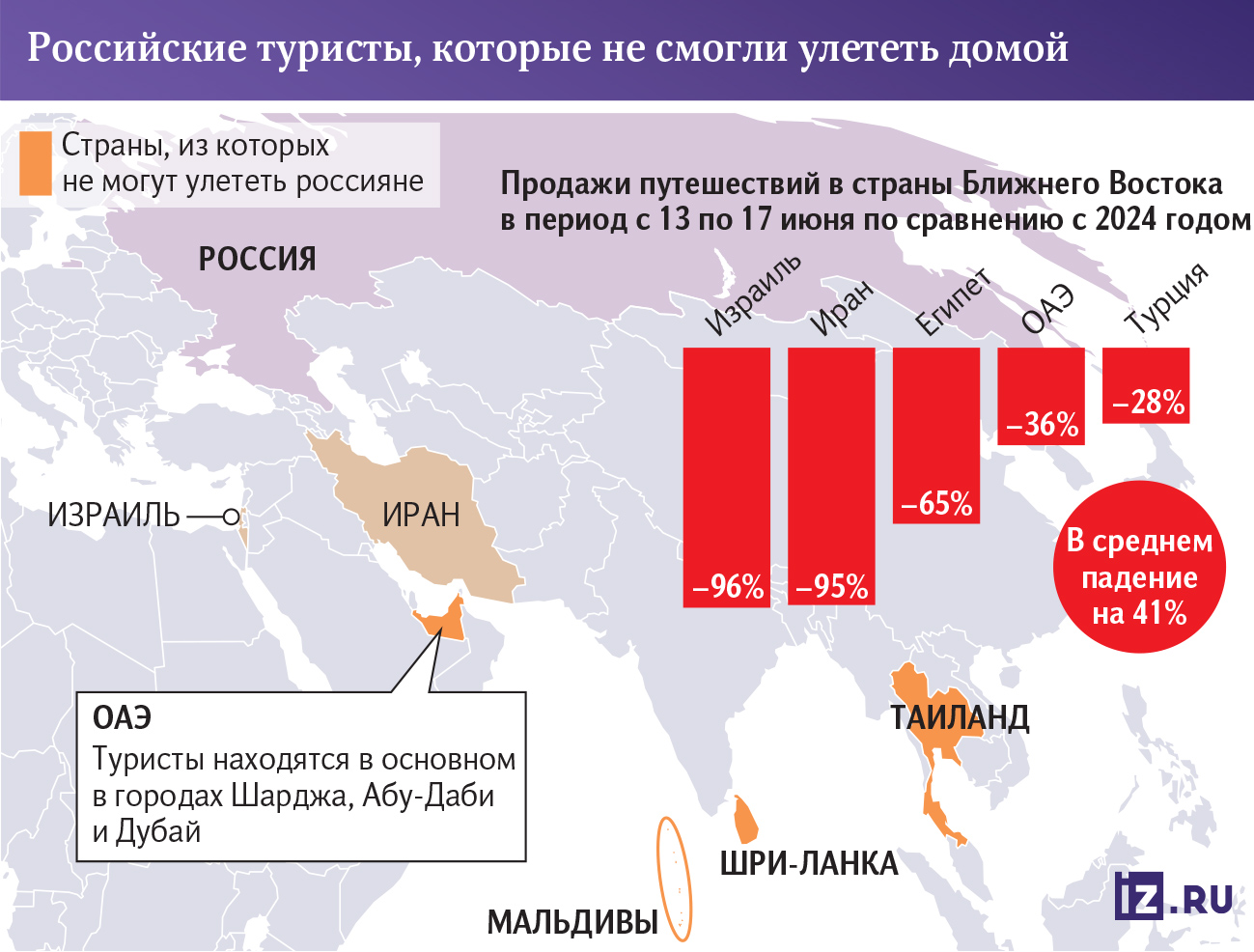
The stranded tourists are mainly in the UAE cities of Sharjah, Abu Dhabi and Dubai, but there are passengers who could not fly from the Maldives, Sri Lanka and Thailand.
The Federal Air Transport Agency reported that on Tuesday, June 17, more than 50 flights by domestic and Arab airlines are planned to be operated between Russia and the UAE.
"Due to the closure of Iran's airspace, carriers continue to fly on modified routes to ensure flight safety — they have become longer, as they pass through the airspace of other states, in some cases landing for refueling," the ministry said.

In addition, Aeroflot has increased its cargo capacity to the United Arab Emirates, the airline's press service noted. Flights to Dubai were switched to wide-body Boeing 777s, which increased the carrying capacity by 90 additional seats in each aircraft.
"All tickets are on open sale and are available for registration, including to tourists who are looking for an alternative due to the reduction in the flight program of other carriers," the airline added.

Flights to Abu Dhabi, Aeroflot reported, continue to be operated there - directly, and back — with refueling in Samara due to the extended route. The airline also continues to operate regular flights from Cairo.
"There are available seats for the upcoming dates," Aeroflot stressed.
At the same time, according to the Aeroflot online scoreboard, there is currently no flight from Abu Dhabi to Moscow - flights are available only from June 18. You cannot fly from Dubai to Moscow on Flydubai until June 19, and there are no Air Arabia flights from Abu Dhabi until June 21, and from Ras al Khaimah until June 22. Flights from Sharjah to Moscow and Yekaterinburg are available from June 17, to Kazan and Ufa from June 21, to Samara from June 22, to Sochi from June 27. The Pobedy website reports that flights from Abu Dhabi to Moscow are not operated or there are no seats.
The conflict that broke out has made its own adjustments to demand, it has decreased slightly, despite the fact that the situation with flight delays is gradually recovering, the press service of the Anex tour operator told Izvestia.
"Many people are vacationing on booked tours, and for those who could not fly, we offer alternative destinations," they added. — There have been some changes in the directions, but now the situation is returning to normal, taking into account adjustments to the flyby zones.

People continue to fly to the Middle East, despite the Iran-Israel conflict, the travel service Kupibilet told Izvestia.
—We are seeing sales growth of about 30% from June 9 to June 16 compared to the previous week," they noted.
The service attributed the increase in sales of air tickets to the Middle East to the forced demand due to flight cancellations and delays, route changes and the flexibility of carriers.
Since June 13, travelers have been canceling trips to the Middle East, one of the booking services told Izvestia. Turkey accounts for 40% of refusals, the UAE for 21%, and Iran and Israel for 16% each.
"In the period from June 13 to June 17, travel sales to the Middle East countries fell by an average of 41% compared to 2024. Israel — 96%, Iran — 95%, Egypt — 65%, UAE — 36%, Turkey — 28%," the company said.

"We asked questions, but no one answered us."
Some tourists could not fly to Russia from the UAE from June 13 to June 15, and some returned only on June 17. One of them is Nika Nilovna, who was vacationing in Abu Dhabi. The woman told Izvestia that the airline had not contacted her on the day of the flight cancellation, on June 13, and had not given any comments to passengers.

— There were no representatives, there was nothing. They just said at the check—in desk: the flight has been canceled and do whatever you want," she stressed.
According to her, some people did not have money for food, and the carrier did not provide it to people while waiting for the next flight. Dmitry, who still cannot fly from Dubai to St. Petersburg, said that he expects departure from the 13th.
"The people who were supposed to leave on June 14-15 are leaving today, but I've been waiting since the 13th, and God willing, there will be a flight tomorrow," he stressed.
Like many tourists, he did not receive any information from the tour operator. He was placed in a hotel, his stay was extended for two days, and water and food, except for breakfast, were at his own expense. Another Russian tourist, Irina, who returned to Russia from the UAE on June 17, told Izvestia that the tour operator had been silent for three days.

— No one from the representatives of the flight company contacted us, everyone was taken to a hotel on the outskirts and that's it. There was no information about what to do next. We asked questions, but no one answered us," she stressed.
Irina is currently in Moscow, and she buys tickets to St. Petersburg herself.
"They promised to compensate, but I don't really know yet," the woman said.

How will the situation affect the tourist flow
Against the background of the conflict between Israel and Iran, demand for travel to the United Arab Emirates is expected to subside, but in two to three weeks after its end, the tourist flow will recover, Aleksan Mkrtchyan, vice president of the Alliance of Travel Agencies of Russia, told Izvestia.

"We see some drawdown, especially from St. Petersburg to the Emirates," he noted. — And the south of Russia is flying normally: flights from Sochi, Mineralnye Vody, Makhachkala are carried out according to schedule. Now Emirati hotels are drastically reducing prices to make everything cheaper than in Turkey. For example, a hotel that cost $500 per day costs $200 per day, which is even cheaper than Sochi.
The tourist flow to Israel, according to the expert, was not large, but it also had to recover.
"At first, it was low due to restrictions against the background of the COVID—19 pandemic, then due to Israel's transition to a combat mode,— explained Aleksan Mkrtchyan.
But there was no chance of an increase in the tourist flow to Iran, according to him, and there will not be.
— Iran will not cancel the visa for Russians, — Aleksan Mkrtchyan explained. — There are also several restrictions that Russians don't really like. For example, women should definitely walk with their heads covered even in extreme heat. A husband and wife cannot relax on the beach together, only separate beaches, and a mother and son over the age of four also have no right to be on the beach together.
But Egypt, he added, remains one of the most popular tourist destinations. According to him, it is safe to fly there now, almost all flights are carried out through Turkey.
The demand for travel to the Middle East may decrease by 20-40% against the background of the escalated conflict, Dmitry Gorin believes. Russians are now more willing to book tours to other countries such as Turkey, Thailand and Vietnam.
The expert noted that tourists' interest in traveling to Middle Eastern countries will decrease until the situation stabilizes. And ATOR Vice President Artur Muradian believes that the situation should return to normal within 10 days.
Переведено сервисом «Яндекс Переводчик»
