- Статьи
- Science and technology
- From Seal to Joy: An ancient artifact has revealed the secret of the Babylonian Kingdom

From Seal to Joy: An ancient artifact has revealed the secret of the Babylonian Kingdom

During excavations in Iraq at the site of the ruins of an ancient city, Russian scientists discovered a well—preserved clay seal, which allowed for a thousand years to shift the dating of the existence of the Land of the Sea, one of Babylon's main competitors for dominance in Mesopotamia. An artifact depicting a mythical lion, mushkhushu, may hold other secrets that a more detailed study will reveal. According to historians, the find can be considered a great success, as new data on the period of power of the opponents of the Babylonian kings may be important for understanding the entire history of mankind.
Ancient clay seal
During an archaeological expedition in Iraq, specialists from Ural Federal University discovered a well-preserved clay seal depicting a mythical lion-like animal in the ruins of the Babylonian city of Tell Dehaila. By the age of this and other finds, scientists were able to determine that the settlement that served as the capital of the Country of the Sea existed in the first, and not the second, as previously thought, millennium BC. The updated dating will help historians to better understand the features of the civilization, the center of which was ancient Babylon.
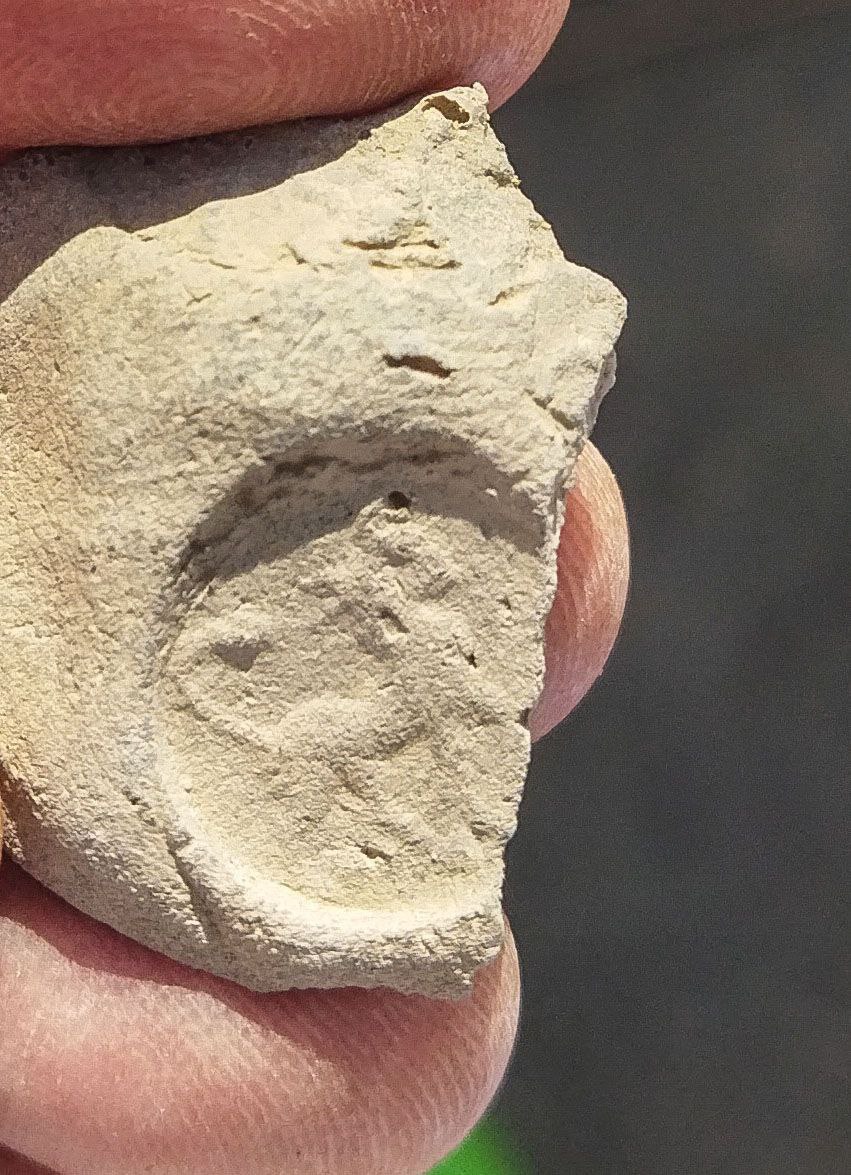
— On the southern outskirts of the settlement, not far from the camp, I found a fragment of a clay bull with two imprints of an ancient seal in the surface material. One of the prints was clearly visible, and his photo was sent to the State Hermitage Museum for consultation. The bull probably depicts the mythological character mushkhushu, which resembles a lion often featured in Babylonian art," said Anna Krasheninnikova, a student at the UrFU Faculty of History.
A bulla is an ancient "seal" made of clay, which was used to seal various objects: baskets, vessels, or a deadbolt on a door. Such bulls differed in shape, appearance and material, performing different functions. According to the historian, in those days they could symbolize belonging to a family. The found artifact most likely belonged to a noble family, as it was discovered in a house near the main street of the ancient city.
The excavations took place in the southern part of the country on the territory of the Tell Dehailah monument in the Dhi Qar administrative region, near the modern city of Nasiriyah.

— The monument where we were excavating is located in an area that turned into a desert 2.5 thousand years ago. Today, Tell Dehaila is the ruins of a fairly large city by ancient standards — about 50 hectares and possibly about 10 thousand inhabitants — which previous researchers dated to the II millennium BC. Around this dating, the so—called period of the Land of the Sea, a whole theory was built in which Tell Dehaila was the capital. This independent and little–studied state actually existed in the Southern Two Rivers region in the XVIII—XV centuries BC, but it is still not known exactly where its capital was," added Anna Krasheninnikova.

The thousand-year shift
Tell Dehaila was considered an old Babylonian city, the researchers added. However, the finds made during this and previous expeditions shifted the dating from the second to the first millennium BC, that is, before the New Babylonian period. This is the era of the New Babylonian Kingdom, the last power of Mesopotamia, founded by the Chaldean dynasty. It included vast territories, including Syria, Phoenicia, and Palestine. This period is also known for the creation of the Hanging Gardens of Semiramis and the development of science.

— With the start of the new excavation season, other finds of the first millennium appeared, and when archaeologist Lika Gusak found two fragments with Cuneiform script, and the expedition's epigrapher Ilya Arkhipov read them, all doubts were left behind: Tell Dehaila is a New Babylonian city. It flourished in the 8th century BC and ceased to exist no later than the 6th century, when the Susuka River, on which it stood, dried up," the student added.
The artifacts found during the expedition remained in Iraq as historical and cultural treasures, the scientists said. They have yet to be studied in detail by modern methods. The expedition, during which the finds were made, has been taking place since 2018. In addition to Tell Dehail, it is also held at another monument, the Neolithic Tell Wajef near the border of Iraq with Iran.

The Land of the Sea is an important center of the ancient world in southern Mesopotamia near the Persian Gulf. It is considered the birthplace of the mysterious and powerful dynasty of kings mentioned in cuneiform tablets. The inhabitants of the kingdom were known for their rebellious temper. It was Babylon's main rival for the primacy in the region. King Hammurabi waged wars with the Land of the Sea. In the last years of his reign, he was able to subdue her, but the control did not last long.
As Dmitry Vasiliev, an archaeologist and associate professor at the Tatishchev Astrakhan State University, explained to Izvestia, in order to find such artifacts, scientists need to do a huge amount of physical work, therefore, in addition to researchers, workers also participate in the excavations.

— The finds that clarify the dating are very important for science, so the discovery of the bull can be considered a great success. The Babylonian civilization, like any other, is of interest to scientists because it is unique. Based on it, conclusions can be drawn about the history of human development as a whole," he said.
According to him, text sources are found even less frequently, these are the most informative artifacts, so the cuneiform tablets found are of particular value.
According to Natalia Panasyuk, a senior lecturer at the Department of General History of the Faculty of Humanities and Social Sciences of the Rudn University, artifacts that allow us to clarify historical dates are of great importance in archaeology. It is important that their age is determined without errors.
Переведено сервисом «Яндекс Переводчик»
