- Статьи
- Society
- Fur, that's all: herring under a fur coat has become the most profitable New Year's salad

Fur, that's all: herring under a fur coat has become the most profitable New Year's salad

This year, a set of three homemade New Year's salads — olivier, herring under a fur coat and crab — will cost 174 rubles per person, analysts told Izvestia. One serving of "fur coat" will cost 51 rubles, olivier — 57 rubles, and crab — 66 rubles. A kilogram of each of these salads costs 114-253 rubles. Over the year, the cost of ingredients increased by an average of 7-10%. The information about how much Russians will pay for the New Year's table on the threshold of 2026 is in the Izvestia article.
What are salads made from?
The most profitable festive dish this year turned out to be herring under a fur coat — the cost of one serving will be 51 rubles, analysts said. Olivier is in second place, and it will cost 57 rubles per person. Crab salad will cost a little more — 66 rubles per serving.

"The calculation took into account the portions of salads per person according to traditional recipes," said the experts of the X5 Club loyalty program. — Herring under a fur coat in public catering establishments costs from 180 rubles, while the home option costs about 3.5 times cheaper. Olivier can be purchased from 150 rubles, which is 2.6 times cheaper, and a portion of crab salad costs from 160 rubles. Cooking at home is 2.4 times more profitable."
But, according to the analytical center "Check Index" of the company "Platform OFD", on average in Russia, the cost of cooking olivier salad with sausage may be higher — in the second half of November 2025, cooking it for four will cost 573 rubles. (4.8% more than last year).

"The calculation is based on the classic, Soviet version of salad with boiled sausage: 500 g of potatoes, 200 g of carrots, five chicken eggs, 300 g of boiled sausage, 100 g of onions, 400 g of canned green peas, 400 g of pickled cucumbers, 200 g of mayonnaise, 50 g of dill or parsley," they said.
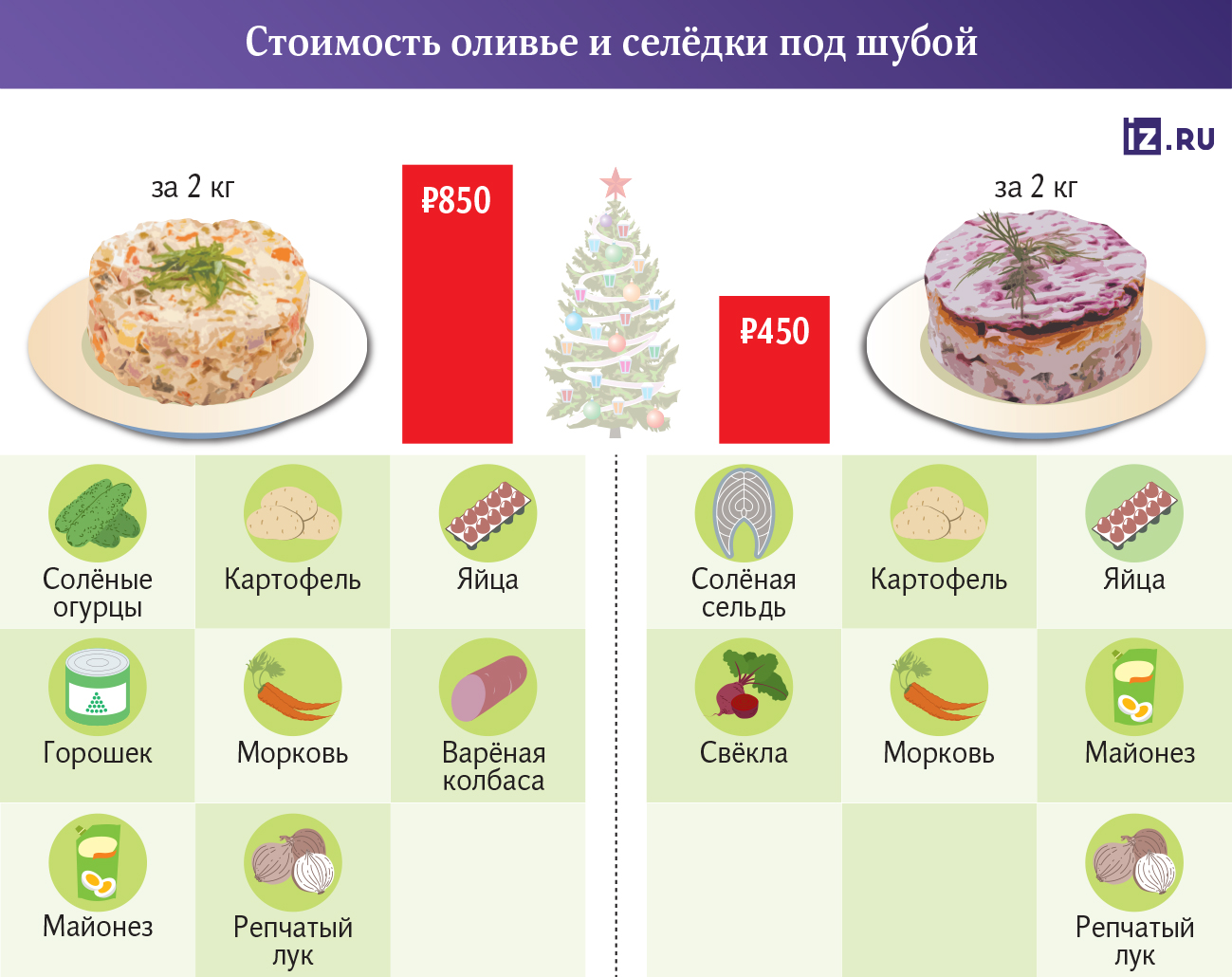
And the online platform Cooper estimated the average cost of 2 kg of olivier salad at 850 rubles. They calculated these figures based on the cost of doctor's sausage, pickles, canned peas, as well as eggs and mayonnaise.

At the same time, the cost of 2 kg of herring under a fur coat, according to this platform, will cost twice as much — about 450 rubles.
Vegetables for salads fell in price by an average of 20% by November 2025, but at the same time, the cost of a serving of olivier increased by 12%, analysts at martech, a First Data company, told Izvestia. Potatoes fell in price by 25% (from 59 rubles per 1 kg to 44 rubles), carrots — by 27% (from 45 to 32 rubles), and beets — by 20% (from 36 to 29 rubles).
The cost of eggs has also decreased by 20% (from 88 rubles per 10 pcs. eggs of the 1st category up to 70 rubles) and by 18% (from 44 rubles per 1 kg to 36 rubles) — onions.
At the same time, some ingredients, on the contrary, have significantly increased in price, First Data added. Boiled doctor's sausage rose in price by 27% (from 283 rubles to 359 rubles), and herring fillets — by 26% (from 225 rubles to 285 rubles). Canned peas became more expensive by 23% (from 71 rubles to 88 rubles), pickled cucumbers increased in average price by 4% (from 191 rubles to 198 rubles).
According to their data, if in 2024 the average cost of ingredients per 1 kg of olivier salad was 253 rubles, then in 2025 it reached 284 rubles. The index of cooking herring under a fur coat increased by 9% — last year the cost of a kilogram of lettuce was 183 rubles, and this year it is already 199 rubles.

And the Auchan Retail Russia press service noted that olivier turned out to be the cheapest salad: the cost of 1 kg of a homemade dish is 114.64 rubles. Herring under a fur coat and mimosa will cost 234.54 rubles and 229.72 rubles. accordingly.

What should be on the New Year's table
Russians began actively preparing for the New Year's feast in the first half of November, the press service of Cooper told Izvestia. Red caviar remains one of the key products: demand for it increased by 5% compared to last year. The average cost of a 100-gram jar is now about 1,374 rubles.
In general, a New Year's table for four in 2025 will cost Russians an average of 9.1 thousand rubles, which is 13.5% more than a year ago, Denis Goldman, an economist and independent PR consultant, told Izvestia.
"Against the background of inflation, individual products behave differently, and sometimes their price increases differ from the average by several times," he said. — So, during the year, potatoes increased in price by 65%, red caviar — by 34%, and butter — by 31%. And these are the very products that are traditionally present on the table of Russians. The main culprits of the rise in price of the New Year's table are potatoes and butter.

According to him, the harvest was affected by adverse weather conditions: spring frosts, drought in some regions and waterlogging in others. As a result, the price per kilogram increased from about 50 rubles at the end of 2023 to 97 rubles by November 2025. Butter has risen in price due to an increase in production costs: milk increased by 20% in August, logistics — by 30-35%. At the same time, chicken has fallen in price by 7%, and tangerines have become more affordable by a quarter — now they can be found in stores from 100 rubles per kilogram.
Experts from the Check Index of the OFD Platform company noted that the price tag for ingredients for olivier salad this year is noticeably lower against the background of lower costs for the categories of the borscht set.
"In general, Russians do not skimp on olivier salad for the festive table, as a rule, trying to choose better ingredients," the analysts emphasized.
According to the Start of Quality consulting company, it used to be more profitable to cook food at home. Now, ready-made food is often a more affordable option, since it is made from components purchased at wholesale prices. The difference between retail and wholesale prices in some categories and stores can reach 150-200%.

— The cost of production of any food product consists of dozens of items of expenses and can vary significantly at each enterprise. It includes the purchase of raw materials and components, labor costs, depreciation of equipment, packaging, logistics, as well as round-the-clock monitoring of product quality using digital solutions. And, of course, there must be a profit. All these indicators vary greatly depending on the scale, logistics and level of automation," said Konstantin Derevskov, the company's CEO and food safety expert.
However, as the expert noted, unscrupulous manufacturers often skimp on quality. During one of the audits, according to him, the rolls of doctor's sausage, the main ingredient of Olivier, were stored indoors in violation of the requirements of the cold chain.
People who sleep for four hours all December, live on coffee and snacks, eat leftovers from business meetings, wonder why their body stops behaving rationally on New Year's Eve, said nutritionist Yulia Khlopova.

— As if it's the salad that's to blame, and not a year of chronic fatigue, — said the specialist. — They don't overeat because of the salad. They overeat from the state in which they meet this salad. A person comes into the New Year already exhausted: exhausted nervous system, background anxiety, lack of sleep, accumulated anger, alcohol as an obligatory ritual, emotional noise around: "we need to celebrate!", the feeling of the last day of the year and at the same time — the last chance to "eat normally."
Against this background, she says, the brain grabs food as a way to calm down. Alcohol is the main driver of New Year's overeating. It is he who disables the mechanisms of saturation and makes a person biochemically hungry even after a hearty dinner, the expert emphasized.
Переведено сервисом «Яндекс Переводчик»
