- Статьи
- Science and technology
- Who has a fireball for what: scientists have revealed the secrets of a meteorite that flew over Moscow

Who has a fireball for what: scientists have revealed the secrets of a meteorite that flew over Moscow

In Moscow, for the first time, samples of a meteorite were presented, the fall of which on October 27 was accompanied by bright flashes and was recorded on video by many users of social networks. Scientists have managed to establish that the object turned out to be a fragment of an asteroid from the Apollo group, whose orbits often pass near the Earth. The intended impact zone was located in the forests of the Novgorod region, but the car hit directly into the roof of one of the houses. Its owners handed over the find to the specialists. The researchers believe that analyzing the collected data can yield important scientific results. However, they do not yet have a consensus on how to name the "star alien".
New information about the meteorite
In the center of the assembly hall of the Vernadsky Institute of Geochemistry and Analytical Chemistry (GEOHI) The wounds are three small light gray stones. They were the source of the bright glow that was visible on October 27 in the Moscow region, Tver, Novgorod, Leningrad and several other regions. There are even fragments recorded from the airliner online. At that time, most experts believed that the phenomenon was caused by space debris, such as satellite or rocket parts, but now all doubts have been dispelled — these are fragments of one of the Apollo asteroids — clusters of cosmic bodies that often intersect with Earth's orbit.

Since the cosmic body entered the laboratory on November 10, scientists have managed to conduct its first studies. The meteorite was found near the settlement of Okulovka in the Nizhny Novgorod region. Its fall lasted for 33 seconds, during which time, due to contact with the atmosphere, it formed a fairly thick crust. The stone has a large number of cracks, so during the flight it quickly crumbled into many fragments.
Specialists from GEOHI RAS examined the samples using a microscope and determined their chemical composition. The bolide includes various minerals, most of all olivine and pyroxene, which are often found in meteorites, as well as small inclusions of metallic iron and nickel. Scientists attributed the find to the chemical group LL, that is, to objects with a low metal content. This is the rarest subtype among ordinary stone meteorites, which makes it a valuable find for scientists.
— Astronomers have analyzed the orbit of this meteorite before entering the Earth's atmosphere. It turned out that the orbit of that cosmic body, which eventually formed our fragment, belongs to the asteroids of the Apollo group. They often come close to our planet and become the source of such bodies," said Kirill Lorenz, head of the Laboratory of Meteoritics and Cosmochemistry at the Russian Academy of Sciences.

According to him, the study of meteorites is of fundamental scientific importance, because in this way it is possible to get an idea of the distant past of the Solar system, about the composition of the matter of small cosmic bodies, which are still difficult to reach. And you can also find out the composition of the substance from which the Earth, Moon, Mars, Mercury originated. Currently, scientists have mostly only remote observation data in this area.
Where and how they searched for the meteorite
The story of the scientists' search for the car resembles a detective story. According to them, several competing groups participated in the hunt for the meteorite. About 50 people included both scientists and those who just wanted to make money. According to experts, the stone flew at a speed of 17-18 km/s. The staff of the scientific centers studied a lot of videos from social networks, thanks to which they were able to determine the likely area of the fall of a celestial body. This is a vast territory in the Novgorod region between the settlements of Pestovo, Okulovka and Borovichi. The stone fell early in the morning and the locals even felt a wave from the explosion in the sky.

GEOHOE experts interviewed eyewitnesses and outlined the search direction for themselves. This area is completely covered with forest, overgrown with moss, so the work could take a long time. However, suddenly an advertisement appeared on the Internet for the sale of a meteorite, which allegedly broke through the roof of one of the houses in the area where the scientists were. At the same time, the sellers agreed to cooperate only on condition of anonymity, since excessive interest in the site of the asteroid fragment would have deprived them of peace.
— We have arrived at the place. And it really turned out to be a meteorite. The largest fragment broke through the roof and split. Dust particles from it, resembling concrete, scattered across the yard. Since the event is unique, we agreed to dismantle the broken part of the roof. The point of fall of this stone itself will help to clarify the trajectory, and, accordingly, it will help in the future to find other samples that may be, — said Konstantin Ryazantsev, a researcher at the Laboratory of Meteoritics and Cosmochemistry of GEOKHA.

Konstantin Ryazantsev, Researcher at the Laboratory of Meteoritics and Cosmochemistry of the Russian Academy of Sciences
According to her, all the materials collected at the crash site will be studied and can provide a lot of useful data. At the same time, other particles may remain in the area, which can be found in the spring when the snow melts. The owners of the house, whose roof was hit by a meteorite, received financial compensation, the amount of which was not disclosed. The roof was repaired at the expense of the researchers.
How do they propose to name the "alien"
Viktor Grokhovsky, chief researcher at the Extra terra consortium laboratory at Ural Federal University, whose representatives also participated in the expedition and have fragments of the bolide, explained to Izvestia that now the main task of scientists is to officially register the find as a meteorite and give it the correct name.
— Until our colleagues send an official application for registration of the discovery, we will not begin research. It is important to give it the right name. We made the mistake of naming the Chelyabinsk meteorite Chebarkul, where its first fragments were found. But in the end, they gave it the name "Chelyabinsk", as its dispersion zone spread over half of the region. The situation is similar with this car. The first find was near Okulovka, but the name "Novgorod" would be more correct, he believes.
According to the procedure, the owners of the meteorite must submit an application to the International Meteorite Society to be included in a special bulletin. Experts will check all the data and publish information about this object on the Internet. It may take several months. After registration, Ural scientists plan to compare data on the mineralogy of the meteorite's melting crust and its interior and conduct other studies.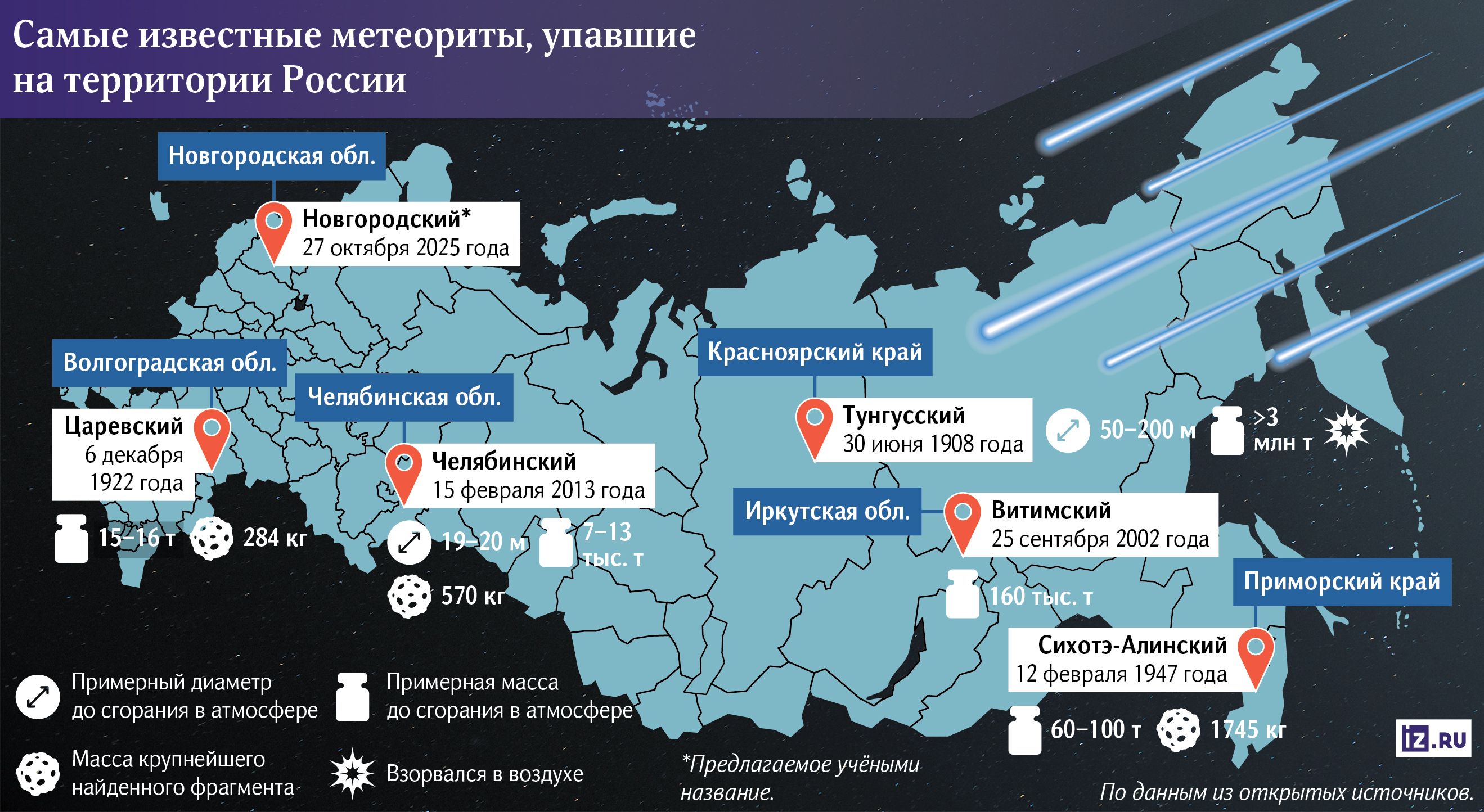
However, according to Kirill Lorenz, head of the Laboratory of Meteoritics and Cosmochemistry at the Russian Academy of Sciences, the correct name for the star fragment would still be "Okulovka", as it is more in line with tradition.
— Now we have one meteorite specimen that definitely fell in the village of Okulovka. This is a fairly large settlement at a distance of 80 km from Novgorod, so the name "Novgorod" is not very logical. Of course, naming meteorites after large cities sounds good. But there are traditions and naming rules," Kirill Lorenz said.
However, according to the scientist, the official name should be indicated in the registration application, and until it is submitted, the question remains open.
Переведено сервисом «Яндекс Переводчик»
