
Demography lesson: in Russia they want to expand payments to families with children

State Duma deputies propose to expand the number of families eligible for monthly benefits in connection with the birth and upbringing of a child, Izvestia found out. Such a bill will be submitted to the State Duma on October 23. According to the document, benefits should be paid to families whose average per capita income does not reach one and a half times the subsistence level. At the same time, United Russia notes that if the costs of the initiative are not included in the budget, which is currently being coordinated by the State Duma and the Cabinet of Ministers, it will be difficult to implement it. About how they are trying to increase the birth rate in the Russian Federation and solve the demographic problem, see the Izvestia article.
How is it planned to expand the payment of social security benefits
The initiative, developed by the deputies of Fair Russia — For Truth, is aimed at increasing the number of families eligible for a monthly allowance in connection with the birth and upbringing of a child (Izvestia has the text of the document). Today, pregnant women can receive it starting from the sixth week, as well as parents with children who have not yet turned 17. At the same time, in both cases, the key condition must be met — the average per capita family income for the previous year cannot exceed the regional subsistence level.

The bill proposes to soften this criterion and allow benefits to those families where the average income of one person is no more than one and a half times the minimum subsistence level, the leader of the SRZP, Sergei Mironov, told Izvestia. Deputy Fyodor Tumusov also became a co-author of the initiative.
— The bill focuses on the most vulnerable categories of citizens, who today find themselves beyond support, but at the same time barely make ends meet. Raising the poverty level from one to one and a half subsistence levels will significantly expand the category of recipients of these social support measures," he said.

In 2025, the cost of living in the Russian Federation was 17,733 rubles per month. In regions, its size can be either higher or lower. It is published on the official websites of regional authorities.
For example, in a family of four from the Samara region, only the father works, who receives 60 thousand rubles a month. The rest of the family, a mother and two children, do not have earnings. To determine the average per capita income of a family, you need to take the entire amount that your father earned for the year and divide it by 12 months and the number of family members. The result is 15 thousand rubles. Since this is lower than the regional subsistence minimum, which is 16,669 rubles, the family is entitled to benefits.

At the same time, if the father received 70 thousand per month, then the average per capita income (17.5 thousand) would exceed the size of the permanent residence and the family could not qualify for social security payments.
The initiative of the deputies involves an increase in the level of need. Thus, the threshold would no longer be 16.6 thousand, but just over 25 thousand rubles, and a family where the father earns 100 thousand rubles would also be able to receive benefits.
First of all, the initiative will help support single parents, large families and low-income families, the explanatory note says. According to Rosstat data for the first quarter of 2025, the population with incomes below the subsistence level is 11.9 million people (8.1%). At the same time, a significant part of Russians who do not fall into this category continue to live in poverty.
"Based on stable income distribution statistics, we estimate that an additional 10% of the population is in the range of one to one and a half subsistence levels," the SRZP reported.

The initiative will require additional expenditures from the state budget. They can be fully covered by redistribution from the introduction of a progressive personal income tax scale for the super-rich, an increase in tax rates for the gaming business and the introduction of a tax on excess profits for the banking sector, according to the SRRP.
Can the bill increase the birth rate
In the context of the demographic crisis, an increase in the number of families receiving benefits can be an important incentive to increase the birth rate, the explanatory note says.
"State support will create more favorable conditions for family planning and child rearing, which, in turn, will contribute to strengthening the institution of the family and improving the standard of living in society," the document says.

Indeed, in recent years, the demographic problem in the Russian Federation has noticeably worsened. According to the results of 2024, the natural population decline amounted to 596 thousand people, according to Rosstat data. At the same time, the number of children born decreased by 3.4% to 1.222 million from 1.265 million in 2023, while the number of deaths, on the contrary, increased by 3.3% to 1.819 million from 1.76 million.

In July 2025, Vladimir Putin called the existing measures to support families with children insufficient, and later stated that this area should be considered a priority in Russian policy. The SRPP initiative may have a positive impact on the birth rate in Russia in the future, Georgy Ostapkovich, scientific director of the HSE Center for Economic Research and Economic Development, told Izvestia.
— The main thing in fertility is income, housing and access to opportunities. An increase in income always stimulates fertility. Therefore, in any case, this is a positive maneuver," the economist is convinced.

However, it should be understood that all previously adopted initiatives in the field of support for families with children have been able to reverse the birth rate situation in the country. In addition, such an initiative will be difficult to implement if it is not included in the budget, which is currently being approved in the State Duma.
All deputy ideas that have not been calculated and agreed upon with the government will be almost impossible to put into practice, says Elena Tsunaeva, first deputy chairman of the Committee on Labor, Social Policy and Veterans' Affairs (United Russia).
— The introduction of the budget was preceded by very serious work. There were meetings in the factions and committees in certain areas. There have been several times thoughts that the budget is not easy. All the social obligations that have already been accepted are embedded in it, taking into account indexing. Therefore, ideas that have not been calculated are unlikely to receive approval," the parliamentarian told Izvestia.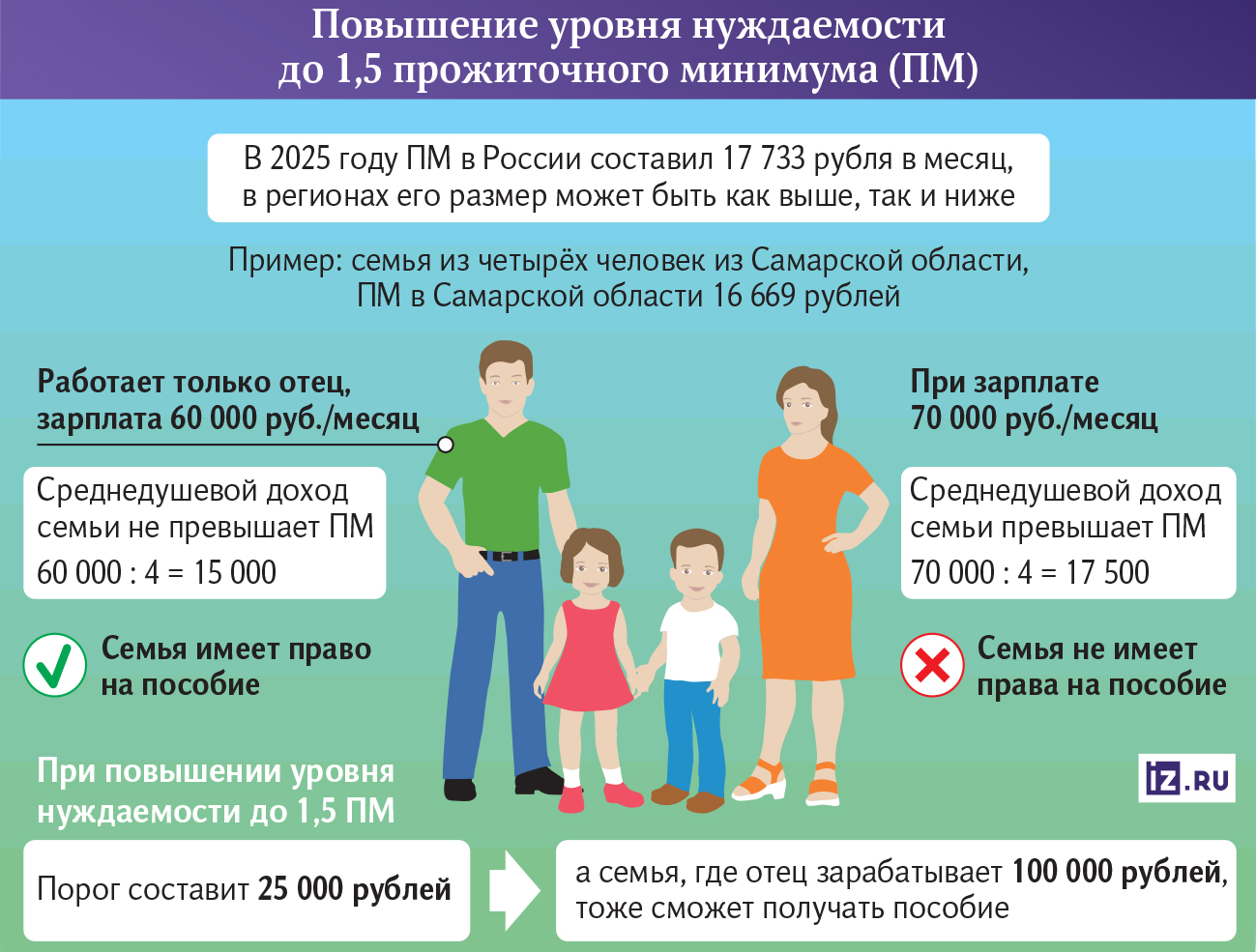
On October 22, the State Duma adopted in the first reading a draft law on the federal budget for 2026 and for the planning period of 2027 and 2028. Measures to strengthen demography have become the most important area, Russian Finance Minister Anton Siluanov said. The "children's budget" for three years will exceed 10 trillion rubles. Thus, it is obvious that this initiative will not be included in the financial plan for the coming year.
At the same time, deputies from other parties, in particular the Liberal Democratic Party and the Communist Party of the Russian Federation, continue to put forward their own proposals to increase support for families with children. So, in January 2025, parliamentarians led by LDPR leader Leonid Slutsky drafted a bill that implies an increase in the amount of child care benefits to 60% of the average parent's earnings. In June of this year, deputy Nina Ostanina (KPRF) came up with the idea of paying maternity capital repeatedly for the birth of each subsequent child, increasing it by 25% of the previous amount.
Переведено сервисом «Яндекс Переводчик»
