Very scary bodies: Jupiter can send hundreds of asteroids towards Earth
- Статьи
- Science and technology
- Very scary bodies: Jupiter can send hundreds of asteroids towards Earth


Russian scientists have studied the influence of Jupiter on the trajectories of asteroids whose orbits are approaching the Earth. According to astronomers, the gravity of a giant planet can change the direction of motion of small celestial bodies. Experts have identified 342 asteroids that could pose a potential threat to Earth in the next 100 years. Details can be found in the Izvestia article.
Which asteroids are dangerous for Earth
Scientists from Tomsk State University (TSU) and the Institute of Astronomy of the Russian Academy of Sciences have studied the influence of Jupiter on the trajectories of asteroids whose orbits are approaching the Earth. The Ministry of Education and Science of the Russian Federation told Izvestia about this. Some of these objects may pose a danger to our planet, experts say.
As the researchers explained, asteroids are rocky bodies that orbit the Sun. Most of them are located in the belt between Mars and Jupiter. Among them, there is a special group whose orbits lie closer than 1.3 AU (about 200 million km) from the trajectory of our planet. They are called "near-Earth asteroids." Currently, more than 30 thousand objects of this class are open.
The astronomical unit (AU) is a unit of measurement equal to the average distance from the Earth to the Sun. It is used for a more visual representation of distances.
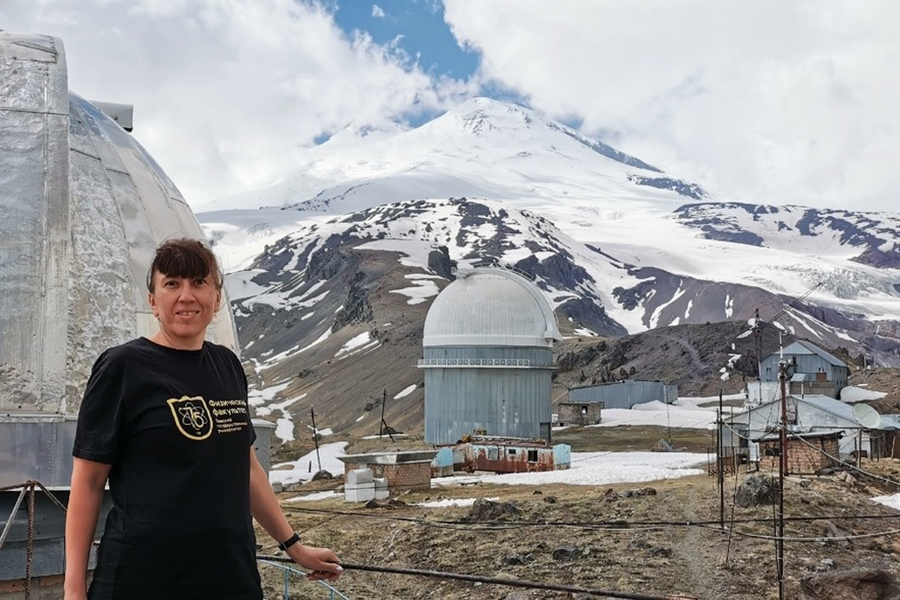
— Of these objects, we have selected those whose path also passes near the orbit of Jupiter. This is the largest planet in the Solar system, which can radically change the direction of movement of small celestial bodies. For example, a giant planet can change the inclination of an asteroid's orbit by several degrees. And this can lead to the fact that an object that did not pose a threat to the Earth may move into an orbit that may turn out to be dangerous," said Tatiana Galushina, professor at the Department of Astronomy and Space Geodesy at the TSU Faculty of Physics.
She explained that the mass of Jupiter is 318 times the mass of the Earth. On the one hand, it is considered the "protector" of the terrestrial planets (such as Mercury, Mars, Earth and Venus), because due to its powerful gravity it attracts and absorbs objects that come from the outer regions of the Solar system. However, it can also act as a "cosmic conductor" by changing the direction of motion of small celestial bodies.
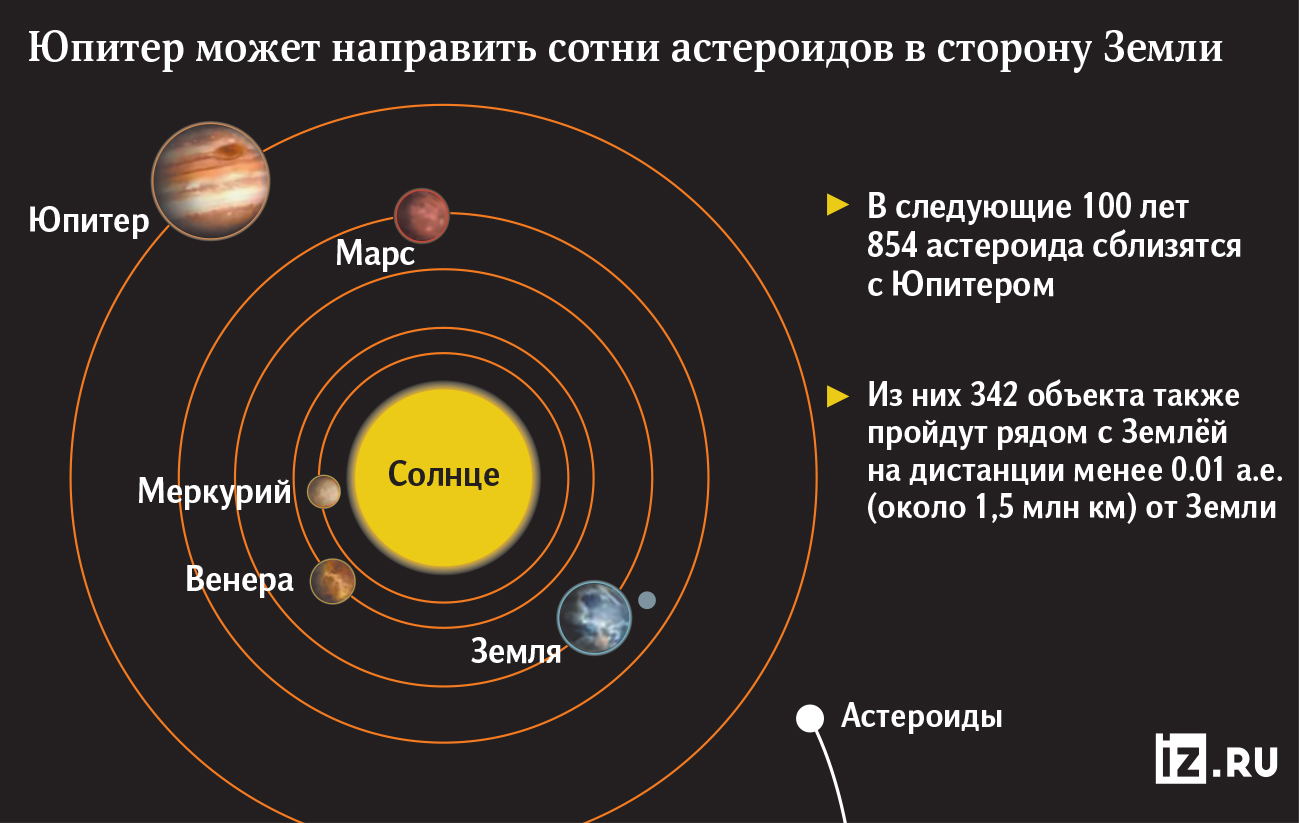
According to the astronomer, during the study, the orbits of more than 4 thousand asteroids approaching the Earth were studied, whose path will also pass near the giant planet. Using the TSU SKIF Cyberia supercomputer, experts numerically traced their orbital evolution over the period from the beginning of our era to the year 4024. As a result, scientists found out that during this time, 1,408 objects of this class were or will be located at a distance of less than 1 AU (about 150 million km) from Jupiter.
Moreover, in the next 100 years, 854 asteroids will approach the giant planet. According to calculations, 342 of these objects will also pass at a distance of less than 0.01 AU (about 1.5 million km) from Earth in the future.
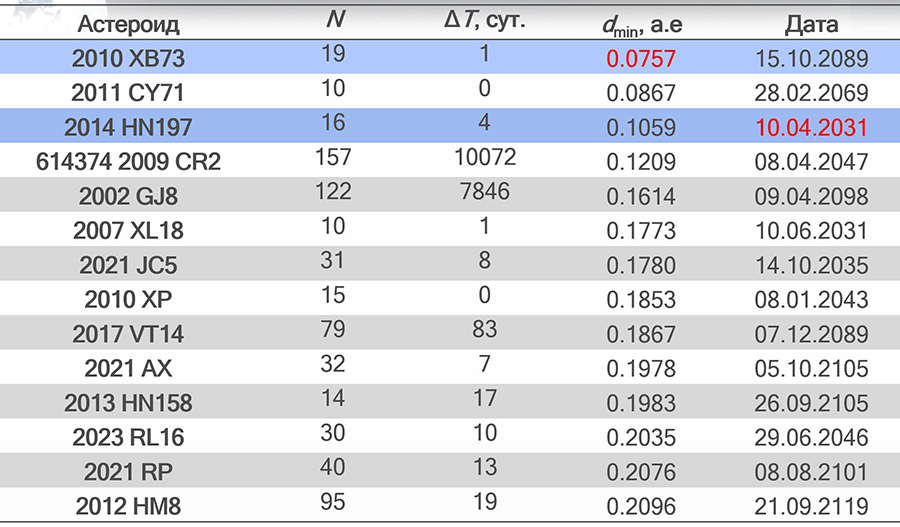
— According to the data obtained, the asteroid 2014 HN197 will experience the closest approach to the giant planet at a distance of about 0.1 AU in 2031. And the asteroid 2010 XB73 will approach it at the shortest distance in 100 years in 2089. The distance between this object and Jupiter will be 0.075733 AU (about 11 million km). A comparison of the dynamics of asteroids before and after approaching Jupiter has shown that the planet's gravity will have a significant impact on the parameters of the orbits of these objects, — said Tatiana Galushina.
According to her, scientists have also clarified the flight path of some of the identified asteroids using the Zeiss-2000 telescope at the Terskol Observatory of the Institute of Astronomy of the Russian Academy of Sciences. The results of these observations allowed us to confirm the conclusions made using numerical modeling.
What space factors can threaten our planet?
Further work will be aimed at investigating other factors that influence the change in the orbits of asteroids. Among them is the pressure of sunlight, when billions of photons constantly "bombard" the asteroid, creating a steady force that acts away from the Sun, the astronomer said.
She also noted that one of the factors to be studied is the Yarkovsky effect. It is related to the fact that the asteroid absorbs solar heat on the day side and re—emits it on the night side. This creates a tiny but constant jet thrust, which over time can significantly shift the orbit of a celestial body. The direction and strength of this effect depend on the speed of rotation, size, and composition of the asteroid.
— On the one hand, the results presented by the scientists are consistent with the conclusions of researchers from the United States and Europe, who predict that in the next 100 years none of the known asteroids larger than 140 m will collide with the Earth. On the other hand, Russian experts have examined in detail the evolution of asteroids approaching our planet and passing near Jupiter. The study of such objects is important from the point of view of analyzing scenarios of their evolution that can lead to a collision with planets," said Eduard Kuznetsov, an employee of the Laboratory of Astrochemical Research at Ural Federal University.
He added that the most dramatic changes in the orbits of asteroids occur when they fall inside the sphere of action of the planet. The size of this region for Jupiter is 0.32 AU (about 48 million km), for Earth — 0.0062 AU (about 0.93 million km).
The International Astronomical Union, represented by the Minor Planet Center, has introduced the concept of potentially dangerous asteroids that can cause significant damage when they collide with Earth, the expert added. These include objects ranging in size from 100-140 m, which can approach the Earth's orbit at a distance of less than 0.05 AU (about 7.5 million km). However, after the fall of the Chelyabinsk meteorite, the issue of the need to lower the boundary in size of the object to several tens of meters is being considered.

According to Eduard Kuznetsov, in addition to asteroids and comets, other factors may pose a danger to the Earth. In particular, super-powerful solar flares and super-strong magnetic storms on Earth caused by them. In addition, the existence of our planet may be threatened by the passage of a star through the Solar System, the intersection of the Galactic disk by the Solar system, a nearby supernova explosion or gamma-ray burst, the Sun entering a dense cloud of interstellar gas, etc. Such events can have a strong impact on the biosphere and technosphere of the Earth, but their probability is very low. Or they are expected on the scale of millions and tens of millions of years.
— The study reminds us that there is nothing permanent in space: objects that are harmless today may become dangerous tomorrow after approaching Jupiter. But, on the other hand, the giant planet is not malicious, but simply indifferent: after its impact, some asteroids, on the contrary, will cease to threaten us. This means that you need to monitor all such facilities, including seemingly safe ones. At the same time, there are no new reasons for concern — we just need to be vigilant," explained Sergey Yazev, professor, director of the Astronomical Observatory of Irkutsk State University, senior researcher at the Institute of Solar—Terrestrial Physics of the Siberian Branch of the Russian Academy of Sciences.
In his opinion, among the potential space threats is the danger of a large asteroid colliding with the Earth and a super flare in the Sun. And it's hard to say what might happen sooner, the expert concluded.
Переведено сервисом «Яндекс Переводчик»
