
Apple of analysis: why demand for new iPhones outstrips supply

Apple is increasing production of the new iPhone 17. It turned out that the world has accumulated a reserve of about 315 million smartphones that users have not changed for a long time. The accumulated backlog, combined with the innovations of the new generation, contributed to a stronger consumer interest. And even in Russia, according to key marketplaces, the demand for the iPhone 17 is significantly ahead of last year's figures. At the same time, it is not necessary to overpay for a famous brand — Izvestia has selected cheaper and budget analogues.
Key pros and cons
The Cupertino company was not ready for the global demand for the basic iPhone 17 model. After the first weekend of presales, demand was so high that Apple ordered a 30% increase in production. There were enough factors — significantly more innovations compared to the iPhone 16 model (it was slightly different from the iPhone 15), an accumulated reserve of 315 million smartphones that users had not updated for a long time, and a bet on the AI functionality of Apple Intelligence.
When comparing the models of the new iPhone 17 line, it becomes clear that simplified versions such as the Air and the basic iPhone 17 provide convenience and compactness at the expense of serious compromises in performance and functionality.
The iPhone Air, positioned as the lightest and thinnest smartphone in the line, is inferior to the older models in almost all key parameters. Unlike the triple system, the Pro versions are equipped with only one main camera. The lack of a telephoto lens and an ultra-wide module significantly limits the shooting possibilities, and software functions cannot fully compensate for this disadvantage.

When comparing the iPhone Air and iPhone 17 Pro Max, the difference becomes most obvious. The Pro Max features a 6.7-inch LTPO display with a refresh rate of up to 120 Hz, high peak brightness, and ProMotion technology. At the same time, the iPhone Air uses a standard 60 Hz OLED panel, which is a clear step back in terms of visual perception.
The Air's performance is also limited: despite the A18 chip, its configuration is limited in the number of graphics cores. In addition, it lacks an active cooling system (which is available in the Pro versions). Therefore, under high loads, such as in games or media processing, the iPhone Air shows earlier throttling and a drop in performance.

The difference also lies in the connection interface. The iPhone 17 Pro and Pro Max use USB-C with support for the USB 3 standard, which allows data transfer at speeds up to 10 Gbps. At the same time, the iPhone Air and the basic iPhone 17 model are limited to USB 2.0 (up to 480 Mbps). This significantly slows down the transfer of large files, especially when shooting in high quality.
The autonomy of the iPhone Air is lower than that of the iPhone 17 and even more so of the 17 Pro Max. The smaller case limits the battery capacity, making the smartphone less reliable for users who actively use it during the day. In turn, the iPhone 17 Pro Max offers one of the best autonomy among the flagships.

The case materials in the new line are also different. Last year's models relied on premium titanium, while this year it was replaced by cheaper aluminum. Although titanium is more resistant to scratches and drops, aluminum gains weight and dissipates heat better.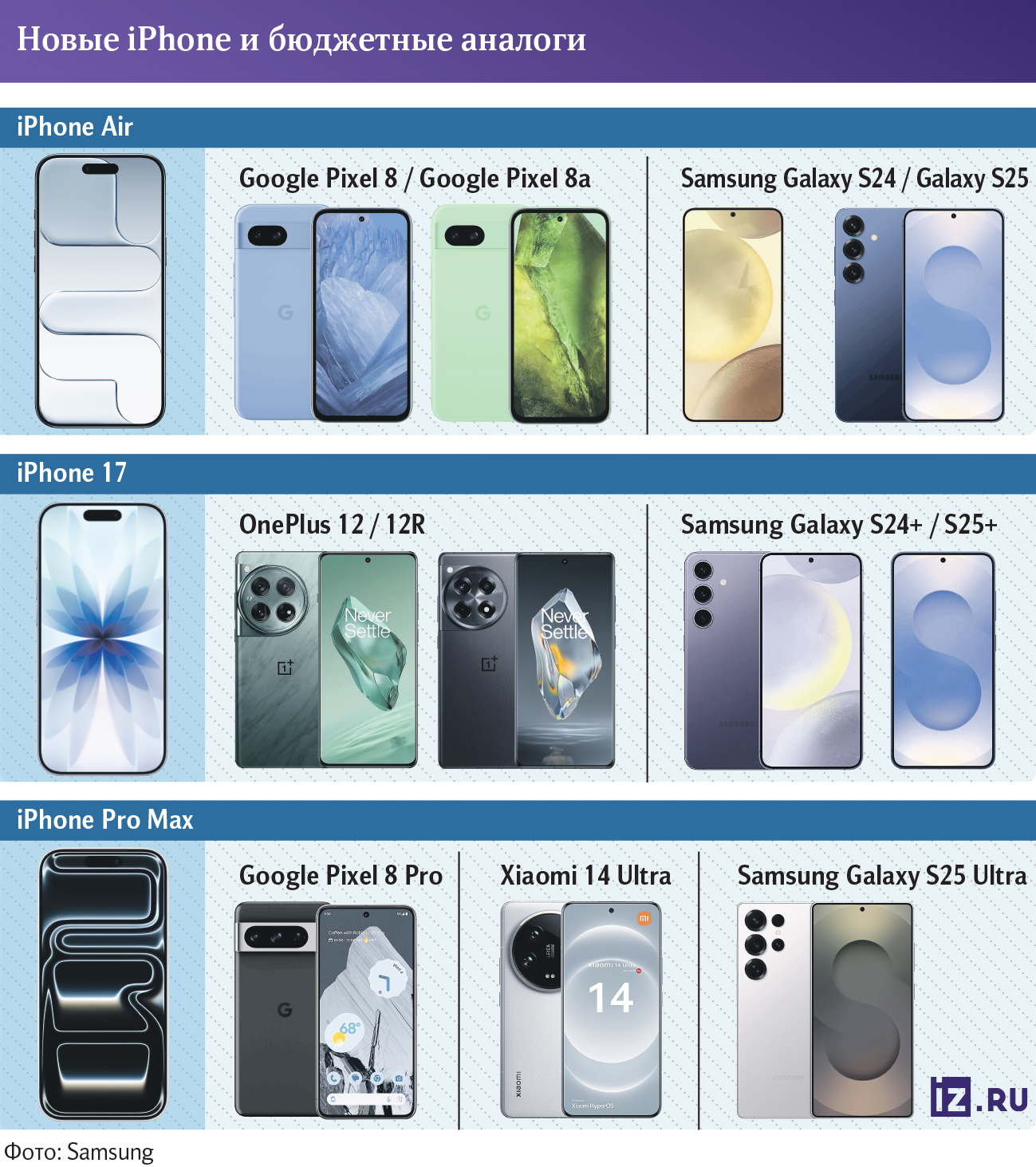
Thus, by choosing the iPhone Air or the basic iPhone 17, the user sacrifices a significant part of the functionality. It loses in camera quality, display refresh rate, graphics system performance, efficient cooling, data transfer rate, and battery life.
Alternatives for those who are not ready to overpay
Buyers considering an alternative to the iPhone may want to look at flagship Android devices. They offer similar or even superior functionality at a more flexible price. The analogues of the iPhone Air are smartphones that combine compactness, lightness and performance. For example, the Google Pixel 8 and 8a range offer user-friendly devices with an emphasis on photography, especially in low light conditions. These models are the first to receive new AI-based features and regular Android updates. Their 120 Hz screens provide smooth scrolling.
In addition, the Samsung Galaxy S24 and S25 are balanced solutions with bright AMOLED displays, wireless charging, and flagship performance. These devices offer a better size-to-power ratio than the iPhone Air, while remaining lightweight and user-friendly.

The analogues of the standard iPhone 17 model can be considered smartphones that combine flagship performance, modern displays and long working hours. Among them are OnePlus 12 and 12R. These devices are characterized by high response speed due to the refresh rate of the screen up to 120 Hz, powerful chipsets and support for fast charging. The Galaxy S24+ is a balanced, medium-format model with a powerful processor, improved camera, and long-lasting software support. Its display has a higher pixel density and refresh rate than the iPhone 17, providing a clearer image and smoother interface experience.

Among the alternatives to the iPhone 17 Pro and Pro Max, several flagship models stand out, each offering its own approach to performance, shooting, and user experience. The Samsung Galaxy S25 Ultra is one of the most technologically advanced Android—based smartphones. It features a 200-megapixel main camera, a 10x optical zoom telephoto lens, and an integrated S Pen stylus. The LTPO technology display supports refresh rates up to 120 Hz. This model is a full-fledged alternative to the iPhone 17 Pro Max both in terms of photography and autonomy, as well as versatility and functionality.

Google Pixel 8 Pro relies on the integration of artificial intelligence and image processing software. His cameras are particularly strong in portrait and night photography, as well as video recording. At the same time, the seven-year support for operating system updates turns the device into a reliable solution for those who are focused on long-term use.

Xiaomi 14 Ultra, in turn, is aimed at mobile photography enthusiasts. The smartphone offers advanced manual camera setup capabilities, was created in partnership with Leica and is equipped with all modern communication interfaces. This device is suitable for those who appreciate full control over the shooting process and strive to get maximum image quality without compromise.
The results of testing new products
According to the results of the pre—order on September 22, significant interest in the new line was recorded - the number of pre-orders increased by 58% in units and by 62% in monetary terms compared to last year, the press service of the restore store chain reported. The main demand was generated by Moscow, St. Petersburg and Yekaterinburg, which accounted for 65% of all orders. Rostov-on-Don, Novosibirsk, Samara and Krasnodar are next in terms of activity.

— The iPhone 17 Pro Max models became the absolute leader in pre-orders (62.7%), within this model range the iPhone 17 Pro Max 512 GB is most actively used. Customers are most interested in the new colors Cosmic Orange and Deep Blue. The largest number of pre-orders (56%) falls on the male audience aged 30-35 years. The interest is related to the new form factor and interesting color. For those who buy a phone at the forefront, the differences from previous models are very important. The iPhone 17 line has a cool new color and an updated camera, representatives of the largest online store in Russia with Apple products updated the information.
Choosing the iPhone Air or the basic iPhone 17 is justified if the main priorities are compactness, lightness and entry into the Apple ecosystem. However, the Pro-line devices, especially the iPhone 17 Pro Max, are significantly superior in terms of functionality, performance, and versatility. For those who are not limited by the Apple ecosystem, it would be wise to consider flagship Android smartphones offering similar or better features for a similar or more affordable price.
Переведено сервисом «Яндекс Переводчик»
