
In drone mode: 262.5 million rubles allocated for intelligent drones

The National Technology Initiative Project Support Fund has identified the winners of the fourth competitive selection among drone technology companies. 262.5 million rubles will be allocated for the implementation of the projects. The AI-powered Air Patrol system will monitor and control drone flights, Citadel will find the enemy using neuroelectronics, and Locust will provide swarm drone control. Read more about these and other supported projects in the Izvestia article.
Neural network technologies
The Competition Commission of the National Technology Initiative Project Support Fund has determined the winners of the fourth competitive selection among technology companies developing unmanned aircraft systems (UAS). Five residents of research and production centers will receive grants for the implementation of high-tech projects. This was reported to Izvestia by the foundation.
262.5 million rubles will be allocated for the implementation of projects in 2025 and 2026. The amount of private investment in the projects will be at least 10% or 30% of the allocated grant, depending on the direction of selection. The NTI Foundation supports companies focused on the organization of mass production, components, subsystems, as well as the development of prototypes of new types of UAS.
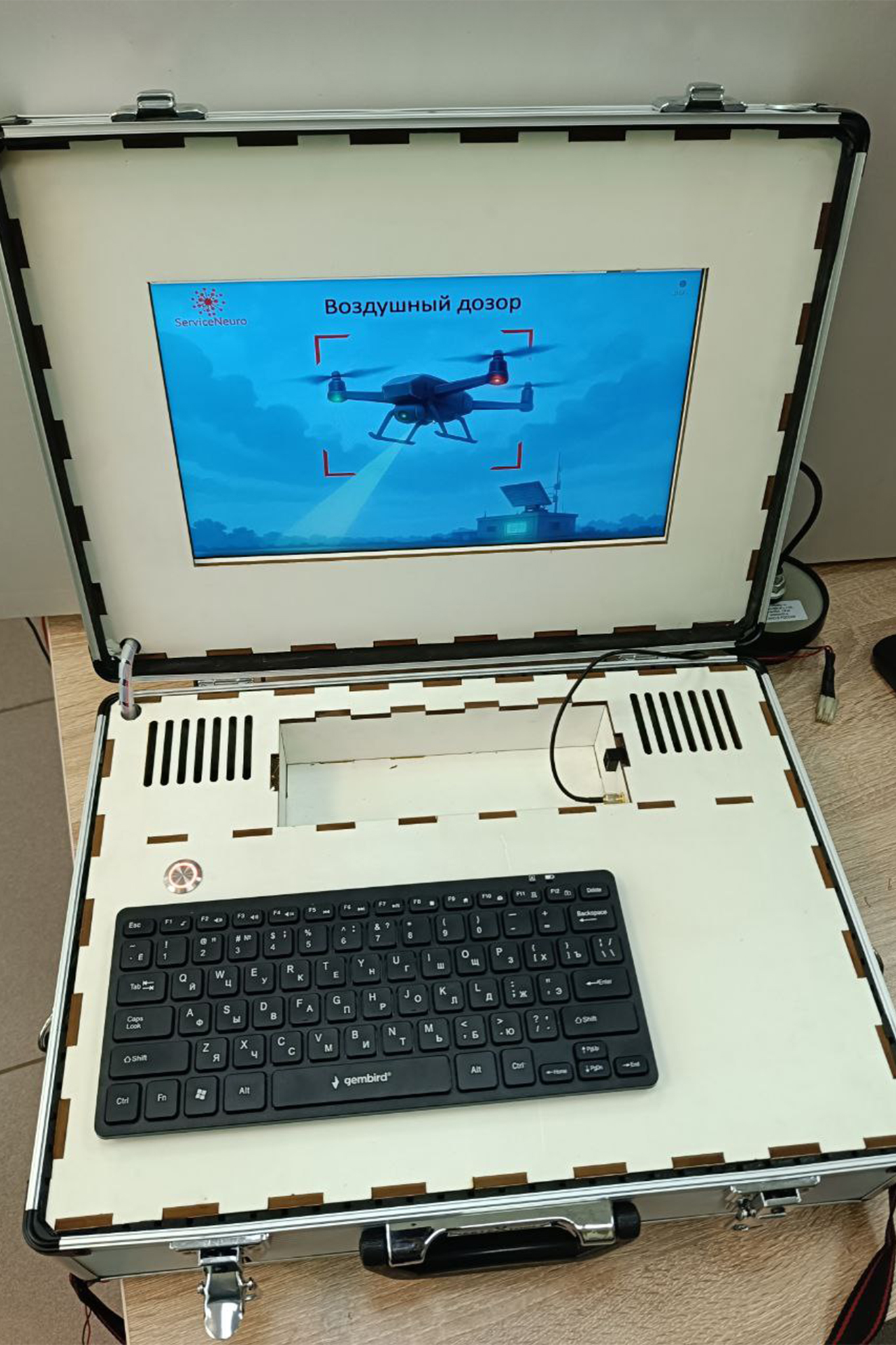
— The fourth selection of projects is aimed at introducing neural network technologies into drone management. 27 projects took part in it. Five of them, the most developed and technologically mature, will receive financial support. Such developments solve the issues of multi-mediating. That is, they are capable of working in the air, on the ground, and in water. This means that they will be useful for rescuing victims, monitoring pollution and forest fires, and conducting scientific research," said Vadim Medvedev, director of the NTI Foundation.
In particular, the Air Watch system from the developer Serviceuro LLC will help to monitor and control the flights of drones. AI algorithms classify various types of signals as accurately as possible, including WiFi and radio modules, the project's test engineers explained. The integration of technology into the concept of the "Digital Sky" for the coordination and management of flights in logistics and agriculture is being considered.
— The experimental sample has passed preliminary tests. This is a completely Russian development. We use advanced UAV detection technology, which is a hybrid system with combined artificial intelligence and radio signal analysis (RF analysis). This improves the accuracy of drone detection by up to 98%. While radars guarantee accuracy in the range of 70-85%. In addition, neural network algorithms help to adapt to new types of UAVs," said Sergey Marinin, project Manager.

Visualization of the Citadel
The Citadel mobile drone detection system using neuroelectronics technologies is capable of simultaneously detecting up to 50 drones weighing up to 10 kg at a maximum speed of 150 km/h. The complex is designed to operate around the clock in all weather conditions, the developers note.
— The development will ensure urban security during mass events, it is suitable for the protection of urban facilities. The detection range is 3 km. A high degree of automation reduces the response time and reduces the qualification requirements for the operator. The main differences between Citadel and its analogues are the increased accuracy and speed of drone detection," explained Valentina Bogushevskaya, CEO of Noviter LLC.

"Locust" and "Monitor Lizard"
The integrated Sarancha FPV drone system will provide swarm control of up to six drones. The use of batteries with a low current transfer coefficient significantly increases energy efficiency.
— The prototype has been tested during operation. The production of the device will be 100% Russian. The frame structure of the frame is easily adaptable to perform special tasks," said Ilya Shevelev, Deputy director of the Laboratory of the Future development company.

"Locust"
The Varan project for automated control of unmanned aerial vehicles was developed by Ploshchad JSC. High optical detection accuracy due to the use of neural network algorithms, integration with the geospatial awareness platform (GEO) and the ability to work in a variety of environments will reduce the impact of the human factor, the project developers explained.
— The prototype of the device has been successfully tested in conditions close to real conditions. The system combines the functions of autonomous and manual control. In automatic mode, tracking and interception of drones is possible without operator involvement. With manual operation, the system will give the operator recommendations for the successful completion of the task. The project combines a human-machine interface and artificial intelligence technologies for UAV management," added Nikita Maslak, CEO of the company.
Another winning company has launched several projects dedicated to the symbiosis of neurotechnology and ALS. The result of the projects will be the emergence of fundamentally new unmanned systems — autonomous biodrons designed to perform various transport, logistics and reconnaissance tasks for civilian and special purposes in conditions where the functioning of modern models of unmanned systems is difficult or impossible (for example, in electronic warfare or in the absence of satellite communications). The projects create their own software, as well as hardware components based on the results of the projects previously implemented by the team.

"Varan"
Currently, the issue of monitoring and tracking unmanned aerial vehicles in our airspace is acute, Sergei Kurapov, a researcher at the Razumovsky Moscow State Technical University, told Izvestia. The testing of these developments will make it possible to understand the principles of operation of AI drones, detection, control and interception systems with AI nationwide, and subsequently build a network structure that can find a drone anywhere in the sky and identify it. According to the expert, all the projects presented are highly appreciated, but their success will only lie in systematic, consistent implementation. Only in this case we will get the result in practice, not on paper.

— In particular, the Air Watch system detects its own and other drones by analyzing radio signals in a wide range. The neural interface allows you to adapt to yet unknown UAVs. And the Citadel mobile complex is a rapidly deployable drone detector with a short detection range. It can be installed on a car and used at mass events. It is effective in conjunction with electronic warfare, uses interceptor drones to destroy enemy UAVs, he noted.
As Sergey Kurapov explained, the Sarancha integrated FPV drone system, which can be used for military and civilian purposes both as a kamikaze and to organize communications coverage of a certain territory using signal repeaters.

"Locust"
— The implementation of an autonomous UAV swarm is a rather complicated thing. It is very good that our designers are working on this task. And the Varan project can use AI to automatically control drones, as well as detect and detect unknown targets. It can work in automatic mode and under the guidance of an operator," the expert concluded.
The competitive selection of projects by residents of the NPC UAS is carried out within the framework of the federal project "Development, standardization and mass production of UAS and components" of the national project "Unmanned Aircraft Systems".
Переведено сервисом «Яндекс Переводчик»
