- Статьи
- Science and technology
- Computational speed: scientists have brought the creation of a quantum computer closer

Computational speed: scientists have brought the creation of a quantum computer closer

Russian scientists have solved an important problem for creating a quantum computer. ITMO specialists have found the fastest way to transfer data between its computing elements, the so-called qubits. With the development of technology, their number in processors is already measured in the hundreds and thousands. For this reason, their management has become a serious task for the creation of fundamentally new computers. According to experts, the solution found by experts can really improve the operation of quantum computers and bring their practical application closer.
The problem of creating a quantum computer
ITMO specialists, together with colleagues from the London Institute of Mathematical Sciences, solved one of the most important problems on the way to creating a quantum computer. Currently, the most advanced models of such computers use an increasing number of qubits ("quantum bits"), the simplest units of information, as analogues of the ordinary bit in electronic computers. In some developments, there are more than a thousand of them, so managing these elements becomes a difficult task. Russian physicists have found a way to transfer data encoded in quantum states between qubits at the highest possible speed.

— The importance of this work is not so much in solving a specific problem about state transfer in an array of qubits, but rather in developing a new method suitable for large quantum systems. This will allow us to find more efficient quantum algorithms, prepare quantum states faster, and generally expand the capabilities of modern quantum systems," said Maxim Gorlach, a leading researcher at ITMO.
Quantum processors already consist of dozens or even hundreds of qubits, and their number will only increase — for example, in the near future, Google developers plan to reach the mark of a thousand units of information, and IBM has already introduced the Condor system, consisting of 1121 qubits. However, simply combining many elements is not enough, it is also necessary to finely control the system — for example, to transfer quantum excitation from one end of the system to the other. If such a transfer is too slow, the quantum state may collapse along the way. Therefore, for platforms with a large number of elements, the requirements for transmission speed and reliability are very high.
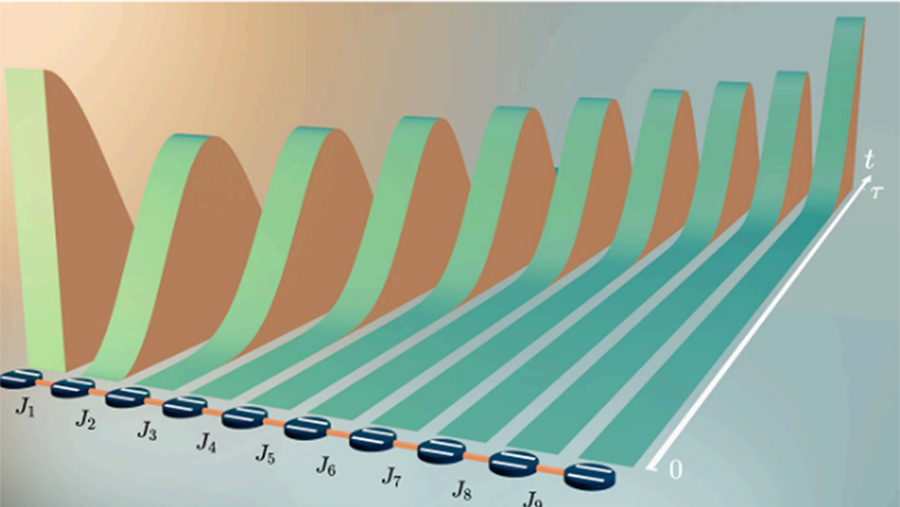
Currently, in order to transfer the excitation in a chain of qubits, they mainly resort to two methods. The first is a step—by-step process: enable communication between neighboring elements, wait until the state flows from one qubit to another, and then enable the next connection. Alternatively, you can make all the connections time-independent and adjust their value. Then the state itself will pass through the chain. However, both of these methods are too slow.
Instead, the scientists used a method called the "quantum brachystochron": the idea is similar to the classical physics problem of the fastest path along which a ball rolls between two points.

— Imagine that you have a set of possible trajectories between points A and B. We go through all of them until we find the one that gets the quantum state to the target the fastest," says Ksenia Chernova, a graduate student at ITMO University.
Scientists suggest not just turning connections on or off, as they do now, but changing their value smoothly over time. According to the authors, the connection between the first two qubits is most strongly activated at the start, then it gradually weakens while longer-range connections "gain strength". As a result, the state is exactly transferred from the first qubit of the chain to the last one.

Physicists have also proposed a general way to calculate the minimum state transfer time for a system with any number of qubits. In the article, the scientists presented calculations for a chain of hundreds of elements — previously, such tasks could only be solved for small systems of several elements.
Practical application
The method proposed by ITMO specialists has achieved record speed while maintaining almost perfect accuracy of state transmission. The implemented approach turned out to be about 40% faster than the methods known today, Gleb Fedorov, senior researcher at the Laboratory of Artificial Quantum Systems at MIPT, explained to Izvestia.
— The approach scales efficiently, allowing you to work with systems of more than 100 qubits. We can call this a breakthrough in terms of modeling molecules and materials, where long chains of operations between the nearest neighbors are needed," he said.
The new protocol minimizes the number of logical operations, reduces errors, and makes it possible to simulate larger systems within a limited time in modern quantum devices. This is another step towards scalable and practical quantum computing, the expert emphasized.

— The work of colleagues solves the problem of controlling the transfer of quantum states, which is important for quantum computing tasks. It shows how to transfer a quantum state along a chain of qubits in an optimal way," said Alexey Fedorov, head of the scientific group at the Russian Quantum Center.
According to Sergey Gunin, a researcher at the Laboratory of Artificial Quantum Systems at MIPT, the solution proposed by the authors can be implemented on real quantum processors using superconducting qubits with variable coupling as a computing platform. And the main results of the study can be reflected in new architectures of such processors.
The work was supported by the Priority 2030 Academic Leadership program, as well as a grant from the Russian Science Foundation.
Переведено сервисом «Яндекс Переводчик»
