
Event Courses: what awaits the ruble due to Trump's new tariffs

By the end of summer, the dollar exchange rate may reach 80 rubles/$, taking into account the tariff policy pursued by Donald Trump, the consensus forecast of Izvestia showed. On July 7, the American president announced new trade measures — he re-froze import duties for countries with which an agreement was reached before July 9. In addition, he added a number of Asian, African and European countries to the list, in particular, Kazakhstan, South Africa, South Korea and Japan. How the US actions will affect the foreign exchange market and why extend them to new countries — in the Izvestia article.
Donald Trump's New Tariffs
Trump's selective approach to tariff policy will lead to the dollar-ruble exchange rate being on the order of 80-85 rubles/$, experts interviewed by Izvestia believe. And in the absence of any external shocks, the "American" can trade cheaper — about 75-80 rubles / $.
On July 7, the US president extended until August 1 the freeze of duties for countries for which the measure was supposed to end on July 9. Among them are the European Union, Canada and Mexico. However, this does not apply to trade with China. The White House website clarifies that the decision was made after consultations with senior officials. At the same time, the base rate of 10% for imported goods, established back in April, is still in effect and is not subject to freezing.

In addition, the list of countries for which increased duties are imposed is expanding. The 25% tariff will apply to goods from Kazakhstan, Malaysia, Tunisia, South Korea and Japan. For products from South Africa and Bosnia and Herzegovina, the rate will be 30%, from Indonesia — 32%, Bangladesh and Serbia — 35%, Cambodia and Thailand — 36%. The highest fee, 40%— is set for Laos and Myanmar. The new tariffs will not be combined with existing industry measures, such as for automobiles, steel and aluminum.

According to Donald Trump, the United States is ready to continue trade with South Korea and Japan, but intends to achieve a more balanced relationship. He explained that the new duties are designed to compensate for the protracted trade deficit caused by the tariff policies of these countries.
A new round of trade wars began with the return of Donald Trump to the White House. On April 2, he announced the introduction of import duties for 185 countries. However, on April 9, the fees for most of them were postponed for 90 days — the parties agreed to negotiate. The exception was China: the "trade truce" with it came into force on May 12 and is also designed for three months. In addition, duties on Chinese goods were reduced from 145% to 30%.
The re—freezing of duties is an element of a pressure strategy: first, the American administration announces tough measures, demonstrating the seriousness of its intentions, and then suspends them, creating a window for negotiations, explained Alexander Firanchuk, a leading researcher at the International Laboratory for Foreign Trade Research at the Presidential Academy. At the same time, if the dialogue reaches an impasse, the threat resumes.
What will happen to the dollar in 2025
The dollar's exchange rate against the ruble and other currencies is primarily affected by the out-of-control U.S. budget deficit and the growing national debt, which has already exceeded $37 trillion. The economic unpredictability of the White House and protectionist rhetoric are increasing pressure on debt securities, leading to higher interest rates and exacerbating financial instability. All this undermines confidence in the "American dollar" as the world's reserve currency and may eventually lead to its weakening, Alexander Firanchuk believes.

— The "swing" in Trump's policy is unfavorable for the dollar exchange rate. The DXY index against a basket of world currencies has not been able to return to the level of 100 points for more than a month. If the duties had really come into force, the currency would have strengthened — this would have been a signal of the strength of the policy of the American president and the United States as a whole," said Natalia Milchakova, a leading analyst at Freedom Finance Global.
According to the expert, now the strengthening of the dollar will be positively influenced only by strong US macroeconomic indicators — GDP growth, lower inflation and the Fed's tough stance on keeping rates at current levels, despite criticism from Trump.

After the statements of the American president, the dollar sank by almost 1 percentage point — on July 8, it was trading at about 77.9 rubles/$. So, since the beginning of the year, the ruble has strengthened by almost 25%. If current trends in domestic policy continue and there are no external shocks, it may reach 75 rubles./$ by the end of summer. However, the majority of analysts surveyed believe that the exchange rate is likely to return to 80-85 rubles/$.
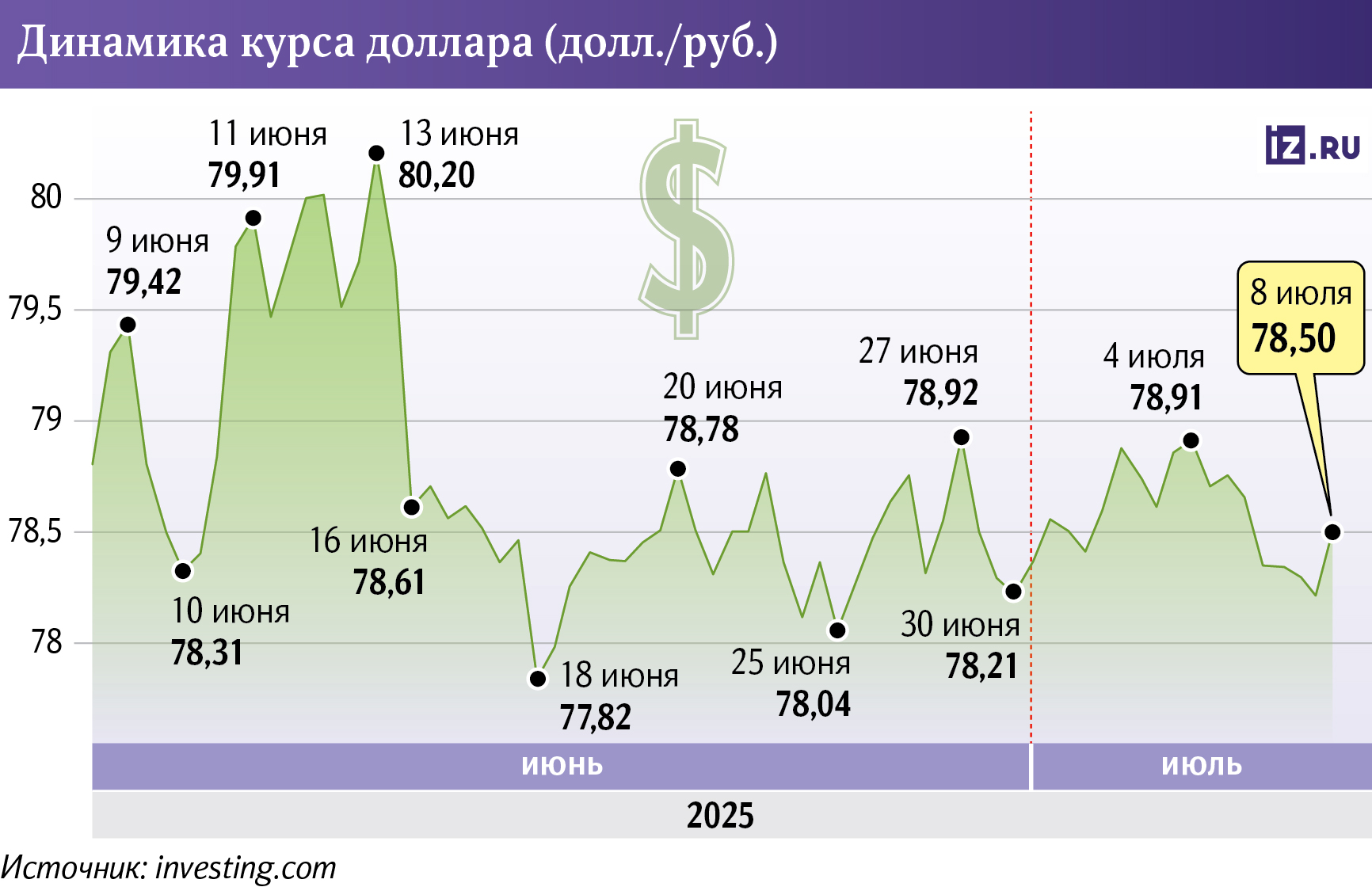
Trade wars are reducing global demand and increasing uncertainty, which has already led to a drop in commodity prices. Although Brent crude had partially recovered its losses by July ($69.6 per barrel on July 8), energy prices have fallen by a quarter since the beginning of the year. Against this background, the Ministry of Finance has tripled its budget deficit forecast to 3.8 trillion rubles. This is due to the fact that the cost of raw materials will be cheaper due to a stronger ruble.

According to Galina Sorokina, director of the GUU Institute of Economics and Finance, Donald Trump himself is not too interested in a strong dollar, so its slight weakening may even play into the hands of the United States.
Why did Trump decide to re-freeze the duties
The decision to extend the 90-day suspension of tariffs may be due to the fact that by the deadline of July 9, trade agreements had been agreed only with the UK, China and Vietnam, said Olga Belenkaya, head of the Macroeconomic Analysis Department at Finam.
Now the American leader has moved from negotiating tactics and bilateral "deals" to unilaterally sending letters to countries about the level of tariffs set for them, but this process has only just begun, she noted. As of today, individual tariffs have been set for only 14 of the more than 180 countries on the April 2 list. Negotiations are currently underway, including with the EU, the expert added.
At the same time, Trump made it clear that the decision on duties is "final, but not 100%": if the leaders of the countries "call and offer another option," the United States will be open to dialogue.

— Trump extended the duty freeze again until August 1, because no one is ready to conclude "big and wonderful" deals on favorable terms for the United States. This speaks not so much about the strength of trading partners as about the weakness of the American leader's policy itself. We assume that the president will continue to put pressure on for some time, "freeze" the negotiations, and then simply put the decision on tariffs under the rug, and for some time everyone will forget about these duties," says Natalia Milchakova from Freedom Finance Global.

As Izvestia wrote earlier, for the next fiscal year, the States approved a financial plan with a sharp increase in defense spending and tax cuts — without any compensating income. At the same time, Trump's ultimate goal is to increase revenue to the US budget. It is not so important how this will be achieved — through duties or the growth of business activity in the country, says Andrei Barkhota, PhD in Economics.
Why did Trump expand tariffs to new countries
Trump uses tariff policy selectively. He shifts the main burden to less economically valuable U.S. partners in order to save space for more delicate work with key countries, said Adam Abdulatipov, senior analyst at BCS World Investments. That is why countries such as Japan and South Korea were the first to face tougher tariff policies, while the White House is acting more cautiously with more significant partners.

At the same time, the countries included in Trump's new list pose the greatest threat to the United States in the context of the tariff race, Andrei Barkhota noted. This is not about geopolitics, but about the high quality and wide range of goods they supply.
— It is enough to recall how Japanese cars and electric guitars quickly replaced American goods in the domestic market. In order for the market to grow, we need a high turnover. And for this, the consumption cycle must be limited. High—quality products extend the useful life and displace standard products," the economist noted.

However, experts interviewed by Izvestia do not rule out that in the future Trump may impose duties against all countries. However, such measures will not work as he expects, stressed Natalia Milchakova from Freedom Finance Global. As a result, this may lead to the trade isolation of the United States — only those who agree to the proposed terms will cooperate with them.
Переведено сервисом «Яндекс Переводчик»
