Progress has started: equipment has been sent to the ISS to solve problems with holes in the skin
- Статьи
- Science and technology
- Progress has started: equipment has been sent to the ISS to solve problems with holes in the skin


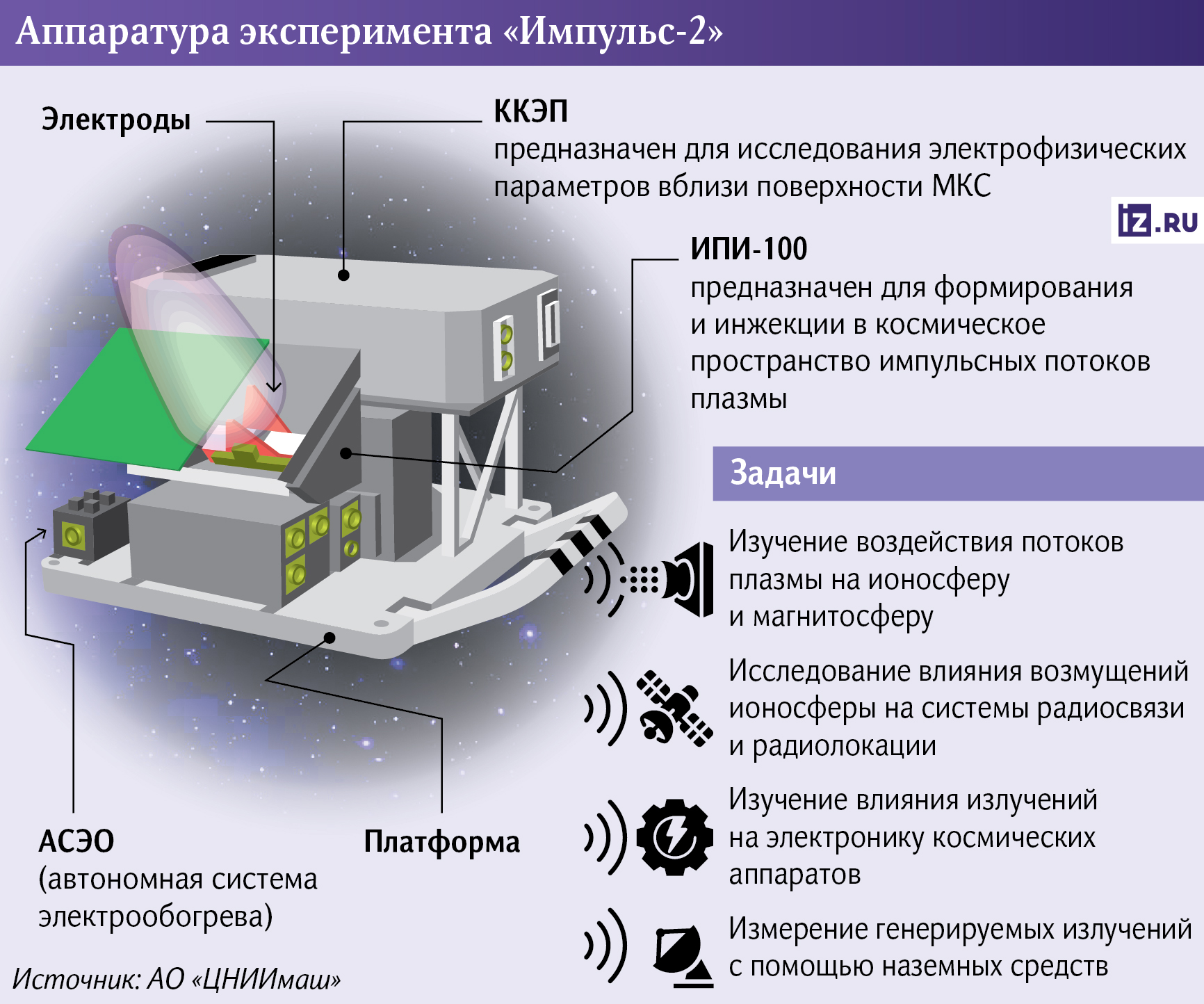
The Progress MS-31 spacecraft will deliver equipment for scientific experiments to the ISS. In particular, a device for detecting air leaks using ultrasound. These studies will help to test the equipment and, at the same time, solve the problem of maintaining the tightness of the station. A "cannon" will also be brought into orbit, from which plasma beams will perturb the ionosphere, studying its properties. According to experts, the device can potentially be used to affect satellites. What other scientific experiments will be conducted at the station can be found in the Izvestia article.
How to fix leaks on the ISS
The Soyuz-2.1a launch vehicle with the Progress MS-31 spacecraft successfully launched on June 3 from site No. 31 of the Baikonur cosmodrome. Docking with the Poisk module of the Russian segment of the ISS is scheduled for July 6 at 00:28 Moscow time. According to Roscosmos, the cargo ship will stay in orbit for about 167 days. It will deliver 2,625 kg of payload to the station.
As previously reported in the State Corporation, the package is intended to supply the crew of the 73rd manned expedition to the ISS. It includes supplies of fuel, gases, water, food, basic necessities and equipment. Among other things, the spacecraft will deliver into orbit more than 540 kg of equipment and materials for scientific experiments and retrofitting and repair of onboard systems.
Experts told us what interesting tasks astronauts will be able to solve with the help of new equipment.
— The Orbita-MG program is of great practical importance. It is aimed at creating a complex of non—destructive technologies to control the tightness of the shells of the modules of the orbital station," said Pavel Gaiduk, Deputy head of the Scientific and Exposition department of the Museum of Cosmonautics.
The problem, he explained, is that when spacecraft are operated, microcracks inevitably appear in their skin. They are gradually expanding. Absolute tightness is impossible to achieve. Leaks also occur on the ISS, they were fixed, but later they reappeared.
Now, as part of the experiment, a device has been sent to the station that detects leaks based on an ultrasonic signal — a weak high-frequency squeak that occurs due to the friction of air molecules against the edges of the crack. The kit also includes tools and supplies for repairs.
Thus, Orbita-MG "kills two birds with one stone": it makes it possible to work out scientific equipment in space conditions and, at the same time, localize and eliminate microcracks.
How to remotely influence spacecraft
According to Academician Anatoly Petrukovich, Director of the Space Research Institute of the Russian Academy of Sciences, the Pulse-2 experiment is of great interest to science. It involves delivering equipment to the ISS and placing it on board from the outside, which affects the ionosphere with short but powerful bursts of plasma, a very hot ionized gas.
— The ionosphere, the upper atmosphere of the Earth, is largely a plasma environment. At the same time, it is important to understand how spacecraft interact with it. "The Pulse is essentially an ion cannon, a set of electrodes that accelerate ions," the scientist said.
The ion beam affects the ionospheric plasma, heats it up and causes it to emit electromagnetic waves. This makes it possible to study the properties of the ionosphere, he added. In particular, how it distorts the radio waves used in radio communications and radar.
— In addition, there is an assumption that ion cannons can affect the electronics of spacecraft, exciting the plasma around them and creating interference. However, some believe that such an impact would be insufficient. The study will help verify this," the academician noted.
According to him, the principle of operation of an ion cannon is generally similar to ion engines. They are used to correct the orbit of spacecraft. They are also promising for interplanetary flights. The experiment will help to study in detail the operation of such units.
How to protect materials from destruction in space
— Among the notable programs for medical and biological purposes, the Virtual experiment can be noted. Now scientists have started its second stage. It consists in the study of the functions of visual movement. In the process of working with the help of virtual reality equipment, astronauts are presented with visual tests and their eye movements are recorded," said a researcher at the Institute of Biomedical Problems WOUNDED Ivan Naumov.
According to him, in zero gravity conditions, formally vision does not suffer, but the speed of the eye's reaction to moving objects can decrease by two to three times. This is due to the close connection of the visual and vestibular systems, which together are responsible for orientation in space.
As the scientist emphasized, these effects can affect the safety of space missions and the efficiency of the crew. For example, an astronaut may misjudge the situation during the docking of a station and a ship or, in future flights, during landings on the surface of the Moon, Mars and other planets.
In turn, Fedor Senatov, Director of the Institute of Biomedical Engineering at NUST MISIS, drew attention to the Biopolymer experiment. It aims to find out which microorganisms can exist inside the space station and how they affect the materials.
So during the experiment, the researchers determine where bacteria and fungi appear and check how resistant the materials are to their effects in space. This is important, in particular, because microorganisms evolve and, when food is scarce, they can consume substances that are not normally touched on Earth.
— There are a large number of promising polymer materials with the necessary properties that can be used as elements of various instruments or spacecraft surfaces. However, changes in these properties (due to the breaking of chemical bonds or oxidation of the polymer) can occur under the influence of microorganisms, radiation or temperature," explained Fedor Senatov.
Therefore, he added, ensuring the stability and predictability of the materials' behavior is an essential task. However, there is a class of materials that must degrade in a controlled manner. They are used, for example, as implants. Research on the ISS will make it possible to study such polymers in sterile and gravity-free conditions, he concluded.
Переведено сервисом «Яндекс Переводчик»
