A suitable fortress: a "refrigerator" for the earth will prevent the destruction of buildings
- Статьи
- Science and technology
- A suitable fortress: a "refrigerator" for the earth will prevent the destruction of buildings


Russian scientists have developed hardware systems for cooling the earth. They "pump out" heat from the ground through probes that are located under buildings and industrial facilities. This preserves the hardness of the earth and protects structures from destruction in the face of global warming. The developers propose sending the resulting heat to a heating system or to greenhouses for growing vegetables and fruits. The development makes it possible to reduce house heating costs by 40% and provide residents of the North with fresh food rich in vitamins.
How to prevent the melting of permafrost
Scientists from Bauman Moscow State Technical University have developed complexes for active soil cooling. Such installations help to prevent the melting of permafrost under buildings and industrial facilities, which occurs due to global warming, and to avoid their destruction.
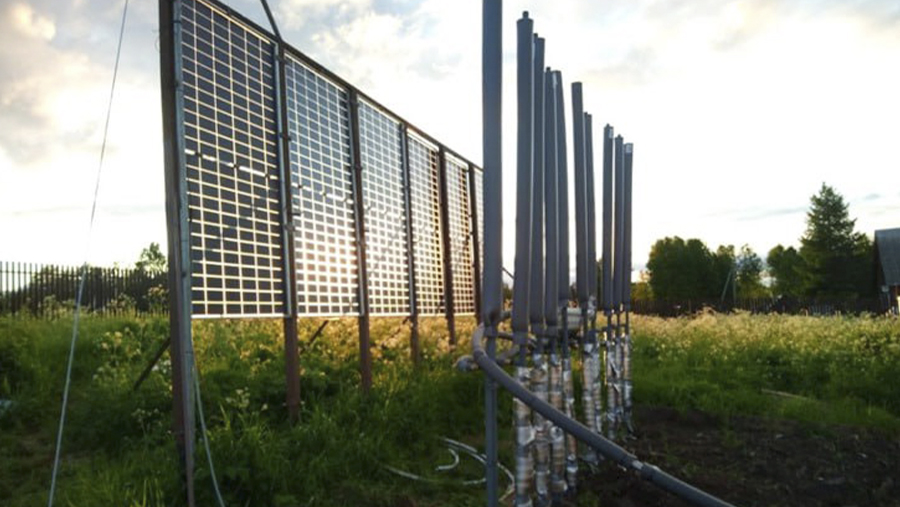
As the developers explained, 63% of Russia's territory (11 million square kilometers) is located in a zone of continuous or intermittent permafrost. Such areas are characterized by the presence of rocks that have year-round negative temperatures and contain ice in their composition.
In these areas, most of the structures in the old days were built on pile ventilated foundations. In them, piles raise the building above the surface, preventing heat transfer from the building to the bearing soils, which prevents them from thawing. Entire cities have been built on this principle. However, now the permafrost is rapidly receding. According to official data, in 10 years its border has shifted 40-80 km to the north, and in a quarter of a century this figure will increase 2-2.5 times.
— As a result of melting, soils lose their strength, turning into a viscous mass that cannot hold piles. As a result, foundations sag, causing buildings to warp and, in extreme cases, collapse. Now, according to experts, tens of billions of rubles are needed annually to restore such facilities," Egor Loktionov, project manager and head of the laboratory of the Moscow State Technical University Photonic Energy Center, told Izvestia.
Unlike previous methods, the new soil anchoring complexes created as part of the project make it possible to fully recoup the cost of operating the system. The proposed approach is based on active heat removal from the earth's surface in summer, which is carried out by means of heat pumps.
They pump heat from the soil through special probes located under buildings, cooling the soil and keeping the permafrost in a stable state. The resulting heat is used to heat buildings or greenhouses. At the same time, the pumps receive energy from solar panels. The panels with them are placed in such a way that, in addition to absorbing light, they would also cut off excess heat from the ground.
How to grow fruits and vegetables for free
Calculations show that the presented development will reduce the operating costs of heating buildings by up to 40%, the scientist explained. The introduction of the complexes will also make it possible to reduce carbon dioxide emissions into the atmosphere to an average of 1 thousand tons per facility over 20 years.
In addition, the developers propose to direct heat to greenhouses. Growing fresh vegetables and fruits in greenhouses will provide residents of the northern regions with fresh food. In particular, due to logistics, the price for them in the northern regions can reach up to 1 thousand rubles and above.
— The technical specification for the development of the system was issued after the inefficiency of the standard cooling systems at one of the facilities in the Yamalo-Nenets Autonomous District was revealed. As part of the project, engineering surveys, digital modeling and an economic assessment of the implementation were carried out with subsequent transfer to the service," Egor Loktionov said.
In his opinion, if implemented on a large scale, the technology can become an effective alternative to traditional solutions in the face of climate change and rising costs of operating the northern infrastructure. Currently, the system has been implemented as experimental sites in Arkhangelsk.
— The problem of stability of permafrost rocks under construction sites is of obvious importance. Soil cooling technologies have been known for decades. One example is the underground in Leningrad. The complex in question is presented as a sum of well—known technologies," Tamara Zhuravleva, a leading engineer at the MIPT Laboratory of Rock Mechanics, commented on the development.
She noted that the estimated economic efficiency of the system is very high. It remains to be hoped that the calculations were performed correctly.
— One of the proven ways to increase the bearing capacity of frozen soils is seasonal cooling devices (CoES). They pump heat out of the ground in winter, when the air temperature is lower than the ground, and in the warmer months they automatically overlap. However, taking into account the intensive displacement of the thawing boundary, the issues of increasing the bearing capacity of soils are becoming more and more urgent, and any new technologies that will be aimed at solving this problem will be in demand," said the Vice—rector for Project Activities at the Northern (Arctic) Federal University named after M.V. Lomonosov.

According to him, the advantage and, at the same time, the disadvantage of the new technology is the use of renewable energy sources (RES). On the one hand, the installations will be able to operate not only in winter, but also in the spring and autumn periods. This will have a positive effect on the bearing capacity of the soils. On the other hand, the instability of renewable energy sources will complicate the task of reliably predicting the operation of devices.
At the same time, Mikhail Krinitsky, head of the Machine Learning Laboratory in the Earth Sciences at MIPT and senior researcher at the P.P. Shirshov Institute of Oceanology (IO RAS), stressed that global warming trends will not end in the coming years. Therefore, the problem of permafrost melting must be addressed.
He said that even with zero human influence, the increase in global atmospheric temperature will continue for another 20 years at a rate of about 0.1–0.3 degrees per decade. Paradoxically, even a complete cessation of aerosol emissions from burning fossil fuels in the early years can add about 0.1 degrees to the temperature. This will happen by reducing the shielding effect, the expert cited the data. Further, for periods from 20 to 50 years, the forecast for an increase in temperature from aerosols falls within the range of about 0.3 degrees.
Переведено сервисом «Яндекс Переводчик»
