
Money on the stop: real wages began to grow twice as slowly

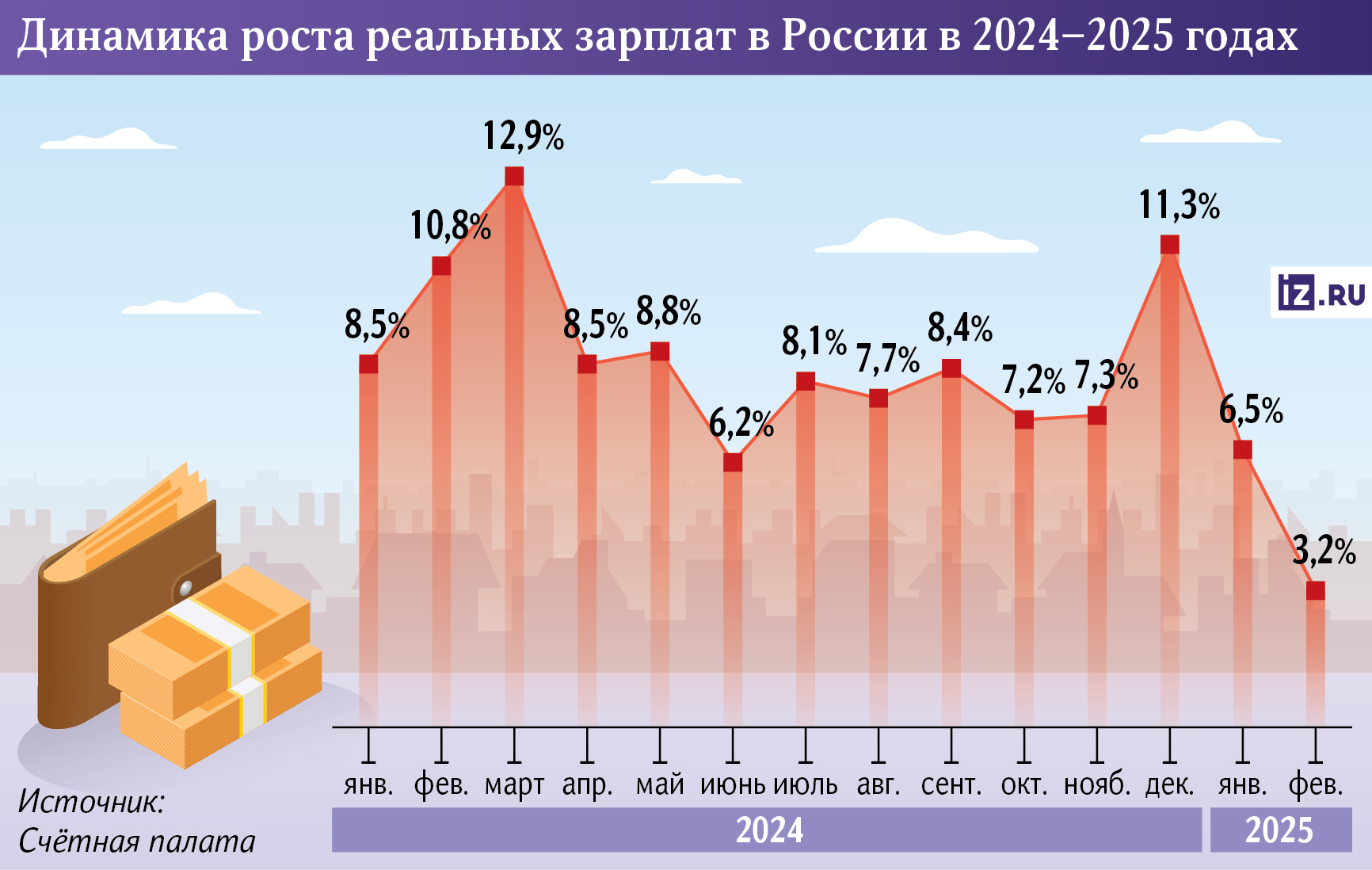
Real wages — that is, adjusted for inflation — began to grow twice as slowly. In the first months of 2025, they increased by 5.2% (against 10% a year earlier), to an average of 90 thousand rubles, according to the report of the Accounting Chamber. Against the backdrop of high inflation, lower demand, and higher taxes, businesses have run out of resources to lure employees with high salaries. On the one hand, it slows down the economy, and on the other, it slows down inflation. Where the rates are being indexed at a faster pace and when the "salary race" will return is in the Izvestia article.
Why is wage growth slowing down in Russia
Salaries in Russia continue to grow amid a shortage of staff. However, due to the high base of 2024, the pace began to slow down. So, at the beginning of March 2025, the average nominal earnings reached almost 90 thousand rubles, which is 16% more than a year earlier. At the same time, taking into account inflation, it increased by only 5.2%, whereas in 2024 the increase was twice as high, according to the June report of the Accounting Chamber (JV) on budget execution (Izvestia studied it).

According to the All-Russian Research Institute of Labor of the Ministry of Labor, which refers to Rosstat, the average monthly nominal salary of employees by April was already 97.6 thousand rubles, and it increased by about 11% over the year. The growth occurred in almost all sectors: for example, professional, scientific and technical activities (+16%), activities in the field of information and communications (+20%), the subordinate institute told Izvestia.
However, in February, real wages increased by only 3.2% compared to January, which is the minimum monthly increase in two years, according to the joint venture.

The main reason for the slowdown is an increase in inflation: from 7.5% in early 2024 to 10% in the first months of 2025, explained Vladimir Chernov, analyst at Freedom Finance Global. That is, the overall price increase actually eats up the salary increase.
In addition, in the middle of last year, the Central Bank raised its key rate. This reduced demand in the economy and slowed down the growth of companies' revenues. As a result, it has become more difficult for businesses to raise salaries.
— Indeed, the "salary race" has subsided. In the first half of 2024, almost 60% of companies reported salary increases, but now this figure has dropped to 40%. Salary growth has been extremely intense in recent years, but this was not due to an increase in company profits, but due to internal reserves. But business resources are running out," the research director added. hh.ru Maria Ignatova.

A steady increase in real wages is impossible without an increase in labor productivity, and in a number of industries it is stagnating, said Anna Khripchenko, Director of Academic and Career Development at the Presidential Academy. The reasons are lack of investments, weak automation and low motivation of employers to develop staff.
Additional pressure is exerted by tax changes: due to the increase in income taxes, businesses are holding back the payroll to compensate for rising costs, the expert stressed.
Where are salaries growing the slowest
This year, wages in agriculture, household services and construction are growing the slowest — plus 4-7% (in nominal terms), said Maria Ignatova from hh.ru . At the same time, there are industries where salaries are declining, such as the extraction of raw materials, minus 6% by 2024.

According to the Ministry of Energy, at the beginning of 2025, wages grew the least in the light and food industries. According to Vladimir Chernov of Freedom Finance Global, these industries operate with low margins, high costs and limited access to credit. In the public sector, especially in education, culture and science, salaries are also rising slowly and often do not keep up with inflation. In addition, real incomes may decrease in logistics and among small businesses, especially if they depend on imports, the expert added.

The unevenness in construction is explained by the fact that there is still growth in defense and infrastructure projects, while there is stagnation in civil engineering and the secondary sector, said Anna Khripchenko from the Presidential Academy. Due to the rising cost of work and lower demand, salary indexation among foremen, bricklayers and other specialists is slowing down.
— The administrative staff is also suffering — office managers, secretaries, assistants. Many functions are being automated, and companies are optimizing costs, often abandoning these positions altogether. The situation is similar in call centers and technical support - there is high turnover and the transition to piecework or flexible pay, without raising rates," the expert added.

Other sensitive areas include law in small and medium—sized businesses. Divisions are shrinking, the workload is growing, but the level of pay is not, she continued. Fashion, technology and electronics are suffering in retail: a variable part of the income of sellers and merchandisers is falling due to lower demand and increased competition.
Where salaries are rising the fastest
— The largest contribution to the overall salary growth is made by areas with a large number of vacancies — these are workers, manufacturing, retail, sales. This is where the maximum demand is observed. A 35% increase in workers' salaries affects the market more than a 50% increase in insurance, simply because there are many more blue—collar workers," said Maria Ignatova from hh.ru .
Right now, construction engineers' salaries are growing the fastest — plus 18.5% per year, SuperJob shared. This is due to the high demand in industry and remote regions. IT specialists and HR specialists are also in the top three.

Similar trends are noted in Avito Rabota. According to the company, in the spring of 2025, salaries of project managers increased the most - almost one and a half times.
Salary increases are also noted in metallurgy and mechanical engineering due to close ties with the defense industry, as well as in the service sector due to the outflow of foreign investment, added Tatiana Ushkats, an expert at the Faculty of Economics of RUDN University.

What will happen to salaries next
A decrease in real wages may weaken domestic demand and slow down the economy, since consumption is one of its key engines, said Svetlana Frumina, Acting Head of the Department of Global Financial Markets and Fintech at Plekhanov Russian University of Economics.
— The slowdown in real wage growth is holding back demand, especially for non-food products. Sales of appliances, clothing, and furniture have dropped significantly this year. People have become more careful in spending, they save more. In the future, this may slow down economic activity and deter business investment in expansion, but on the other hand, it may cool inflation," believes Vladimir Chernov.

In addition, without a noticeable increase in salaries and regular indexation, apathy and the effect of "quiet dismissal" are increasing — people physically stay in place, but lose their involvement, switch to part-time jobs or look for alternative employment formats, Anna Khripchenko emphasized.
Against the background of a shortage of resources, employers are beginning to review strategies, placing increasing emphasis on additional bonuses. For example, in the first quarter of 2025, the number of vacancies with free parking doubled. They also began to offer refunds for gasoline and VMI much more often, Avito Rabota shared. And in some sectors, especially in IT, they provide compensation in the form of options or linking income to project results, Vladimir Chernov noted.
 By the end of 2025, real wage growth is likely to remain in the range of 4-6%, subject to lower inflation in the second half of the year, the analyst believes. According to him, a new wave of active growth may begin only in 2026 and only if the macroeconomics stabilize, the Central Bank's policy eases and GDP growth rates recover above 2-2.5%.
Переведено сервисом «Яндекс Переводчик»
