- Статьи
- Economy
- Summer condition: the ruble was predicted to strengthen to 75 per dollar by the end of June

Summer condition: the ruble was predicted to strengthen to 75 per dollar by the end of June

By the end of June, the Russian currency may strengthen at a level below 75 rubles/$, follows from the consensus forecast of Izvestia. This is the result of rising energy prices due to a new round of conflict in the Middle East: over the past few days, oil prices have jumped by 10% to $70 per barrel. In addition, the ruble will traditionally be supported by the tax period by the end of the month. There are other fundamental factors that play in his favor: negotiations on the settlement of the Ukrainian conflict, trade wars, as well as a high key. How long the trend towards strengthening the Russian currency will last and what it will be by the end of the year is in the Izvestia article.
What will the dollar exchange rate be in June?
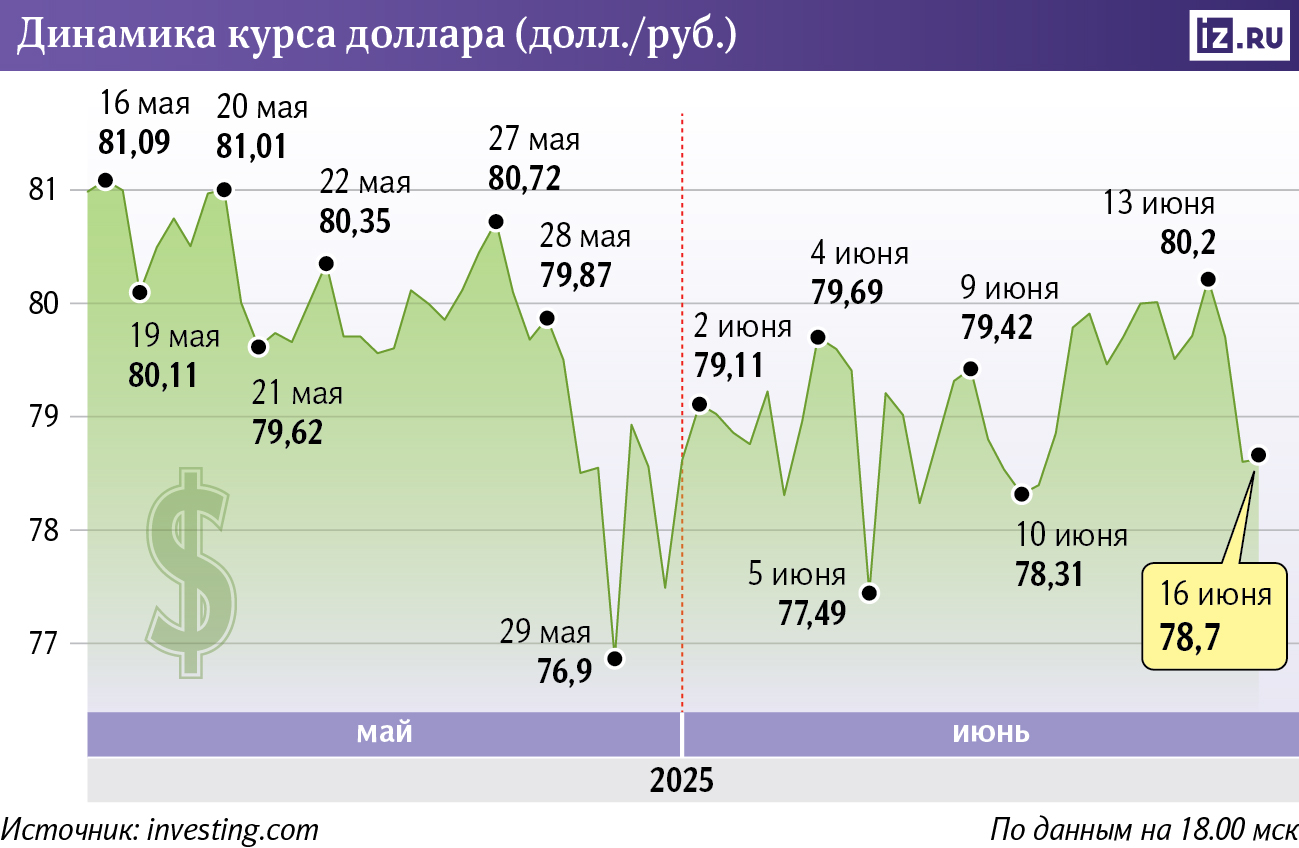
By the end of the month, the ruble will strengthen to 75 per dollar, according to experts from universities and banks interviewed by Izvestia. On June 16, at 18:00, the American was trading at 78.7 rubles. Since the beginning of the year, the national currency has already added 25% in value, and this trend will only intensify in the coming weeks.

— On Wednesday, June 11, before the long weekend, the ruble fell to 80 per dollar amid increased demand for the currency. However, it later recovered to 79 per dollar in the face of rising oil prices by almost $10 per barrel amid the unfolding Iran-Israel conflict," explained Yuri Popov, senior analyst at SberCIB Investment Research.
The escalation in the Middle East occurred on the night of June 13. Israel has attacked Iran's nuclear and military infrastructure, killing three of the Islamic Republic's most senior military commanders, including the Chief of Staff of the Armed Forces and IRGC Commander Mohammad Bagheri. In the evening, Iran responded by firing more than 150 rockets into Israel, which struck the building of the country's Ministry of Defense in Tel Aviv.
With rising oil prices, the revenues of both Russian companies and the country's budget from its exports in ruble terms increase. Consequently, the positive trade balance of the Russian Federation is increasing, recalled Vladimir Chernov, analyst at Freedom Finance Global. He added: the supply of currency in the domestic market is growing with the same demand, and this leads to a decrease in its value relative to the Russian ruble.
"Therefore, against the background of the escalation of the military conflict in the Middle East and, as a result, rising world oil prices, the value of the Russian national currency is strengthening slightly," says Vladimir Chernov.

As Izvestia wrote earlier, against the background of the aggravation of the Iranian-Israeli conflict, Brent oil may break through the $100 per barrel mark in the coming months.
On the other hand, the ruble has not been as strongly correlated with oil prices lately as it was before. For example, in early April, the decline in oil prices reached 20%, and the ruble exchange rate even strengthened slightly (by 1.5%), Ivan Efanov, an analyst at Cifra Broker, drew attention.
In addition, as Mikhail Vasiliev, chief analyst at Sovcombank, recalled, export earnings from oil sales reach the domestic market with a lag of several months. Therefore, the ruble may feel the main impact of the current rise in oil prices in August.

What else will support the ruble
However, there are other factors that are currently shaping up in favor of the ruble. First of all, this is the tax period. At the end of each month, companies, including exporters, must transfer fees to the budget.: to do this, they sell the earned currency, thereby increasing its supply on the market. In June, businesses will have to pay VAT, income tax, excise taxes, mineral extraction tax, and personal income tax. The tax period slightly increases the demand for the national currency and strengthens its exchange rate by 1-2 rubles/$, recalled Vladimir Chernov from Freedom Finance Global.

The geopolitical situation as a whole is now positively influencing the ruble exchange rate. Negotiations on the settlement of the Ukrainian conflict are also contributing, said Alexander Potavin, an analyst at Finam.
In addition, the dollar is now weakening overall against most foreign currencies. This is due to the trade wars that have begun against a number of countries due to US President Donald Trump. The United States has worsened relations with China and its allies, undermining confidence in dollar assets.
There are also internal Russian reasons that support the course. The main one is the high key rate, which, according to the results of the June meeting, the Bank of Russia reduced, but only by 1 percentage point— to 20%. This, in turn, contributes to the attractiveness of ruble savings deposits at 19-20% per annum, Mikhail Vasiliev noted. In addition, a high key value cools consumer and investment demand, which means that importers need less foreign money to purchase goods abroad.

On the other hand, there are factors that can play against the strengthening of the Russian national currency, but there are few of them. For example, the risks of tougher sanctions from the European Union, said Vladimir Chernov.

What will the ruble exchange rate be in 2025?
However, according to experts interviewed by Izvestia, by the end of the summer, the national currency will gradually weaken and roll back to the current levels at the beginning of June — about 80 rubles / $. The trend will continue by the end of the year.
The authorities expect the same thing. According to the macro forecast of the Ministry of Economic Development, at the end of 2025, the dollar will cost 94.3 rubles. Judging by Izvestia's consensus forecast, the ruble will indeed be in the range of 95-97 rubles/$ by the end of the year. However, analysts' opinions vary too much here. The most negative assessment was given by independent expert Andrey Barkhota — 110 rubles/$, and the most positive at Plekhanov Russian University of Economics — 80-85 rubles/$ are expected there.
As experts explained, the national currency will weaken as the authorities begin to gradually reduce the key rate (and the attractiveness of ruble assets will decrease), and geopolitical tensions may, on the contrary, worsen.
Importers and citizens who can buy foreign goods cheaper benefit from a strong ruble, says Mikhail Vasiliev from Sovcombank. In addition, he continued, with such a national currency, we can expect a faster slowdown in inflation, which means that the key rate reduction cycle will begin soon.
However, a too strong exchange rate is unprofitable for the budget and exporters — because of this, the treasury risks not receiving enough funds. In particular, the national currency quotes are related to the fact that the Ministry of Finance has tripled expectations for the federal budget deficit to 3.8 trillion rubles this year, and if we talk about budgets at all levels, analysts surveyed by the Central Bank predict that it may reach 4.4 trillion.
Переведено сервисом «Яндекс Переводчик»
