
Pour more gasoline: new refineries will appear in the Far East

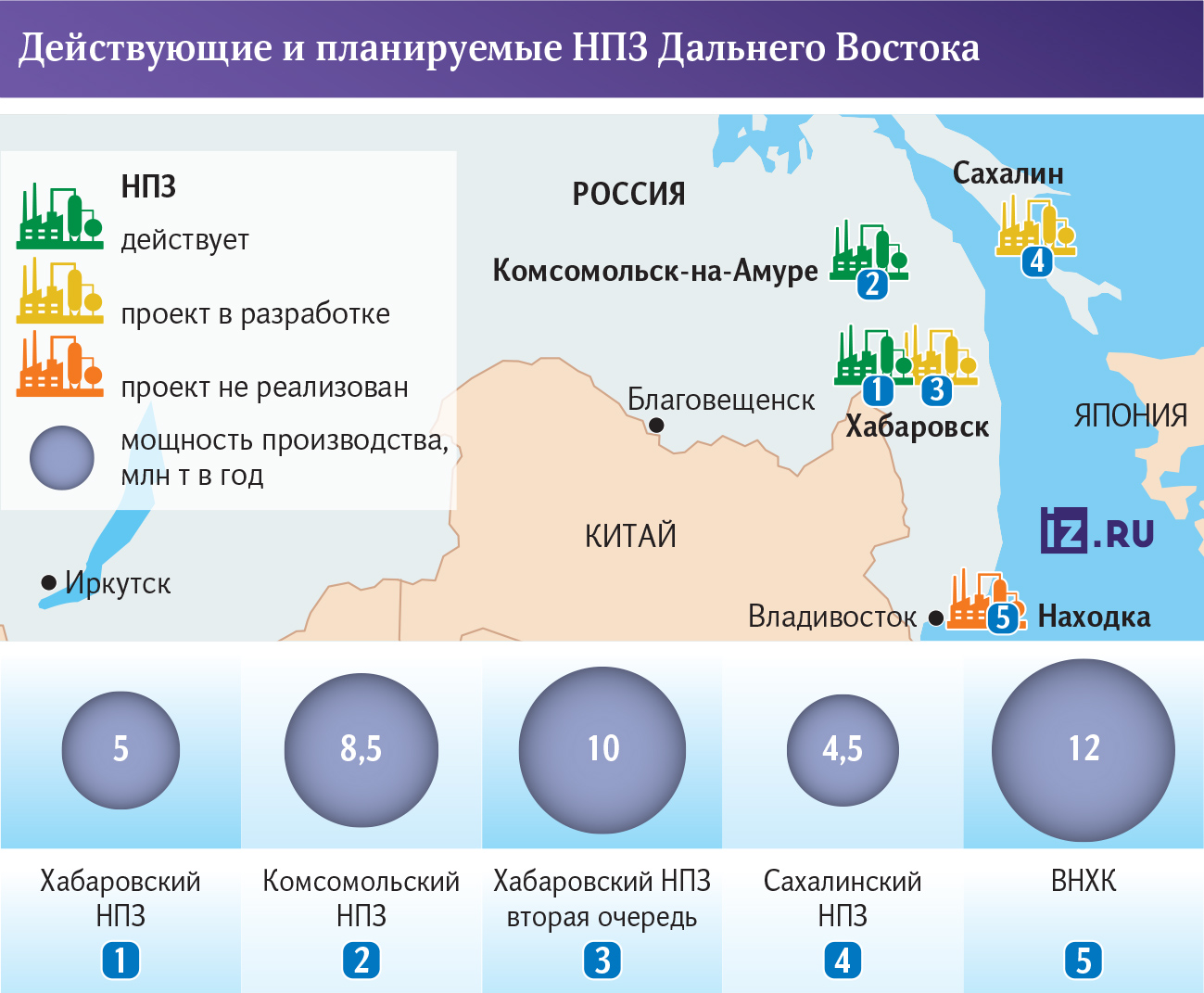
There are plans to build several oil refineries in the Far East. Currently, two projects are under development at once — on Sakhalin, which is being implemented by Gazprom, and in the Khabarovsk Territory, which is being developed by an Independent Oil Company (NOC). The first one is already undergoing the investment justification procedure, and the fate of the second enterprise will be determined in the fall. The introduction of new refining capacities can significantly change the situation with fuel supply in the region, up to half of whose needs are now covered by supplies from other districts of the country, experts say.
Oil refineries in the Far East
Two projects for the construction of new oil refining facilities are under development in the Far East. One of them is on Sakhalin, Gazprom is engaged in its preparation. The project is undergoing the Investment Justification procedure (OBIN).
— This project will determine the construction site, the amount of fuel received, confirm safety for the environment, and specify the construction and commissioning dates. The decision on construction will be made based on the results of the survey, " the Ministry of Investment, Industry and External Relations of the Sakhalin Region told Izvestia.

Gazprom did not respond to the editorial's request, however, it was previously reported that the justification for investments in the refinery with a capacity of 4.5 million tons of petroleum products per year was planned to be prepared by March 1, 2023. It was assumed that Gazprom would make a decision on the fate of the project based on this document.
A source familiar with the development of the project said that up to ten options for processing gas condensate at this plant were being considered, from 2.989 million to 4.890 million tons per year. At the same time, the consultants who initially worked on the project noted the "poor economics of the project." Nevertheless, according to the interlocutor of Izvestia, currently the OBIN is being prepared by NIIgazeconomika.

In addition, at the end of May, the Russian Railways Partner magazine, citing the Minister of Energy of the Khabarovsk Territory, German Tyutyukov, reported on the construction by NOC of the second stage of the Khabarovsk refinery with a capacity of up to 10 million tons.
"At the moment, the issue of building the second stage of the plant is in serious discussion with colleagues, with NOC. In fact, this is a new plant of the group with a capacity of up to 10 million tons per year. The existing plant currently has a capacity of up to 5 million tons," the minister said.

He confirmed this information to Izvestia.
— It's too early to comment on this issue. The project is under development. We can return to this issue in the fall," German Tyutyukov said.
The editorial board sent a request to the Khabarovsk Oil Refinery.

The fuel situation in the Far East
The idea of creating these facilities is quite natural, since the Far East is experiencing a serious shortage of petroleum products — with consumption of about 6 million tons per year, its own production is about 4 million tons. That is, about 2 million tons per year have to be imported from Siberia and Central Russia, said Valery Andrianov, associate professor at the Financial University under the Government of the Russian Federation.
— Given the limited capacity of the railways, as well as the high tariffs of Russian Railways, this leads to supply disruptions and to higher prices for petroleum products for the population. By the way, it was the Khabarovsk Territory that at the end of May this year became the record holder in Russia for increasing the cost of gasoline," he told Izvestia.
According to him, the Sakhalin Region is now completely dependent on fuel supplies from the mainland, although oil production is underway in the region.
— As far as we know, the new plant can also produce jet fuel for the needs of the regional airline Aurora, — said Valery Andrianov.

Plans for the development of the economy of the Far East in connection with the general "turn to the East" of the domestic economy also require an improvement in the supply of fuel to the region, the expert added. Therefore, the creation of new enterprises is an extremely important task. In addition, the growth of regional oil refining may become an incentive for the implementation of production projects in the east of the country, he added.
Today, there are only two large refineries operating in the Far East — Komsomolsk and Khabarovsk. In 2023, they accounted for only 3% of the total gasoline production in the country (1.2 million out of 43.9 million tons) and 2% of diesel (2 million out of 88.1 million tons). The rest of the fuel is imported from other regions, mainly from Siberia.
According to Rosstat, in the period from May 20 to May 26, 2025, a change in gasoline prices was recorded in 34 regions, most of all in the Khabarovsk Territory (+1.4%). The average prices for AI-92 were 56.62 rubles per liter, AI-95 — 61.87 rubles, diesel — 71.35 rubles. At the end of May, the most expensive fuel in Russia was sold in the Far East and Yakutia. There, AI-92 costs 72.03 rubles, AI-95 costs 75.35 rubles, and diesel fuel costs 92.84 rubles. The cheapest (by the standards of the Far Eastern Federal District) is in the Khabarovsk Territory, even despite the price increase: AI-92 — 60.14 rubles, AI-95 — 62.55, diesel fuel — 76.23 rubles per liter.

At the same time, last year, Russian Deputy Prime Minister Alexander Novak stated that there were no plans to build new refineries, including in the east of the country.
"We do not plan the construction of new refineries due to the fact that we already have excess capacity, we have a large—scale program underway for the reconstruction and modernization of refineries," he explained.
According to him, the plants have spare capacities that can be used to increase production volumes.
Izvestia asked the Ministry of Energy to clarify whether the government's position on this issue has changed.

Meanwhile, Russia's Energy Strategy notes that "taking into account the satisfaction of demand in the domestic market, the volume of oil refining in Russia on the horizon until 2050 will depend on the possibility of effective realization of export potential."
"In the target scenario, processing volumes are expected to remain at least 283 million tons per year. In the inertial direction, the risk of reducing the export niche and increasing competition in the world is estimated, which will lead to an optimization of the refining volume to 272 million tons in 2036. At the same time, taking into account the modernization, this volume will fully cover the needs of the domestic market," the document says.
In 2024, the volume of processing, according to Deputy Prime Minister Alexander Novak, amounted to 266.5 million tons.

Increase in refining capacity
Historically, oil refining enterprises in Russia have been established in the central part of Russia, and over the past three decades there has been a need to increase refining and petrochemical capacities in the Far East, said Tamara Safonova, CEO of the independent analytical agency NAANS-MEDIA.
"The development of oil and gas processing facilities in the Far East can make it possible to provide the region with high—quality fuel, reduce logistical costs when transporting fuel to consumers, and ensure the export of value—added products by replacing the export of raw materials," she believes.

Dmitry Gusev, Deputy Chairman of the Supervisory Board of the Reliable Partner Association, recalled the history of the project of the Eastern Petrochemical Company (VNHK).
"For the second decade now, the Ministry of Finance has been unable to agree on adequate conditions for VNHK, and the construction of two new plants is an important issue for the region," he said.

The expert noted that the expansion of refining capacities in the Khabarovsk Territory will not only improve the situation in the domestic market of the region, but also expand export opportunities in terms of sending our petroleum products to Asian markets.
— In order for these plans to become reality, appropriate tax conditions are needed. In this regard, the story of VNHK is extremely revealing — this project was not provided with a sufficient amount of tax preferences, which led to its freezing. If this had not happened, the Far East would already be self—sufficient in terms of fuel consumption and could even export fuel," believes Valery Andrianov.

Rosneft planned to build a refinery in the Far East, the first stage of which would include a refinery with a capacity of 12 million tons of oil per year, the second — a petrochemical complex for 3.4 million tons. The preliminary estimate of the funds needed for the implementation of the VNHK (including investments in the construction of infrastructure facilities) amounted to more than 700 billion rubles. The project was originally conceived back in the 1970s, but later the idea was revived by a state-owned company. In early 2022, it was reported that VNHK was once again in an active phase of discussion at the government level. At the same time, the Ministry of Finance stated that the project is necessary and the discussion of economic benefits and incentives for it will continue. Izvestia sent a request to the financial department.
In conditions of high interest rates, the payback period for projects increases dramatically, and in the absence of government subsidies, in particular in the form of an investment component, the profitability of the project may be in a negative zone, Tamara Safonova concluded.
Переведено сервисом «Яндекс Переводчик»
