- Статьи
- Culture
- A rather big horse: the ballet "The Hunchback Horse" has returned to the Bolshoi Theater

A rather big horse: the ballet "The Hunchback Horse" has returned to the Bolshoi Theater

Rodion Shchedrin's masterpiece became only the third ballet in the line of the children's repertoire of the GABTA on the Historical Stage, besides "The Nutcracker" and "Don Quixote." In the interpretation of the director from the Ural Opera, the fairy tale will be replenished with new characters, slightly change the plot and receive a modern interpretation. Valery Gergiev became the musical director of the premiere. The leading soloists of the ballet company are engaged in the performance. Izvestia visited the premiere and appreciated the idea of the young team.
50 thousand for a ticket
Premiere tickets bite. The price in the stalls is 50 thousand. In addition, the letter rows appeared — A and B. This means that by buying a ticket to the front row, you will find yourself on the third row from the orchestra pit. Those who find it important to sit in front of everyone should keep this in mind. The cheapest seat in the gallery is 5 thousand. A standing ticket costs 1,250 rubles, but it's not so easy to catch it. The same prices are available at the Bolshoi for the ballets The Nutcracker and Swan Lake. Another thing is that it is so difficult to get tickets for the New Year's performance that sometimes you have to become an auction participant, and tickets for the "Humpbacked Horse" are even now available at the box office and on the theater's website. While.
The premiere was attended by a prepared audience. The men inhaled the scents of expensive perfumes and looked at the beautiful dresses of their companions. The children were dressed up by their parents as if for a ball.

This is the third production of "The Hunchback Horse" on the stage of the main theater of the country. This ballet is an early work by Rodion Shchedrin. He painted it by order of the Bolshoi, while still studying at the conservatory. During the rehearsals, the young composer met, as he said, "his Firebird," Maya Plisetskaya, the Great Prima Ballerina. This score is dedicated to her. In the 1960 production, she performed the role of the Tsar Maiden. Ivan was danced by Vladimir Vasiliev in the play. And the choreographer Alexander Radunsky himself appeared in the role of the Tsar. The next production of "The Hunchback Horse" was performed at the Bolshoi in 1999. And now, a quarter of a century later, the fairy tale has returned to the poster of the GABTA.
The running time of Shchedrin's work is 2 hours and 40 minutes. Choreographer Maxim Petrov slightly doctored the original, but also returned to the performance the numbers that were not performed in other productions. In the past, he himself danced at the Mariinsky Theatre. In the play "The Hunchback Horse" by Ratmansky, he appeared on stage for 12 years. Petrov also wrote the libretto for his own production.
All shades of grey
Juliana Laikova was responsible for the design of the play. Maxim Petrov invited the artist to the Bolshoi Theater. They work together in Yekaterinburg at the Ural Opera Ballet Theater, where Petrov heads the ballet troupe and Laikova is the main artist. A year ago, they staged "Tales of Perrault" together. The debut on the Bolshoi stage is a stage in the creative biography of the directors.

Let us remind you that "The Hunchback Horse" is a children's fairy tale, which the Bolshoi Theater relies on to attract a young audience. There were a lot of kids in the theater. The girls and boys dressed up went to the magic. There was already a curtain fire in the hall hinting at this. There was a picture of a fiery explosion on the entire volume of the portal. The only thing that was alarming was an old, gray, worn door with a strange yellow scroll on the side, which was embedded in the lower corner of the curtain. We've seen this before somewhere. In the Mariinsky play "A Life for the Tsar" ("Ivan Susanin"), the door in the right corner of the empty stage was also one of the main decorations. One could only hope that this detail was justified in the Humpbacked Skate.
With the first chords of Rodion Shchedrin's music, a Hunchback Horse jumped onto the stage. The soloist of the ballet company, Georgy Gusev, carried a plastic horse's head. After jumping around the stage in a circle, he took it off and jumped straight into the "fire", making a hole in the curtain. Spectacular. It is clear that horses do not know how to open the door. Then why is she here? Behind the curtain was a hut and a huge hayloft, which represented a field. The house resembled a panel building from the nearest farming co-op. If the field was worked out in detail with hay, did they really not find shingles on the roof of the hut? But the conventional decoration of the dwelling was decorated with garlands with stars. There were enough of them in the design of the firmament.

Rodion Shchedrin's music is dynamic, cheerful, with a national flavor. The orchestra plays with enthusiasm, with Valery Gergiev at the console. Under such melodies, the imagination draws something fabulously gingerbread. But the artist Juliana Laikova chose a restrained design of the performance. The costumes of the heroes were dominated by gray. The decorations are made in the same cold shade. She dilutes monochrome gray with accents of red. The combination of these colors in clothes is a classic. The recent premiere of Rigoletto at the Bolshoi also did not differ in color, there were two dominant colors — black with its shades and red.

The horse invasion
Creating images of heroes, Juliana Laikova did not want to step towards textbook pictures. Ivan's father looks like an old rocker: a fashionable cropped jacket, high boots, and a full gray beard. He has three sons: the eldest, Danila (Mark Orlov), is smart, the middle, Gavrila (Nikita Kapustin)— is both, and the youngest, Ivan, is a fool. The premier of the ballet company, Honored Artist of the Russian Federation Vladislav Lantratov, perfectly coped with the acting task set by director Anton Morozov. His Ivan seems to have fallen into a fairy tale, he is surprised at everything, everything is a joy to him.
But the fairy tale will be ahead. She will come into the hero's life with the appearance of a Skate. He helped catch four wild white horses that trampled a wheat field at night. Horse invasion is a freedom of the directors. In Peter Ershov's original, there was only a mare with a long golden mane. It was she who trampled the crops. For her freedom, the mare promised Ivan three horses. He could sell two handsome men, but not the little one for any promises. Even though he is three inches tall, has two humps on his back and ears as big as a yard, he will be Ivan's assistant and protector in everything. The image of the Skate is resolved in the overall aesthetics of the production. It's not brown like Yershov's, it's not traditional — it has a tail. The horse is piebald, with a mane, nimble, bouncing.
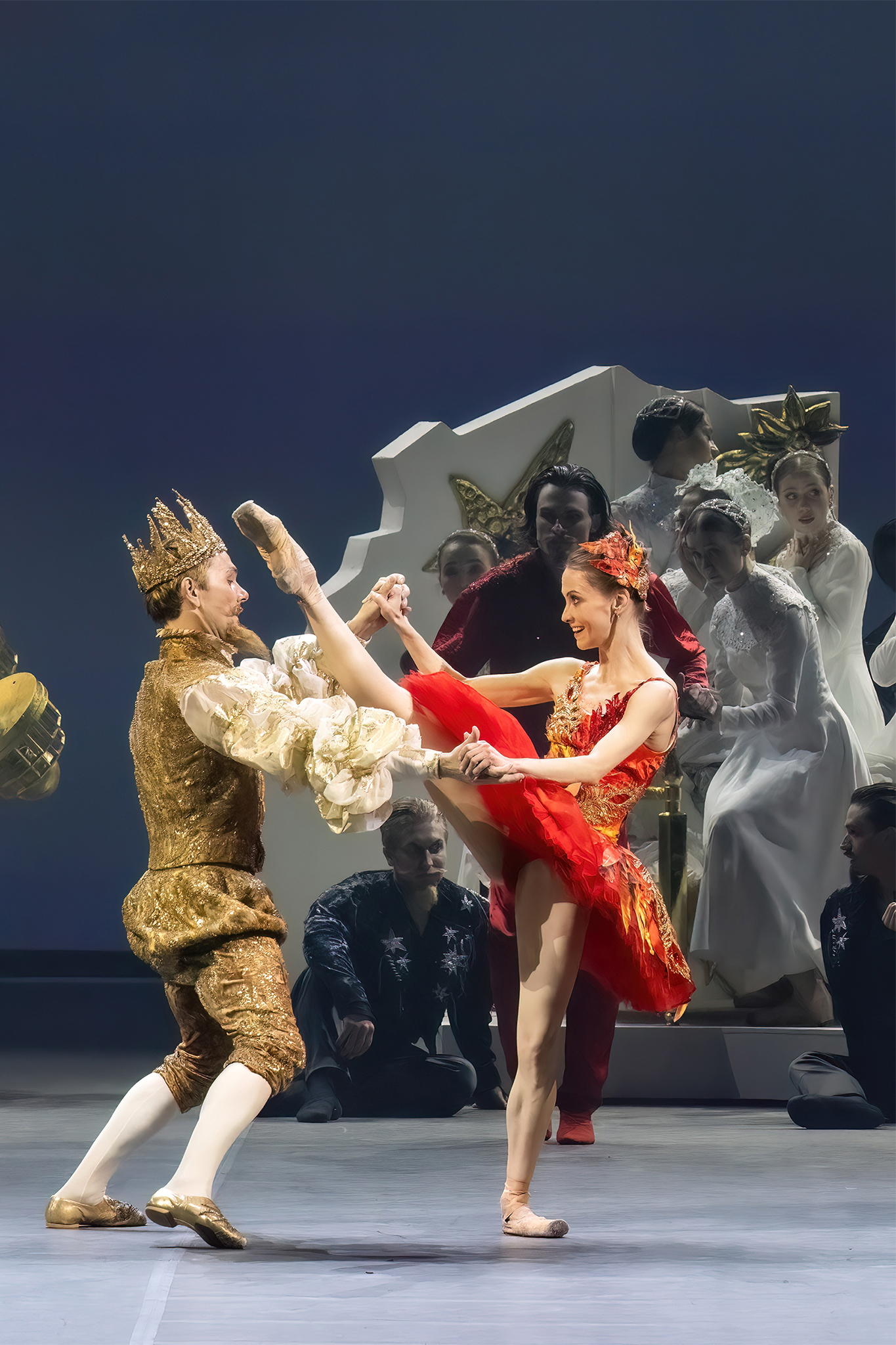
The Hunchback horse will help Ivan catch the Firebird as well. He will do it in an original way: just give the bird a headlock. While she is fainting, Ivan will deliver her to the Tsar (Honored Artist of the Russian Federation Vyacheslav Lopatin).
The royal mansions open to the viewer gradually. At first it is a space with a snow—white colonnade, then a throne room with a magnificent curtain, and in the next scene there is a bedchamber-a hole that hides behind a red wall. In the design of the blood-red curtain, Juliana Laikova demonstrated her passion for applied art. The entire surface of the expensive canopy seems to be embroidered with giant beads and sequins. A magnificent find. The artist used the same technique in the design of the underwater world. The albino whale will also be covered in embroidery here.
May it burn with fire
According to the director, the performer of the Firebird part, Honored Artist of the Russian Federation Anastasia Stashkevich, plays two roles in the play. She also appears in the form of a Tsar Maiden. And the viewer should not notice it. The ballerina created diametrically opposite characters: the mysterious and freedom-loving Firebird and the broken, wayward Tsar Maiden.
But where else it is sometimes difficult to notice Anastasia Stashkevich is in a flock of birds. Among the fiery birds, her Firebird is the leader. But for some reason, her visual image is identical to the others. Identical tutus, identical pointe shoes of fabulous creatures. The only way to tell the one that Ivan needs to catch is by the small tiara on Anastasia's head. And in group numbers, in order to identify the leader, you need to keep track of who has the harder game.: that's the main one. That is, you either need to sit closer or have excellent eyesight.
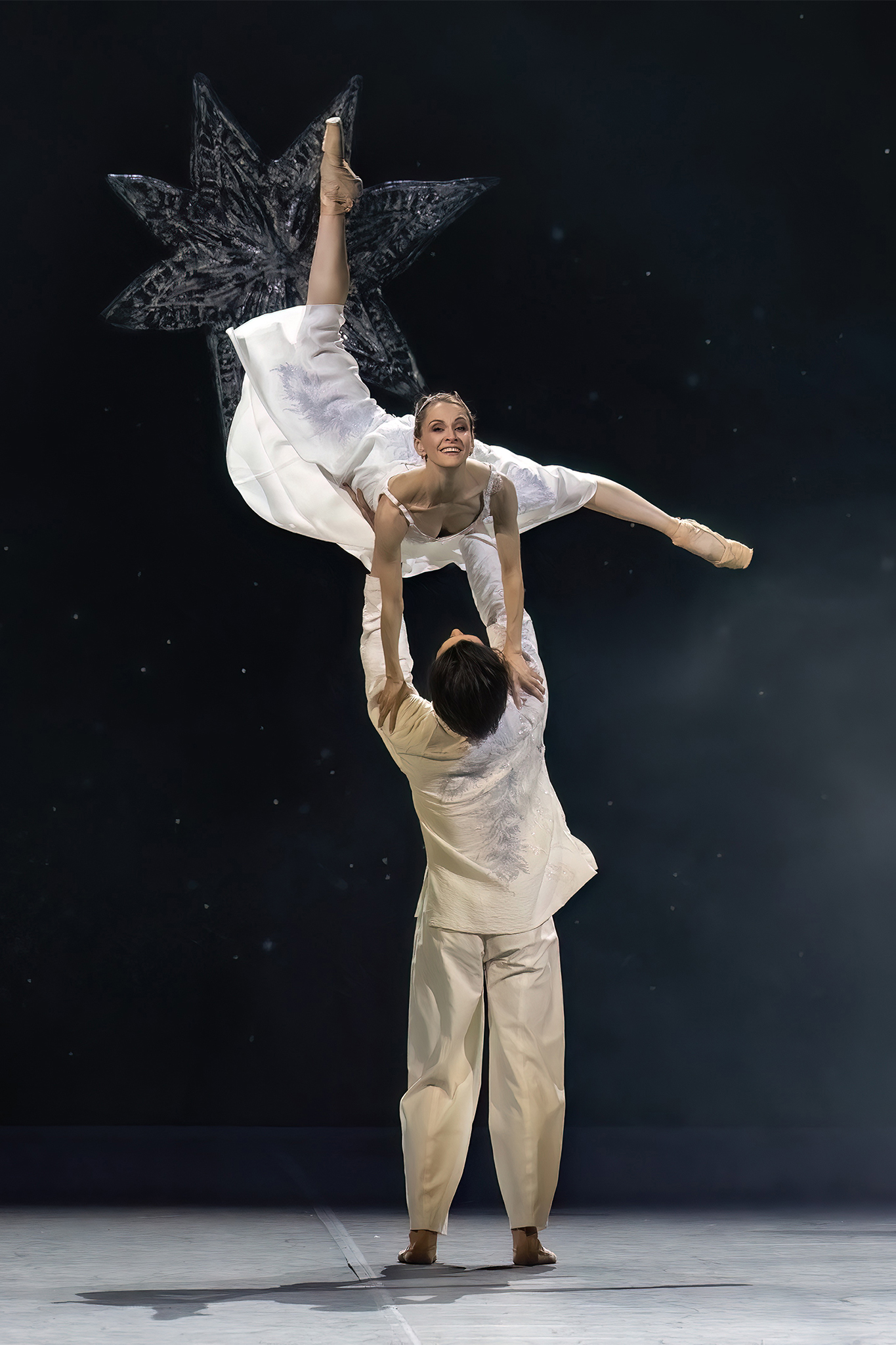
The plastic of the firebirds is sharp, broken somewhere. They're not swans, they're fire birds. The director's find is a reed Firebird doll. Burning with red light, it flies over the stage several times. It is operated by puppeteers Mikhail Petrukhin and Artur Kalashnikov.

The beginning of the second act was also spectacular. The silver mountain seems to be burning with flames — these are firebirds illuminating it with their plumage. And the hill, covered in golden feathers, also changes color in every scene. Lighting designer Konstantin Binkin took full advantage of the equipment of the Historical Stage of the GABTA. The texture of the rocks is made of a material that shimmers when the spotlight imperceptibly changes the angle of the beam for the viewer.
And the depths of the sea swallowed them up
There are many mass scenes in the play. The townspeople in the City-capital, in gray dresses with red belts, in kokoshniks, lead round dances. And the royal mothers, led by the Housekeeper (Anastasia Meskova), seem to be from another play. All in white, and even with elegant decorations in the form of swordmaidens' masks. In this image, they rather resemble the inhabitants of Verona from Prokofiev's ballet Romeo and Juliet.

Half of the dancers come out on pointe shoes, and the rest in shoes. At the same time, they have the same choreography for some reason. Why this move was introduced is not very clear. There are a lot of unnecessary movements in the crowd scenes. Dynamic music sometimes revealed the mistakes of the artists — perhaps it was the excitement of the corps de ballet.
Ovations, except for soloists, were repeatedly disrupted by Ivan Poddubnyak, the performer of the Groom's part. His high, sweeping jumps could not leave anyone indifferent. And the scarlet suit was eye-catching.
What you really believe in is the inhabitants of the underwater kingdom. Waves made of plexiglass hung over the stage. Ships are rocking on them, octopuses, fish, and stars are sailing. The inhabitants of the underwater kingdom repeat the movements of synchronized swimmers in the pool. Dancers in air tutus flutter around the stage. And the wave is driven by the Queen of the bottom (Yulia Stepanova). Under her pressure, even Ivan seemed confused.

The lavish decoration of the royal chambers and the underwater world is at odds with some scenes in the second act, where there is nothing on the stage. As if the budget wasn't even enough for the backdrop. The production turned out to be aesthetic in some places, interesting in some places, and even magical. But the Nutcracker probably shouldn't worry yet.
Переведено сервисом «Яндекс Переводчик»
