
Forever young: how Izvestia wrote about the death of Sergei Yesenin

Exactly 100 years ago, the world of Russian poetry lost one of the most striking, tragic and controversial figures — Sergei Yesenin. On December 28, 1925, employees of the Leningrad Angleterre Hotel discovered the poet's body. The chronology of those events remains the subject of study and debate almost a century later, but the memory of Yesenin himself has long been part of Russia's cultural code. On the anniversary of the poet's death, Izvestia has raised its own archives and shares unique texts about how the newspaper covered these tragic days.
The number that hasn't been knocked on again
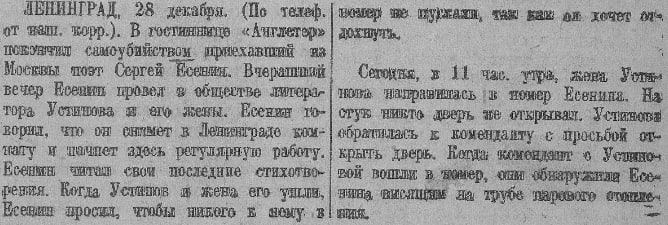
Hooligan, "the last poet of the village", peasant rebel — Sergey Yesenin lived only 30 years. His body was found in one of the rooms of the Angleterre Hotel in Leningrad. The very next day, in the 296th issue of Izvestia, a note appeared under the heading "Yesenin's suicide." The correspondent transmitted the text by phone. According to the journalist, the poet spent the evening before his death in the company of writer Georgy Ustinov and his wife Elizabeth.
"Yesenin said that he would rent a room in Leningrad and start regular work here. Yesenin read his latest poems. When Ustinov and his wife left, Yesenin asked that no one be allowed in his room, as he wanted to rest. Today, at 11 a.m., Ustinov's wife went to Yesenin's room. No one answered the door. Ustinova asked the commandant to open the door. When the commandant and Ustinova entered the room, they found Yesenin hanging from the steam heating pipe," the correspondent said by phone.
Two days later, Izvestia publishes the details of what happened. According to the note, in the morning, having obviously already made a decision, the poet wanted to write the last poem, but there was no ink in the room. Then Yesenin took a knife, cut his arm in several places above the hand, dipped the pen in his own blood — it was lying in the desk — and wrote:
Goodbye, my friend, goodbye.,
My darling, you're in my chest.
The intended parting
He promises a meeting ahead.
Goodbye, my friend, without a hand or a word.
Don't be sad and don't look sad.
It's not new to die in this life.,
But life, of course, is not new.
It later turned out that on the eve of his death, Yesenin handed over a piece of paper with this poem to his friend, the poet Wolf Ehrlich. According to him, Sergei tried to persuade him to read the poem later, when he would be alone. In the confusion, Ehrlich forgot about the leaflet and handed it over to the investigation only a day after the poet's death.

Room No. 5 at the Angleterre Hotel, where Sergei Yesenin committed suicide
According to the journalist, the poet's body was discovered the next day, and on December 29, an autopsy took place at the Nechaev Hospital. The results of the forensic autopsy showed that "no pathological changes were found in the poet's brain." In the evening, the body was transported from the hospital to the premises of the Writers' Union, where a civil memorial service was held, and at 23:15, accompanied by the wife and sister of the deceased, it was sent to Moscow.

A large-scale farewell and a small brown coffin
The researchers emphasize that the last months of Yesenin's life were marked by acute inner feelings and an anxious state. The poet has long suffered from severe depression and alcohol addiction, and has repeatedly expressed suicidal thoughts in conversations with his loved ones. His last completed work, the poem "The Black Man", became a frank testimony to a deep mental crisis.
— Without a doubt, he was a man with a delicate mental organization. Like many geniuses, he was not mentally stable. This is evidenced by the states of mental anguish and inner fracture, clearly visible in his work. In addition, there is evidence from his psychiatric contemporaries who claimed that Yesenin suffered from bipolar disorder," clinical psychologist Olga Mirkina told Izvestia.
The poet's funeral took place on New Year's Eve, December 31. On this day, Izvestia published two articles about Sergei Yesenin at once: an obituary of literary critic Leopold Averbakh and details about the funeral procession planned in Moscow.
The newspaper reported: "The poet will be buried at the Vagankovo cemetery. The removal of the body from the Press House will take place at 11 a.m. The path of the procession: Printing House — Herzen House — Pushkin monument — Vagankovskoye Cemetery".

Funeral of the poet Sergei Yesenin
A flower-strewn coffin was installed in the Great Hall of the House of Printing. A poster "The body of the Russian national poet Sergei Yesenin rests here" hung on the fence of the building. Writers, friends and government officials took turns standing in the guard of honor: Vsevolod Ivanov, Sergey Klychkov, Peter Oreshin, Alexander Voronsky, Vasily Nasedkin, director Vsevolod Meyerhold. All entertainment events in Moscow, including New Year's Eve celebrations, have been canceled.
"This small brown coffin, narrow, short, almost childish, which today the whole of literary Moscow will take to the Vagankovskoye cemetery, takes away from us the greatest lyricist of our time," Averbakh wrote.
He noted that among Yesenin's readers were "Soviet youngsters, and a slave laborer, and a serving intellectual, and a revolutionary party member." They all came to say goodbye to the poet. The newspapers recorded that the procession had gone down in history as one of the largest literary farewells of the 20th century. People went to the coffin all night — the flow began on the evening of December 30 and did not stop until early morning.
— Yesenin's death became a national tragedy for Russia and abroad. Not only Russian. Many newspapers in Belgium, Spain, Latvia, Finland, Japan, etc. responded. In France alone, nine newspapers published notes about the poet's death. The Soviet government decided to accept the costs of the poet's funeral to the state account. In the memoirs of Vadim Shershenevich, there is an episode about a tramp who, having caught up with the hearse, asked: "Who are they taking?" they replied: "Yesenina." He asked: "Is this the one who wrote poetry?" The tramp fell into a snowdrift and cried like a boy. Winter was crying, the tramp, Moscow, the whole of Russia," Natalia Shubnikova—Guseva, a literary critic and specialist on Sergei Yesenin, told Izvestia.

A year later
On January 10, 1926, Izvestia reported that in the summer of 1925, Yesenin had prepared three volumes of selected works and poems for publication. In order to perpetuate the poet's memory, the State Publishing House decided to expand this edition into a "complete collection of works", including prose.
— Izvestia was a very important newspaper for Yesenin. He had a friend, Semyon Borisov (real name Shern), who worked for this publication. Izvestia published Yesenin's essay on America called "Iron Mirgorod" (1923) and his reflections on the future of Russia. Of course, they were heavily edited in terms of the controversy with Vladimir Mayakovsky, but Yesenin was forced to agree with this. In general, Izvestia was one of those newspapers that he regularly read," Natalia Shubnikova-Guseva said.

Sergey Bezrukov in the film "Yesenin"
Exactly one year later, Izvestia journalists, along with the whole of reading Russia, came to the poet's grave.
"The path to the poet's grave is covered with deep snow. A grave cleared in the morning is covered with snow so that it is difficult to find it. At the end of the alley is a tree with an iron fence, on which is a black plaque with the inscription "Sergei Yesenin". Caring hands swept the snow, cleaned the grave with a Christmas tree and flowers. The poet's young son picks up the Christmas trees all the time, sweeps the snow off them and carefully puts them back on the snowdrift. The poet's sister is here," the correspondent wrote.
After short speeches, the meeting closes with an appeal to the poet's friends to collect everything related to Yesenin in his museum.
— Yesenin's love for the Motherland is deep and organic. He suffered painfully from all the sorrows and sufferings of his people. He brilliantly embodied his love for Russia in poetry and sincerely believed in the power of the poetic word and its influence on man. "Every verse of mine heals the soul of a beast," the poet wrote. The motif of a sick soul for the diseases of the world became a cross-cutting motif of his work. The topics he raised reflect his deep connection with the national values of the Russian people: Homeland, home, family, relatives and friends. Love for one's neighbor. Love for every living thing, for every tree, for every blade of grass on our native land," said Shubnikova-Guseva.
For many generations of Russians, Yesenin is not just a poet, but a symbol of the Russian soul. His poems speak of love for his native land, the pain of loss, and the utmost sincerity of feelings. They have been translated into dozens of languages, and individual lines have become popular quotations and part of the country's cultural memory.
Переведено сервисом «Яндекс Переводчик»
