From gas to gas: a new catalyst will help create a network of hydrogen gas stations
- Статьи
- Science and technology
- From gas to gas: a new catalyst will help create a network of hydrogen gas stations


Russian scientists have created a catalyst for compact hydrogen production. It has shown a twofold superiority over its foreign counterparts. The new development will make it possible to create compact complexes for refueling with hydrogen fuel throughout the country. This can be a significant step towards the development of an environmentally friendly energy infrastructure based on hydrogen. However, according to experts, government support is needed to implement this project.
How the new catalyst will help to obtain pure hydrogen
Scientists from the A.F. Ioffe Institute of Physics and Technology of the Russian Academy of Sciences and the St. Petersburg State Electrotechnical University named after V.I. Ulyanov (Lenin) have created a special catalyst in the form of granules to improve the reaction of hydrogen production from natural gas in small reactors. The new material will make it possible to create compact installations capable of operating independently.
The development is focused on applications at hydrogen refueling stations, both mobile and stationary, which will produce fuel directly at the place of its use. According to the researchers, this could become the basis for creating a network of hydrogen filling stations in Russia.
— This gas is considered one of the most promising energy sources of the future. In particular, it can be obtained in various ways, stored in various forms, and efficiently converted back into energy. However, the introduction of such technologies is currently hampered by the high cost of equipment, requirements for safety and durability of materials," explained Anna Matveeva, one of the developers, senior researcher at the Laboratory of Materials and Processes of Hydrogen Energy at the A.F. Ioffe Institute of Physics and Technology of the Russian Academy of Sciences, to Izvestia.
According to her, in industry, hydrogen is mainly produced in large-scale factories, where expensive catalysts and complex infrastructure are used. At the same time, for Russia, with its vast territory, developed gas transportation network and disparate consumers, small-scale production facilities located directly in places of consumption are more suitable. A new catalyst was created for such parameters.
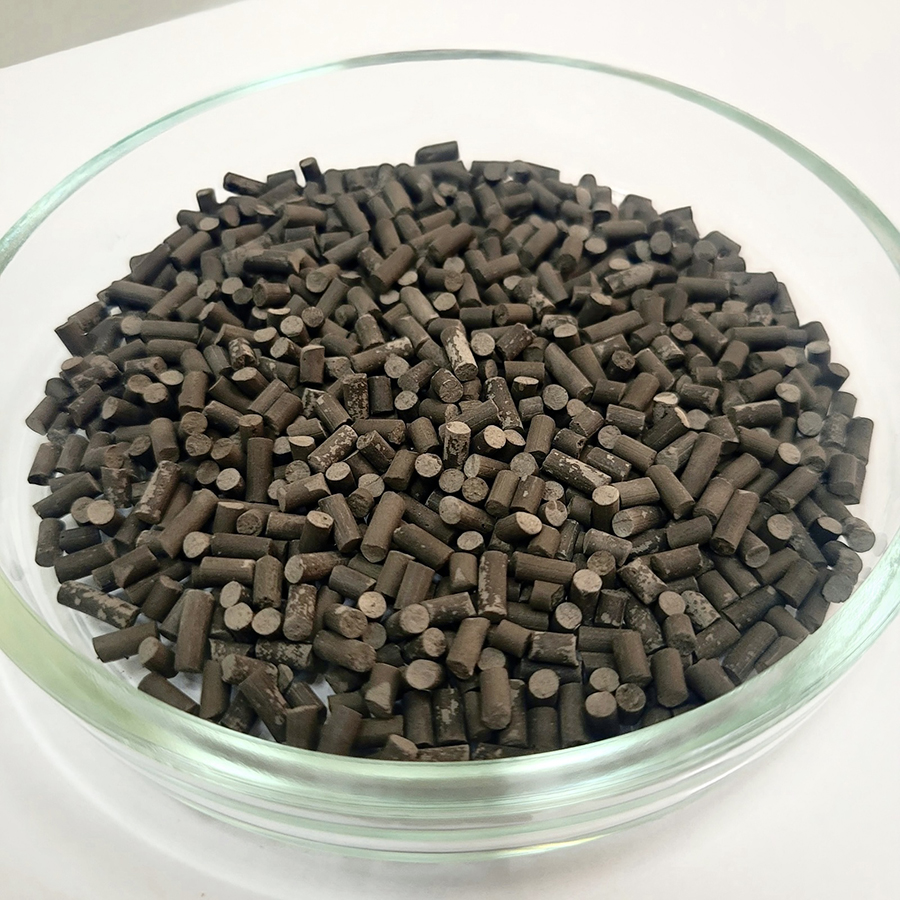
— We worked on the theme of mobile gas stations — the size of a standard container. Devices that can be brought, connected to the main gas pipeline and start the process of producing hydrogen. The heart of such a station is a hydrogen production facility. Its height is about the height of a human. Catalysts in the form of large granules, which are used in industrial reactors, are not suitable for them," said Shamil Omarov, a junior researcher at the same laboratory. — Therefore, granules of a smaller size (about 3-5 mm), a certain shape and with specified properties were developed. For example, they are resistant to "poisoning" by harmful impurities that are present in natural gas. The material is also adapted to operating modes when the unit is operating during the day and is idle at night or operated at low speeds.
Another advantage of the catalyst is that there is no need for constant monitoring during long—term operation. This is important for autonomous stations that operate without an operator.
"We consistently selected the geometry of the granules, porosity, and heat treatment modes, since even small deviations in these parameters significantly affect the kinetics of the reaction and the service life of the catalyst," said Anna Matveeva.
Tests have shown that the new catalyst works effectively and does not wear out for a long time. In many respects, it surpasses its Russian and foreign counterparts, which are used in large factories.
How to create a network of hydrogen gas stations
In the future, the development will make it possible to develop hydrogen infrastructure along highways, in industrial zones and logistics centers — without dependence on imports and taking into account Russian conditions, tasks and priorities, Vadim, project manager, Head of the Laboratory of Materials and Processes of Hydrogen Energy at the A.F. Ioffe Institute of Physics and Technology of the Russian Academy of Sciences and Associate Professor of the Department of Physical Chemistry at St. Petersburg State University LETI, told Izvestia. Popkov. It is important that scientists conduct research together with enterprises that will start manufacturing filling stations and producing pellets in the future. This format makes it possible to adapt the properties of the catalyst and reactor parameters to engineering solutions. The next step is to assemble a pilot plant and test the catalyst in real conditions.
The development of hydrogen energy opens up ways to create environmentally friendly and high-power electric vehicles, said Sofya Morozova, Head of the Laboratory of Ion Exchange Membrane Technologies and the Department of Electrochemical Energy at the Institute of Electric Propulsion at MIPT. Hydrogen electric vehicles and trains are mainly of interest, but sea and air analogues of such vehicles are possible. According to her, the creation of hydrogen transport is a complex task that combines solutions for the production, storage and transportation of hydrogen. Despite the fact that the presented catalyst is an important step in this direction, issues in related areas have not yet been resolved.
— Hydrogen allows you to obtain a high energy density, which is comparable to gasoline engines. However, hydrogen energy projects have not become widespread due to safety problems, as this gas is explosive, and lack of infrastructure," says Yuri Molodykh, Managing Director of the NTI Foundation's Technology Competition System Development Center.
According to him, the introduction of this type of transport should be preceded by investments aimed at creating networks of fast charging stations.
— The high sensitivity of catalysts to sulfur—containing impurities is an important barrier to the creation of compact plants for hydrogen production. The scientists' development closes the vulnerability of the initial stage of the technological chain and allows us to create a more reliable module for pre—purification of raw materials," Pavel Sitnikov, assistant Professor at the Department of Refrigeration, Cryogenic Technology, Air Conditioning and Life Support Systems at Bauman Moscow State Technical University, employee of the Center for Hydrogen Energy LLC, shared his opinion.
However, the introduction of fully functional hydrogen filling stations with on-site local generation requires overcoming a number of engineering and economic challenges. In addition, capital costs for such systems remain high, and the cost of hydrogen produced at a low-tonnage plant will significantly exceed the cost of gas from large centralized plants.
Therefore, government support is important for launching such projects. It also requires the development of regulatory documents that regulate the placement and operation of complexes.
Переведено сервисом «Яндекс Переводчик»
