
The mistake came out: how the Third Reich planned to conquer the USSR

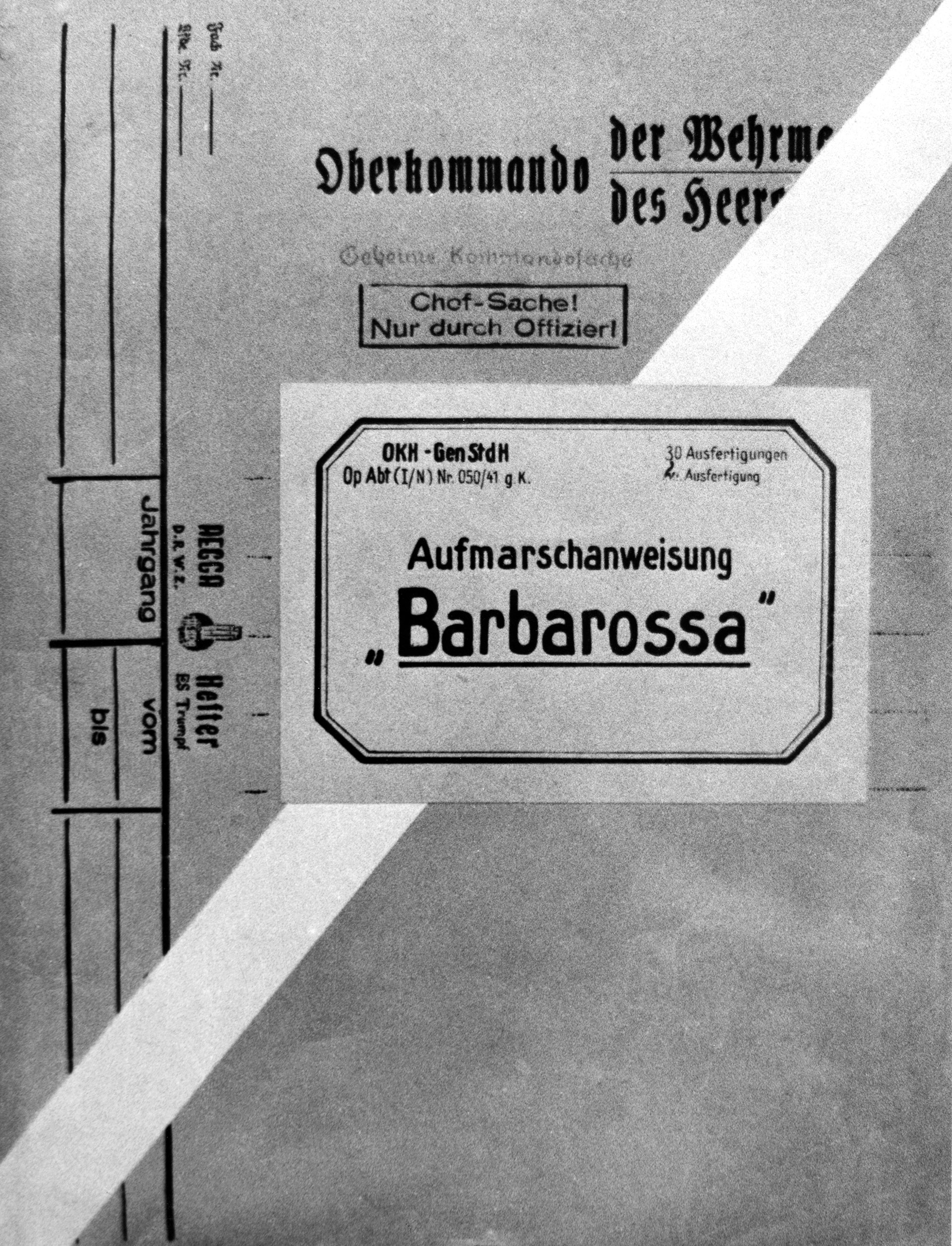
On December 18, 1940, Adolf Hitler signed Directive No. 21, which outlined the plan for the German military invasion of the USSR. The operation was codenamed "Barbarossa", in honor of the militant Holy Roman Emperor Frederick I Barbarossa. This red-bearded soldier fought more than once in Italy, twice participated in the crusades, moving East. However, he died on his way to Palestine, on the mountain river Selif, drowning under the weight of armor. The Third Reich had a similar fate. Details can be found in the Izvestia article.
Three weeks to defeat
After the defeat of France, Great Britain remained the only threat to Germany in Western Europe. "The hope of England is Russia and America. If hopes for Russia collapse, America will also fall away from England, since the defeat of Russia will result in an incredible strengthening of Japan in East Asia. If Russia is defeated, England will lose its last hope. Then Germany will rule in Europe and the Balkans," Hitler told his closest advisers and chief of staff.

The parade of German troops in occupied Paris. The year 1940
In July 1940, the Chief of Staff of the 18th Army, Major General Erich Marx, was assigned by the General Staff to develop a concept for a military campaign against the Soviet Union. At that time, Hitler was seized by the idea that the war against Russia should be started without interrupting, but only by switching to a passive mode of military operations against England. First of all, this was not expected in Moscow. Secondly, he believed that success in the East would help undermine Britain's military and political position. Marx initially proposed to launch a concentrated strike on Ukraine, reach the Donbas, and then suddenly turn on Moscow and Gorky. Then other "staff minds" joined the task, including General Friedrich Paulus, who proposed attacking with three army groups. Many years after the war, General Franz Halder, in 1940, the chief of the General Staff of the Army, claimed that Hitler "never communicated his intentions to the commanders of the armies, navy and Air Force, who were entrusted with the leadership of military operations." The commanders who suffered a fiasco tried to prove that they had nothing to do with the criminal plans of the war. This is guile. Since the fall of 1940, Hitler had personally discussed the details of the future war with them more than once. They all agreed that the defeat of the Red Army would be lightning-fast. Marx set aside 9-17 weeks for it. Von Brauchitsch — about 8-9 weeks. In conversations, Hitler mentioned different, but invariably sprint deadlines: 6 weeks, even 3 weeks...

Field Marshal Wilhelm Keitel, Field Marshal Walter von Brauchitsch, Adolf Hitler and General Franz Halder study a military map. The year 1941
The following idea was also voiced at these meetings: in 1942, "all German armed forces will be provided with food at the expense of Russia. Tens of millions of people will be condemned to starvation if we take everything we need out of the country."

Pressure and ruthlessness
The plan, which was worked on by dozens of generals, was presented to Hitler on December 5. He made some adjustments to the development. The German military later believed that it was the Fuhrer's decisions that caused future defeats. Hitler's final directive of December 18 began as follows: "The German armed forces must be ready to defeat Soviet Russia in a short-term campaign even before the war against Britain is over." Based on intelligence data, the leader of Nazism believed that the main forces of the Red Army were concentrated on the western borders of the country.
Already on March 30, 1941, when the invasion was three months away, Hitler addressed his generals with a speech on the principles of the future war. He was saying: "Soviet commissars and officials should be treated like criminals, regardless of whether they belong to the armed forces or the civilian administration. Therefore, they will not be treated as military personnel and they will not be treated as prisoners of war. All of them captured should be handed over to the field departments of the SD, and if this is not possible, shot on the spot."

The Wehrmacht training camp in Germany. The year 1941
The Fuhrer's generals were preparing to win, preparing to meet an army in the USSR that would be broken after the first blows. A few months before the start of the war, the Wehrmacht headquarters issued secret directives: "On the treatment of captured Soviet political and military workers," "On the application of military jurisdiction in the Barbarossa area and on special measures of the troops." The generals deliberately prepared the army for a war without rules, in which the enemy is treated as "genetic garbage." Most of these generals managed to get off with short prison terms after the war...
More than five million soldiers and officers were being trained to be sent to the front. 190 divisions, of which 19 were armored and 14 motorized, and another 24 divisions were in reserve. Tanks and artillery were to play a crucial role in the war. For Army Group South, it was planned to strike Moldova, Ukraine, and the Crimea and enter the Caucasus, while simultaneously moving to the Astrakhan—Stalingrad line.

German motorized infantry on the border of the USSR. June 1941
The North Army Group was preparing a strike on the Baltic States, Leningrad, and an advance towards Arkhangelsk and Murmansk. The German army "Norway" was also supposed to advance north together with the Finnish army.
Finally, the most powerful army group, Center, aimed at the crucial Minsk—Smolensk—Moscow line. They had to advance to Nizhny Novgorod, and then to align the front line along the Volga and the Northern Dvina.

German infantry and equipment of Army Group Center on the march in the USSR. July 1941
The Soviet government had no doubt that war with Nazi Germany was inevitable, despite the non-aggression pact. Over the past few years, the size of the Red Army and Navy has increased significantly. Rearmament was underway. But by the summer of 1941, it was far from full combat readiness. In the early months, the Germans were able to take advantage of the army's combat experience, numerical and technical superiority. Admittedly, there was no accurate information about the scale and timing of the attack in the USSR, and the Germans managed to confuse the Kremlin by dissolving reliable information into a swamp of disinformation. Most experts in the world believed that Berlin would not dare to start a new war without ending Britain.
"Underestimated the Russian colossus"
Despite German punctuality, the plan turned out to be a gamble. The very first days of the war showed that the triumphal plan was impossible. On the borders, Soviet military units showed resilience and courage.

Part of the wall of one of the casemates of the north-western part of the Brest fortress. Inscription: "I'm dying, but I'm not giving up. Goodbye, Motherland. 20/VII-41»
The German offensive faced the greatest difficulties in the North, where Leningrad stood as an indestructible stronghold in their path, shackling large forces.

Soldiers of the Volkhov Front during the construction of anti-tank defenses on the Luga line near Leningrad. August 20, 1941
The first months of the Great Patriotic War were tragic for the Soviet Union and the Red Army, but the German generals realized that the plan of a lightning war had failed. On the 51st day of the war, Halder wrote in his diary: "The current situation increasingly indicates that we underestimated the Russian colossus, who consistently prepared for war with the obvious and ruthless determination that is so characteristic of totalitarian states. This applies both to issues of management and mobilization of the economy, as well as to the organization of communication of military potential. At the beginning of the war, we expected to have about 200 enemy divisions against us. Now, 360 divisions have already been identified. Of course, these divisions are not as armed and staffed as ours, and their command is often tactically much weaker than ours, but these divisions exist. And even if we break up a dozen of these divisions, the Russians will put up another dozen. The time factor works for the enemy, as his troops are located near their own supply bases, while we are moving further and further away from ours. That is why our troops are scattered along a huge front, not having sufficient formations in depth, and are subjected to incessant enemy attacks."

Registration of volunteers for the Red Army at the Oktyabrsky district military enlistment office in Moscow. June 23, 1941
Which mistakes of the German strategists turned out to be the key ones? All of them are associated with underestimating the enemy and overestimating their own strength. Perhaps the generals in this sense were guided by Hitler's emotional ideas, by his belief that the Slavs were not able to resist the German supermen. Therefore, the Germans had no doubt that after the loss of the western regions, the Soviet Union would not be able to adjust the economy.

A Soviet tank on the march to the front line. June 1941
Hitler also underestimated the Red Army, including its mobilization capabilities and its dispersion throughout the Soviet Union. German strategists believed that breaking into the first line of defense on the western borders of the USSR would be a decisive collapse for the Soviet army. They did not believe that the Red Army would be able to resist east of Smolensk, after defeats in the opening of the war. The Third Reich also did not believe in the ability of the Soviet economy to adapt to extreme military conditions, despite the loss of industrialized areas in the west. He underestimated the army discipline and training of the commanders, who, although inferior to the German officers at first, were ready to fight and learn from their mistakes. In short, the ideology of national superiority inherent in Hitler has shown its inconsistency.

Hitler also relied on the political turmoil that was to rise in the USSR after the military failures. He did not believe in the rootedness of communist ideas among the people and considered it quite likely that Joseph Stalin and his team would be overthrown 2-3 months after the war. He considered the collapse of the Soviet Union into several territorial entities to be a logical continuation of the campaign. Something similar happened during the First World War — both in Russia and in the Ottoman Empire. But the Soviet political system proved to be stronger.

Columns of fighters are moving to the front. Moscow, June 23, 1941
One gets the impression that the Nazis forced expansion, regardless of objective conditions. They needed too much to seize the resources of the Soviet Union, to expand the "living space", and millions of slaves. Therefore, Hitler hastily decided on a risky operation, resorting to far-fetched arguments. This decision turned out to be the key mistake of the German Fuhrer, which led him and his country to an inevitable and well-deserved catastrophe.
The author is the deputy editor—in-chief of the magazine "Historian"
Переведено сервисом «Яндекс Переводчик»
