
"Friendship" ends: Hungary and Slovakia urge EC to protect oil pipeline from Ukraine

The Druzhba oil pipeline, through the southern branch of which Russian oil flows to Hungary and Slovakia, has stopped working again due to an attack by drones of the Armed Forces of Ukraine. This is the third suspension in the last nine days. About what the EU's reaction to what is happening and about the prospects of the pipeline can be found in the Izvestia article.
Attack on the Druzhba oil pipeline on August 22, 2025: what is known, the latest news
The Druzhba oil pipeline stopped working due to another attack. According to Hungarian Foreign Minister Peter Szijjarto, this happened for the third time in a short period of time.
"The transportation of crude oil to Hungary has been stopped again! This is another attack on the energy security of our country. Another attempt to drag us into a war," Szijjarto said.
Information about the attack on Druzhba was also confirmed by the Minister of Economy of Slovakia, Denisa Sakova.
"Another attack on the Druzhba pipeline near the Belarusian border. The overload will stop soon," she wrote on social media. Authorities are investigating the extent of the damage, Sakova added.
Hungary and Slovakia have called on the European Commission to force Ukraine to stop attacks on the pipeline.
"The physical and geographical reality is that without this pipeline, the safe supply of our countries is simply impossible," said Ministers Peter Szijjarto and Juraj Blanaru.
Hungary and Slovakia also appealed to the EC to guarantee the security of energy supply after the Ukrainian Armed Forces attacks on the oil pipeline.
Druzhba — where it goes, the map, whether it works or not
Druzhba is the world's largest oil pipeline to Europe. The route runs from Almetyevsk in Tatarstan through Samara and Bryansk to the Belarusian Mozyr, and then branches into two sections: the southern (through Ukraine, the Czech Republic, Slovakia and Hungary) and the northern (through Belarus, Poland, Germany). The total length is 8,9 thousand km, of which 3,9 thousand km passes through the territory of Russia. Previously, Latvia and Lithuania also pumped oil through the northern branch, but these supplies have been stopped since 2006.
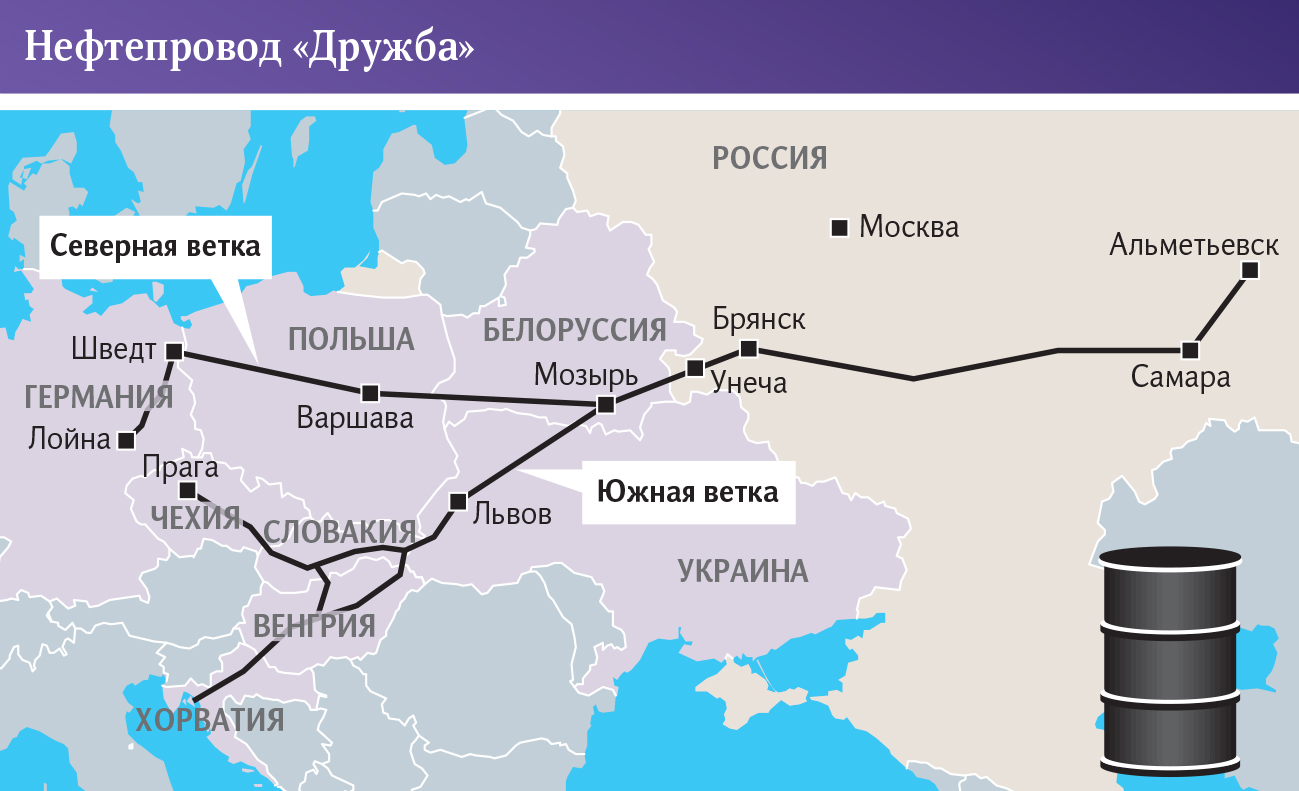
The pipeline is capable of delivering 66.5 million tons of oil per year, including 49.8 million tons via the northern branch and about 16.7 million tons via the southern branch.
However, due to EU sanctions on the northern branch of Druzhba, Russian oil has not been supplied since 2023. On the other hand, Kazakhstan's KEBCO crude oil is supplied to Poland and Germany in smaller volumes, which is indistinguishable in composition from the Russian Urals.
Along the southern branch, Russian oil went to Hungary, Slovakia and the Czech Republic, while the latter announced at the end of 2024 that it would abandon Russian black gold and switch to alternative supplies from Italian ports. In turn, Hungary and Slovakia insisted that the EU sanctions temporarily did not apply to Druzhba and were excluded from the 18th package.
Alexander Frolov, Deputy Director General of the Institute of National Energy and editor-in-chief of the InfoTEK portal, told Izvestia that supplies along both branches of the pipeline were most likely stopped as a result of the accident. At the same time, Kazakhstan, as it happened earlier with the attack on the CPC pipeline in the Caspian Sea, prefers not to comment on what is happening, the expert noted.
— In recent years, Slovakia and Hungary together have received less than 10 million tons of fuel per year from Russia. At the same time, the main problem with supplies through this oil pipeline is not related to Ukraine's attempts to "sting" the infrastructure, but to the strategy adopted by the EU to completely abandon Russian hydrocarbons after 2027. It is assumed that after this period, neither Hungary nor Slovakia will be able to receive Russian oil, although they obviously would like to continue," the expert explained.
As for possible alternative pipeline supplies after 2027, including from Kazakhstan, according to the expert, Astana does not have the necessary volumes and they are unlikely to appear, and in general, the current EU regulations on the rejection of oil and gas from Russia prohibit any schemes in this matter.
Political analyst Vadim Trukhachev, in a forecast for Izvestia, noted that it was unlikely that there would be any reaction from the EU.
— The European Union has set a goal to get rid of Russian oil supplies, and Ukraine is helping in this. Moreover, Ukraine is punishing Hungary for raising the issue of the fate of the Hungarians of Transcarpathia and blocking negotiations on Ukraine's membership in the EU and NATO," the expert explained.
At the same time, according to him, Budapest could cut off the supply of electricity to Kiev, but in this case the European Union would completely remove Hungary from the allowance.
"Orban and Szijjarto understand this perfectly well, and therefore, instead of turning the switch, they utter a lot of words that are poorly supported by deeds," the expert noted.
Oleg Karpovich, vice-rector of the Diplomatic Academy of the Russian Foreign Ministry, believes that the EU is trying to put pressure on Hungary and undermine Viktor Orban's position.
— The Hungarian leader has repeatedly stated that a "color revolution" scenario is being prepared against him. Apparently, undermining the energy potential of this country, according to Kiev's plan, should make its leaders more accommodating or help the opposition gain points. The EU explicitly supports this scenario. But so far, Ukraine's actions only contribute to the cohesion of Hungarian society and strengthen the unwillingness of Orban's team and soften its position on Kiev's European integration, Oleg Karpovich believes.
Hungarian political scientist Gabor Stier also does not expect a reaction from the European Commission.
— The EC has not done anything before, and it will not do anything this time. It will be beneficial for Brussels if Hungary and Slovakia, which have become exceptions, will not be able to receive oil from Russia in the future. It is also beneficial for Ukraine. This is blackmail, this is pressure on Hungary, on Slovakia, in connection with why we resist the European integration of Ukraine," explained Gabor Stier.
The expert stressed that this is the third attack, which means that this is not an accident and Ukrainians will do this regularly.
— This is a big game, but in this game we have a trump card: 42% of Ukraine's electricity comes through Hungary. And the Foreign Minister has mentioned this more than once. If this problem worsens, Hungary should take some measures," believes Gabor Stier.
Speaking about the US position, the expert recalled that Hungarian Prime Minister Viktor Orban had already addressed President Donald Trump, but he only expressed regret over what was happening.
"If he wants to, he can put pressure on Ukraine, but this is not the most important issue for him right now," the expert is sure.
The history of the construction of "Friendship"
The construction of Druzhba began on December 10, 1960, contrary to the usual practice — from the final, and not from the initial sections. The main reason was geopolitical: in this way, the USSR demonstrated the seriousness of its intentions to provide the socialist countries with a sufficient amount of hydrocarbon raw materials. During the construction of the pipeline, each country was responsible for its own part, as the pipeline became the property of the respective State. Construction was completed four years later, in October 1964. Transneft became the operator of the Russian section.
The pipeline was laid through the mountains, crossed hundreds of roads and railways — 175 bridges and 113 crossings were built for it. It also runs along the bottom of 45 major rivers, including the Volga, Oka, Dniester, Dnieper, Pripyat, Danube, Vistula and Oder.
Переведено сервисом «Яндекс Переводчик»
