- Статьи
- Society
- They lied about the altitude: confusion with instrument readings could have caused the crash of the An-24 Angara

They lied about the altitude: confusion with instrument readings could have caused the crash of the An-24 Angara

Rosaviatsia recommended that all pilots and flight controllers be additionally trained using the international altitude detection system in order to avoid disasters such as the crash of the An-24 near Tynda. During the investigation of this disaster, it was previously established that the Angara plane could have crashed due to confusion with the altitude determination: the instruments showed it relative to sea level, and the pilots thought that this was the height above the airfield, and as a result flew significantly below the prescribed level. This follows from a letter from the head of the Federal Air Transport Agency Dmitry Yadrov to the heads of airlines. In recent years, airfields in the Russian Federation have been actively transferring from the Soviet system for determining altitude in meters from runway level (QFE) to the international system in feet from sea level (QNH). Some airports operate according to Soviet standards, others according to international standards, and this can cause confusion among pilots, experts confirm.
The preliminary cause of the An-24 Angara disaster
During the investigation of the crash of the An-24 aircraft of the Angara airline near Tynda, it was previously established that this could have happened due to confusion with the definition of altitude, follows from a letter from the head of the Federal Air Transport Agency Dmitry Yadrov to the heads of civil aviation organizations. Izvestia has reviewed the document. It notes that during the descent, the AN-24 crew set pressure on the barometric altimeters according to QNH (international rules using the zero mark at sea level). However, when passing the checkpoint, the crew reported to the dispatcher about the altitude of 1100 m, which corresponds to the QFE (Soviet rules for measuring altitude from runway level at the airfield).

Judging by the negotiations of the crew, the next set altitude was 745 m, which corresponds to the QFE pressure approach map in Tynda. At the same time, heavy rain and clouds at altitudes of 225-600 m did not allow the crew to visually observe the ground during landing. And the dispatchers could not give the exact altitude data, since there was no mark from the aircraft on the radar screen.
At an altitude of 150 m relative to the airfield (765 m relative to sea level), the aircraft touched the crowns of trees on a hill, according to a letter from the Federal Air Transport Agency. As a result, the plane collapsed and burned down, and all the people on board died.
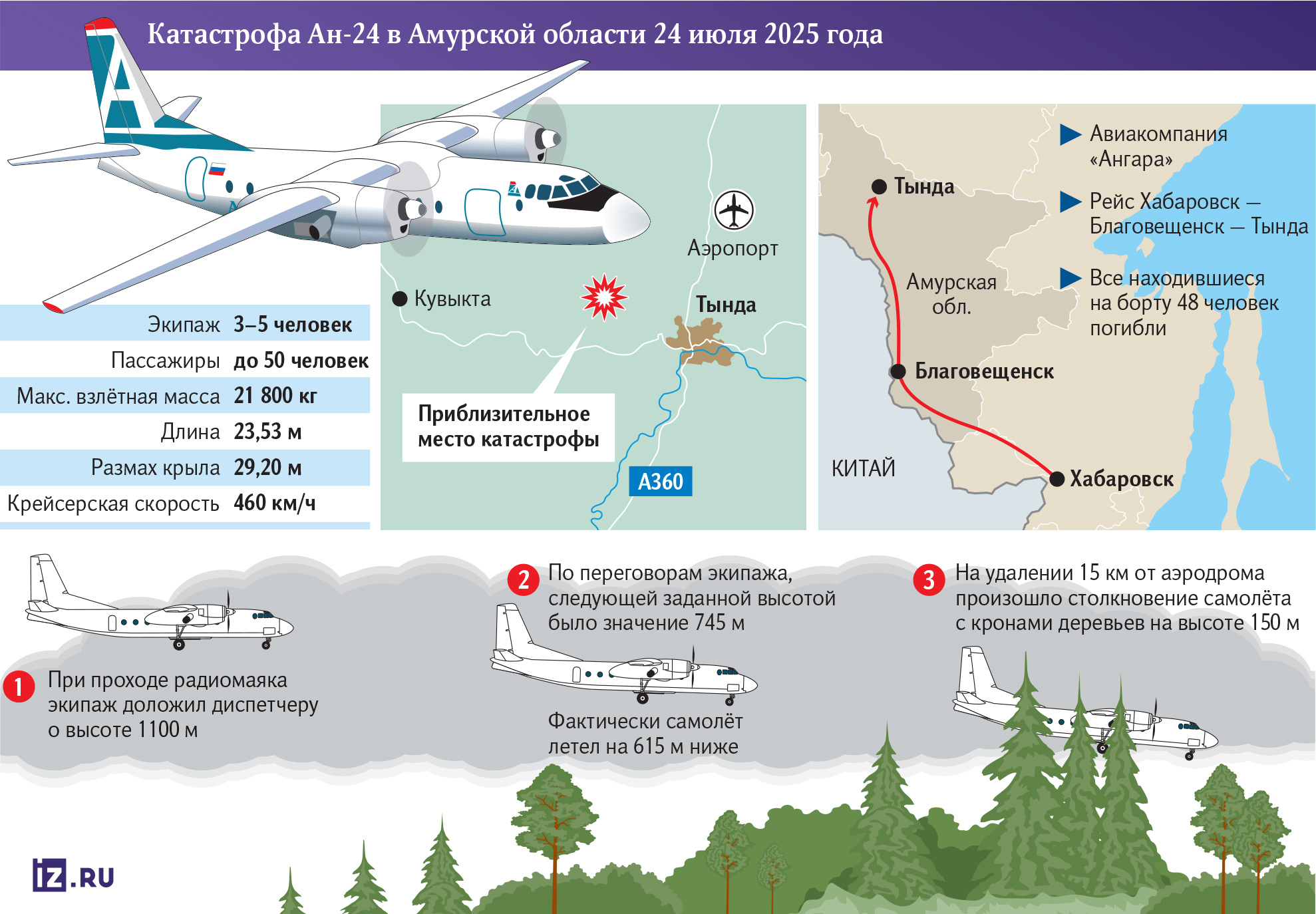
"Preliminary information about the circumstances of the accident involving the AN-24RV RA-47315 aircraft allows us to classify it as an event in the category of "Collision with the ground in controlled flight" (CFIT)," the document says.
The Federal Air Transport Agency CFIT also includes the Mi-8T "Agroindustrial Complex "Vzlet" disaster, which occurred on July 14, 130 km from Okhotsk. In conditions of poor visibility, the helicopter collided with a mountainside at an altitude of 870 m relative to sea level. Three crew members and two maintenance specialists were killed.

"CFIT aviation accidents are the result of factors such as flying below the required trajectory, errors in setting pressure on barometric altimeters, navigation errors, improper use of on—board equipment, etc.," the letter says.
In order to prevent such accidents, the head of the Federal Air Transport Agency Dmitry Yadrov instructed civil aviation organizations to conduct additional classes with flight personnel and airfield personnel on the application of the QFE and QNH rules. It is proposed to pay special attention to airfields that have recently adopted the international standard.

The Federal Air Transport Agency, in response to a request from Izvestia, stressed that it "provides information on the preliminary results of the investigation of the An-24 aircraft disaster, established at the current time, which will be clarified and supplemented during further investigation." The ministry stressed that "it is premature to talk about the cause of the disaster now," and "information on flight safety has been released only for the purpose of carrying out corrective measures or actions aimed at improving flight safety."

Izvestia also sent a request to the Interstate Aviation Committee (IAC), which is determining the causes of the An-24 crash, with a request to comment on the data contained in the letter from the head of the Federal Air Transport Agency.
Why did the pilots confuse the flight altitude?
— There are two rules for determining flight altitude in Russia. The Soviet QFE takes the runway as zero, and the international QNH takes the sea level," Andrei Litvinov, a first-class civil aviation pilot and aviation expert, told Izvestia. — The latter began to be introduced when we had a massive influx of "foreign cars" and the international standards of the ICAO were adopted.
The Federal Air Transport Agency stressed that "the use of QNH is an international practice, it is safer than QFE." The ministry also stated that this measure is aimed at improving the level of flight safety when servicing Russian and foreign airlines, while "eliminating the possibility of QFE flights is not planned."

As the press service of Smartavia airline told Izvestia, the Ministry of Transport made the decision to switch to QNH in December 2011 as part of bringing the legislation of the Russian Federation in the field of civil aviation in line with international standards.

This process was slow. First, major international airports switched to foreign standards, and then others caught up. Dozens of regional airfields are currently being transferred to QNH. According to the State ATM Corporation, 34 airfields, including Tynda, were transferred to QNH in 2024.
There are currently 132 airfields operating in Russia with QNH pressure. By the end of 2025, 33 more will be added to them.
"The difference in the readings of the altimeters operating on QFE and QNH reaches hundreds of meters,— honored pilot Yuri Sytnik told Izvestia. — And the higher the airfield is above sea level, the higher it is.
If there is an error with the zero setting, the aircraft may fly lower than the instruments show, the pilot notes.
— On modern domestic and foreign—made airliners, that is, on Superjet, Boeing, Airbus, etc., there is no confusion, since there are duplicate instruments that show altitude in both QFE and QNH, - continues Andrey Litvinov.

But on old Soviet aircraft that turned 40-50 years old, only one zero value can be entered into the altimeter. And the risk of getting confused between duplicate height determination rules is increasing, especially in the regions, the expert notes.
"Pilots in the regions began flying to airfields with different QFE and QNH standards, and to determine the altitude they had to check with documents on the pressure status at specific locations," Andrey Patrakov, founder of the RunAvia flight safety service, told Izvestia.
For example, Khabarovsk operates according to the Soviet QFE standard, while Blagoveshchensk (Ignatievo) and Tynda operate according to the international QNH standard, the expert notes.
As a result, according to Andrey Patrakov, the Khabarovsk – Blagoveshchensk – Tynda AN-24 flights fly to airfields with different altitude indicators. This situation can lead to crew errors, especially on airplanes of the 70s with a low level of flight automation, where everything is based on the human factor. The problem is related to the lack of a single pressure standard value for height determination.

Miroslav Boychuk, President of the Russian Flight Crew Union, an Airbus A330 pilot, drew attention to the fact that every pilot must familiarize himself with the data of the arrival airfield, its features, including the altitude measurement system he uses before departure.

— Pilots are taught to navigate freely in different measurement systems during their studies at aviation schools or universities — this is basic knowledge. Further training, including retraining, is the task of airlines, which are required to monitor the qualifications of the crew," Boychuk said.
And the flight director of IrAero Airlines, the largest operator of the AN-24/26, said that, given the transition to the international QNH altitude reference system, scheduled training of flight personnel has been going on for several years.
— IrAero conducts theoretical and simulator training with all flight personnel, including QNH pressure flights. The practice of performing QNH pressure flights to both controlled and uncontrolled airfields is being developed," he stressed.
The Federal Air Transport Agency explained that the main difficulty in retraining pilots from QFE to QNH is the need to switch between altitude reference systems at different airfields, which creates an additional burden on the crew. "However, all this burden is offset by mandatory high-quality airline training and simulator training, which guarantees reliable adaptation for all pilots. Safety is ensured by strict adherence to procedures, the use of detailed control charts and mandatory cross—control in the cockpit," the agency is confident.
These measures, together with the planned transition of all airfields to a single standard, completely eliminate the possibility of error, the Federal Air Transport Agency believes.
Переведено сервисом «Яндекс Переводчик»
