- Статьи
- Science and technology
- Dust and nothingness: how the Perseid flow model will help in the construction of lunar bases

Dust and nothingness: how the Perseid flow model will help in the construction of lunar bases

Russian scientists have created a computer model of the impact of meteors from the Perseid stream, which astronomers observe every year in August, on the Moon's exosphere. According to calculations, the bombardment of the satellite of our planet by the smallest particles leads to a gradual weakening of its gas shell. The data obtained will be important for planning future space missions, including choosing safe landing sites and crew schedules. For more information, see the Izvestia article.
Annual meteor shower
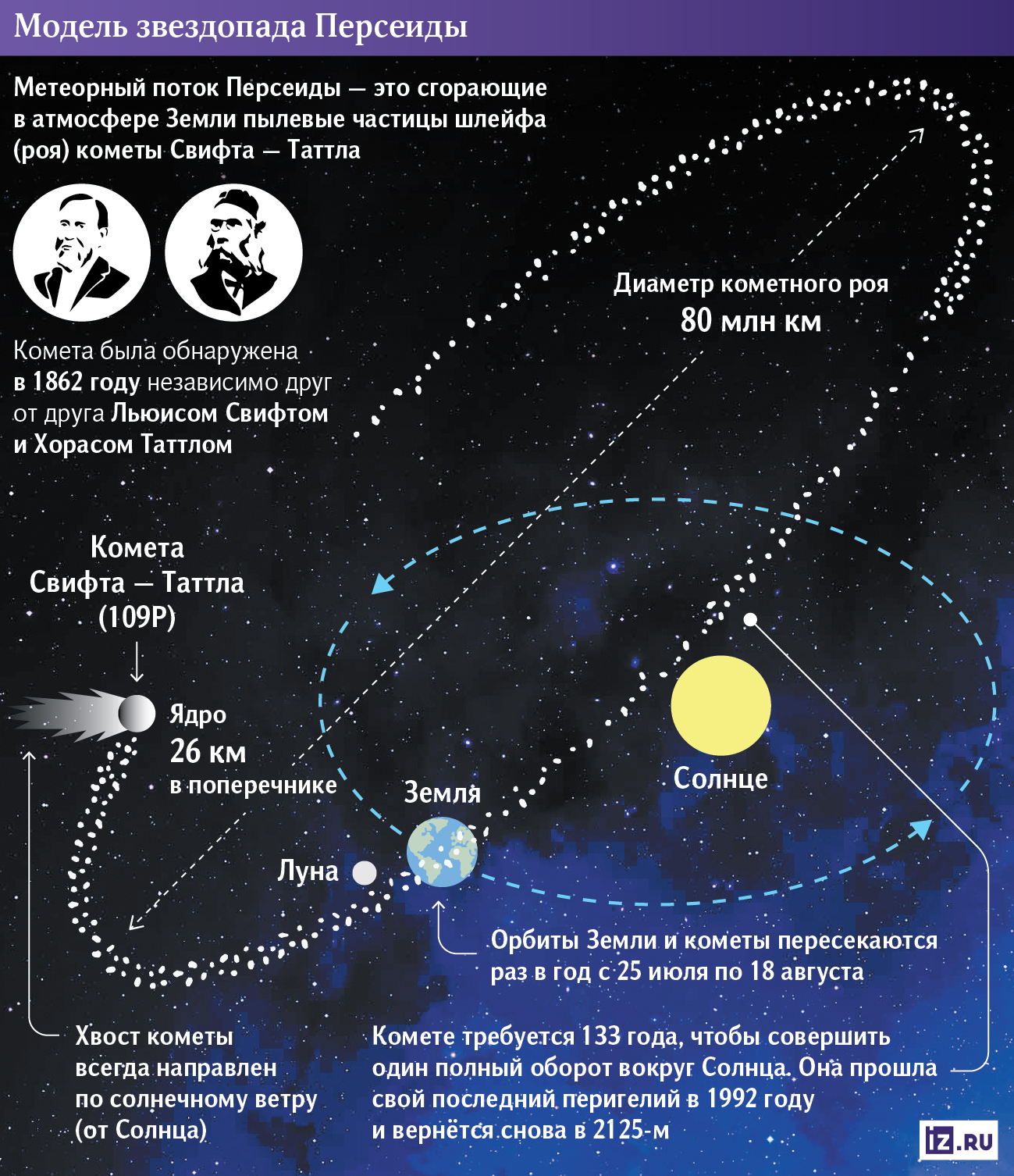
Specialists from Ural Federal University (UrFU), together with colleagues, have created a computer model that describes the activity of the Perseid meteoroid stream on the Moon. This annual phenomenon occurs in August and reaches its peak on the 12th-13th, when a plume of tiny dust particles left by Comet Swift–Tuttle reaches the Earth's atmosphere and causes a "star shower". An article describing the study was published in the scientific journal Meteoritics and Planetary Science.
Calculations by scientists and observations by Russian telescopes have shown that meteors fall not only on our planet, but also on its satellite, while increasingly weakening its exosphere — a rarefied gaseous shell. It differs from the Earth's atmosphere by its low density and different chemical composition. These models will allow their impact to be taken into account when developing equipment for lunar missions. And also to build expedition routes so as to avoid falling into the zone of meteor bombardment.

The Swift-Tuttle Comet
— Each time Comet Swift–Tuttle approaches the Sun, it emits a certain number of particles. This is repeated with each orbit turn. Simulations over the past 25,000 years have shown that 175 such dust plumes formed during this period, which were highly likely to reach the Earth and the Moon in the form of a stream of meteoroids. Our calculations and the results of observations coincided, which confirmed the reliability of the model," said Maria Gritsevich, senior researcher at the UrFU Extra Terra Consortium Scientific Laboratory.

The model was built based on data on the events of 2009, which were recorded using objective observations. Simulations have shown that streams of tiny meteoroid particles weighing up to 5-10 millionths of a gram per square centimeter crash into the lunar exosphere at high speed, significantly affecting its composition and condition. At the same time, the exosphere becomes even more rarefied.
— There was a meteor bombardment on the moon. All objects in the solar system that do not have an atmosphere are susceptible to this. This process leads to cosmic weathering. And when preparing lunar missions, it is necessary to take into account these phenomena that occur not only on the surface of the satellite, but also in the orbits of the Moon and Earth. Sometimes collisions of these tiny particles cause visible damage to machinery. Although the dust is very fine, it has a high velocity. And our model can predict where and when to encounter them, and not fly there. Choose the landing sites and the schedule of the expedition," said Maria Gritsevich.

According to the expert, these models will also provide an opportunity to better understand what happened during the formation of the Solar system. Dust from comets may turn out to be one of the carriers by which life spread in the universe.

A beautiful heavenly sight
All studies that focus on near-space objects are extremely important, as they make it possible to conduct experiments in the most inaccessible environments. Knowing the density of the meteor shower at a certain time, scientists can measure and compare other parameters before and after, said Pavel Nikiforov, chairman of the Irkutsk Regional Astronomical Society.
— In this way, you can get a lot of valuable conclusions about changing natural conditions, so there should be as many such studies as possible. Comets have a very interesting chemical composition and are considered one of the most likely carriers of life to Earth," said Pavel Nikiforov.

As explained to Izvestia by astrophotographer Maxim Khisamutdinov, the Perseid meteor shower is a spectacular sight that can be seen from Earth with the naked eye. Amateurs photograph it every year with wide-angle lenses. Meteors flash like bright sparks against the night sky. And the observers are trying to count them. At the same time, the Moon only interferes with observations, as it illuminates the sky.
According to media reports at the Moscow Planetarium, the meteor shower will peak this year on the night of August 12-13, at about 23:00 Moscow time. However, it will be most noticeable after midnight. At the same time, up to 100 meteors per hour can fall, that is, 1-2 luminous objects per minute. However, in large cities, observations will be hampered by strong illumination from night lighting.
Переведено сервисом «Яндекс Переводчик»
