
An incendiary thing: how the Russian novelty behaves on the road
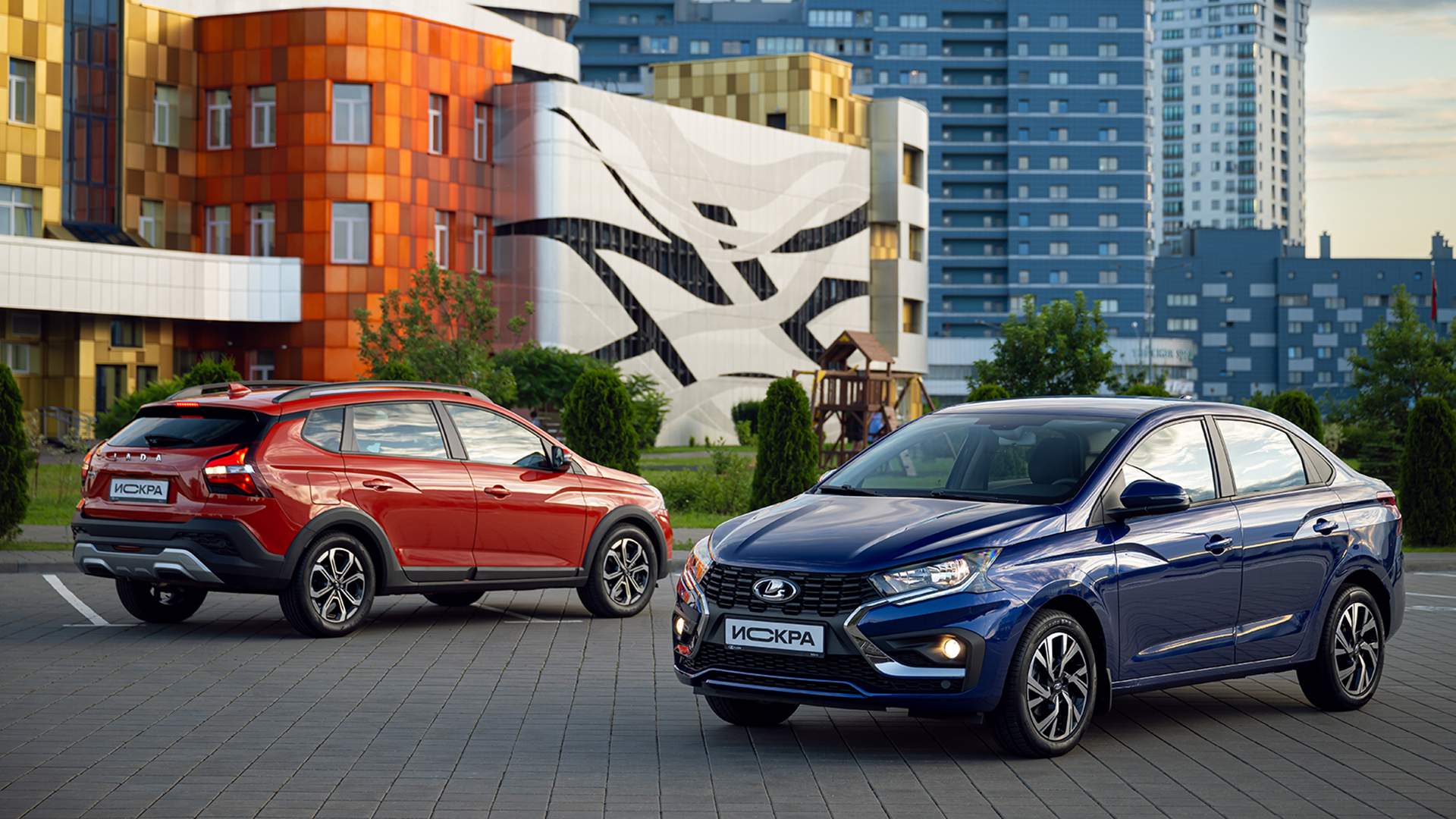
Lada Iskra is a doubly amazing premiere. AvtoVAZ rarely launches completely new models. And a car cheaper than one and a half million rubles is a rarity for today's Russian market. Whether Iskra would cause a fire in the market was investigated by the Izvestia correspondent, who drove a car for hundreds of kilometers along the roads of Belarus.
Lada Iskra — what kind of car is this?
The first serial Iskra had just reached dealers, but the pesky bloggers had already discovered Renault's inscription on some body parts and were outraged.: how is this so, because AvtoVAZ claimed that the localization of the car reaches 90%, and here the inscription is French, the pillow is Japanese. The press service of the Volga Automobile Plant reacted with some surprise: the car was developed back when Renault was a shareholder - what, now, because of one "unfriendly" inscription, to re—order expensive molds? AvtoVAZ representatives once again confirmed the 90% localization level and stressed that the bodies are stamped from Russian metal. Moreover, more than half of the body parts are made of high-strength steels, and the exterior panels are galvanized, with the exception of the roof. Even if the representatives of the plant are lying about something, what's wrong if, in the face of unprecedented sanctions, some components still come from abroad.

The Lada Iskra sedan is 6 mm longer than the Granta and 11 mm shorter than the Vesta. Sedan dimensions: 4333×1777×1517 mm. The SW Cross version is larger: 4342×1785×1544. The wheelbase of the cars is the same — 2603 mm.
Officially, AvtoVAZ does not communicate with the former shareholder and generally has a grudge against him. The French escaped, and the car had to be completed by our engineers, who made about a thousand changes to the design. These are domestic engines, other transmissions, suspension elements, and electronics. The rear suspension was borrowed from Vesta, the platform is now called Iskra. The car built on this platform has little in common with the new Logan, they say, although the external similarity is noticeable. The exterior and interior were approved "under the French."
The French style can also be traced in the playful shape of the headlights, the pattern of the taillights, and the deliberately crude body kit of the Cross version. At the same time, the novelty continues the style outlined by Steve Mattin — "x-face", deep stamping on the sidewalls, bizarre bends of the trunk lid. Absolutely recognizable Lada, and it is immediately noticeable that it is the most modern. Perhaps this is not the most advanced design, but it is devoid of what is called "Chinese", its language is understandable to those who miss the budget European foreign car. The presence of a station wagon body in the line is a real rarity, and bright colors like blue and orange highlight the "Spark" in the stream. Although most often we will see white and black cars.
Lada Iskra — what's inside
The wheelbase of the Iskra is slightly smaller than that of the Vesta, so the second row is narrower and the doorway is narrower from below. The margin above the head and in front of the knees is smaller, but the seat on the high sofa is comfortable, and the feet can be hidden deep under the front seat. The trunk of both the station wagon and sedan is unexpectedly deep, and a full-size spare tire is located in the spacious underground.
The interior of the sedan is enlivened by the "forged carbon" insert and the texture of the seats, the SW Cross station wagon inside is more elegant due to the red inserts. There is also a "French" approach here — a couple of design chips like diamond ducts and frankly budget finishing materials, like those of Logans and Dusters.

In addition to heated seats, Iskra is equipped with heated steering wheel, heated windshield and windshield washer nozzles.
The plastic is exceptionally hard and echoing, and the panels differ only in texture, which is the responsibility of the Russian company Krasnaya Mashina.
At the same time, the door cards are made of several parts, and if some third-party company decides to make soft, fabric- or leatherette-lined armrests, they can easily be installed in their regular places.
Right now, the elbow feels uncomfortable on the hard armrest, but there are no other complaints about the driver's seat. The seat is comfortable, with good lateral support, tall drivers will appreciate the height adjustment of the cushion in the range of 80 mm and the steering wheel overhang adjustment available in more expensive trim levels. The location of the large buttons is logical, the analog devices are easy to read, and the simple, manually operated air conditioner cools the interior perfectly when it's over +30 degrees outside.
Lada Iskra and lavender raf
The shape of the stylish cup holders echoes the rhombuses of the ducts, but the functionality raises questions. First of all, all three are unlikely to fit a bulky glass with lavender raff or a smoothie. Secondly, the cup holders are located in the blind spot, and they are also covered by a folding armrest. You have to find the glass by touch, and there is a high risk of spilling its contents on the carpet or on your trousers. Water bottles can be placed in door pockets, but the problem of lavender rafa is more serious than it seems.

The ground clearance of the sedan is 170 mm. Seals on the inside of the doors protect the thresholds from dirt
AvtoVAZ wants to attract young people with Iskra, those millennials and zoomers from 25 to 32 years old. That's why the test was held in a popular place for young people now — in Minsk.
First of all, they want to attract digital services — the Lada Connect application has been revived for them, and the multimedia system has Internet access with prepaid traffic for three years and Yandex services with a mandatory Alice. The tablet's screen is small, with wide margins on the left and right, but they promise to increase the diagonal in the future. And to make it easier for the buzzer to exist in the world of physical knobs and buttons, the car was equipped with rain and light sensors as standard. However, in such a car there is no air conditioning, no electric windows, or even rear head restraints.
Lada Iskra — automatic or mechanical?
— The handling is good, it rides like a Logan, there are disadvantages in terms of plastic. A good budget option, — Alice is already aware of the pros and cons of Lada Iskra. Usually well-equipped cars are brought to journalistic tests, so in Minsk I got acquainted with the SW-Cross sedan and station wagon with a 16-valve engine (106 hp), with a choice of a new six-speed "mechanics" or CVT. The basic "eight-winged" unit (90 hp) with five-speed mechanics, as well as the cars in the station wagon body remained out of the brackets.

The ground clearance of the SW Cross is 200 mm. Despite the wider tires, it has a narrower track.
The CVT first turns off the motor, and only then begins to change the gear ratio, so Iskra responds with a loud growl to any attempt to accelerate. If you release the pedal, the transmission is in no hurry to slow down.
With the pedal in the floor, the Iskra roars even louder, but all the "steam goes off the whistle" — the claimed acceleration to a hundred for the sedan takes 13.8 seconds, and for the heavier SW Cross — all 14. The Iskra is noticeably heavier than the Grants and only slightly lighter than the Vesta, which is why it is inferior to them in dynamics.
For a beginner, and for many, the Iskra will clearly be the first car, such a temperament of a car with a CVT will be useful. The advantages include a less sharp steering wheel than the Vesta, neutral cornering behavior, and fairly confident deceleration. Advanced drivers will want more power and a lower suspension, so AvtoVAZ already needs to think about the Drive Active or Sportline version.
With the six-speed mechanics, the car accelerates faster, especially the sedan. And to drive at a fast pace, you don't have to turn the engine too much.
You need to get used to the specifics of turning on the gears. If you put too much pressure on the lever, including the first and second ones, it runs into an invisible "step". In order for the transmissions to come in the first time, you need to relax your hand.

The sedan (106 hp) with a 6-speed manual transmission accelerates from zero to "hundred" in 12.6 seconds. The maximum speed is 177 km/h. The average consumption is 7.8 liters per 100 km.
At the same time, cars with "mechanics" turned out to be more voracious than with a CVT, even on the highway. The consumption on the on-board computer differs by about half a liter.
If the tachometer of a car with an automatic transmission at a constant speed of 120 km/h is frozen at 2100, then with a manual transmission in sixth gear it shows 2500 revolutions, and the SW Cross with a shorter main gear approaches 3000. The Cross is, in principle, noisier than the sedan, with rails whistling through the air and wider tires slapping on bumps. In general, the habits of Iskra are somewhat rude, which makes me think of Logan. The Lada's dense suspension may be inferior in terms of energy consumption, but those who set it up were well aware that the car would have to drive on rough roads.
Lada Iskra — what are the prospects?
The test cars were released on the assembly line in Tolyatti, but belong to the early series. Therefore, there were some rough edges that traditionally accompany the launch of a new model. So, the cruise control did not work for one car, the other suddenly triggered a warning about an open trunk lid, and the third had a warning about low tire pressure.

A sedan with a CVT consumes an average of 7.2 liters per "hundred". Acceleration to 100 km/ h takes 13.8 seconds. The maximum speed is 168 km /h.
On the one hand, you can joke that Iskra rejects newfangled options, on the other, all these rough edges are easy to fix. Initially, according to the Renaulution plan, Iskra was supposed to replace Granta, and the Vesta platform, as conceived by the French, had no continuation. Like in the movie Highlander, there was only one left.
— "Grant" has already been buried three times. Despite the market decline that we are currently witnessing, Granta remains the sales leader," says Oleg Grunenkov, Director of Products and Programs at AvtoVAZ.

The Iskra SW Cross (106 hp) with a 6-speed manual transmission accelerates from zero to "hundred" in 13 seconds. The maximum speed is 172 km/h. The average consumption is 8.1 liters per 100 km.
Iskra, in fact, was trapped between two models. It is not difficult to be better equipped than the Granta, but it is also necessary to give way to the Vesta, designated the flagship. For this reason, Iskra will not receive climate control in the coming years - this is an expensive option. There will also be no fully LED headlights, which are on the Vesta, and the rear brakes will remain drum brakes. The engine start button is not supposed to be new, and remote start is still promised. It will be solved "seamlessly" — the car does not need to be turned off, the driver simply inserts the key into the lock and drives. At the same time, remote activation of the seat heating or lowering the windows on the Iskra is unlikely to appear — it is difficult.
They promise to improve the dynamic characteristics of the car, but the turbo engine will not appear on it — it is geometrically unrealistic to just put it on the Iskra and Vesta, says Oleg Grunenkov. At the same time, a prototype of the sports Iskra with a 1.8-liter boosted engine has already been shown.

Acceleration of a car with a CVT takes 14 seconds. The maximum speed is 164 km/h. The declared consumption is 7.2 liters per 100 km.
Although AvtoVAZ has already reported on the successful completion of the crash test using the ARCAP method, Iskra will be equipped with only two frontal airbags for the time being. Nevertheless, there is a place for side cushions and blinds, and for the latter, they even abandoned ceiling handles for passengers.
Lada Iskra — how much does it cost?
It is not surprising that several AvtoVAZ models compete in almost the same segment. Let us recall that when the Granta appeared, the rear-wheel drive classic, Samara, Kalina and Priora were simultaneously present on the market. Nevertheless, the new product proved to be quite viable, while the demand for outdated models dropped dramatically.
The price of the car was a significant factor, and in the case of Iskra, this is also a trump card. Let the base price be significantly higher than the Grants, but how long has a new car with a price tag of 1 million 250 thousand rubles been introduced in Russia? It is clear that for this money the buyer gets a car with an eight-valve engine with optional light and rain sensors, but without air conditioning. "Condey" is available in the next version for 1 million 319 thousand rubles. For about 1.5 million, you can purchase either a sedan with an automatic transmission or a basic station wagon. The car in the average configuration will cost 1.6–1.7 million rubles, depending on the body. The top—end sedan costs about 1.7 million rubles, and the Cross costs 1.8 million rubles. The top features a full winter package, leather steering wheel, rear-view camera, fog lights and 16-inch wheels.
In addition to the price, the novelty effect plays on Iskra's side. However, AvtoVAZ has modest plans for Iskra so far — 20-30 thousand this year, and then how will it go. The maximum capacity is 150 thousand cars, there is an additional site in St. Petersburg - the former Nissan plant. A smooth start plays into Iskra's hands — there is time to cure "childhood illnesses", and in the meantime competitors will sell off stocks of last year's cars and will no longer be able to dump.
Переведено сервисом «Яндекс Переводчик»
