
Meeting of the winners: how the Potsdam Conference was organized and conducted
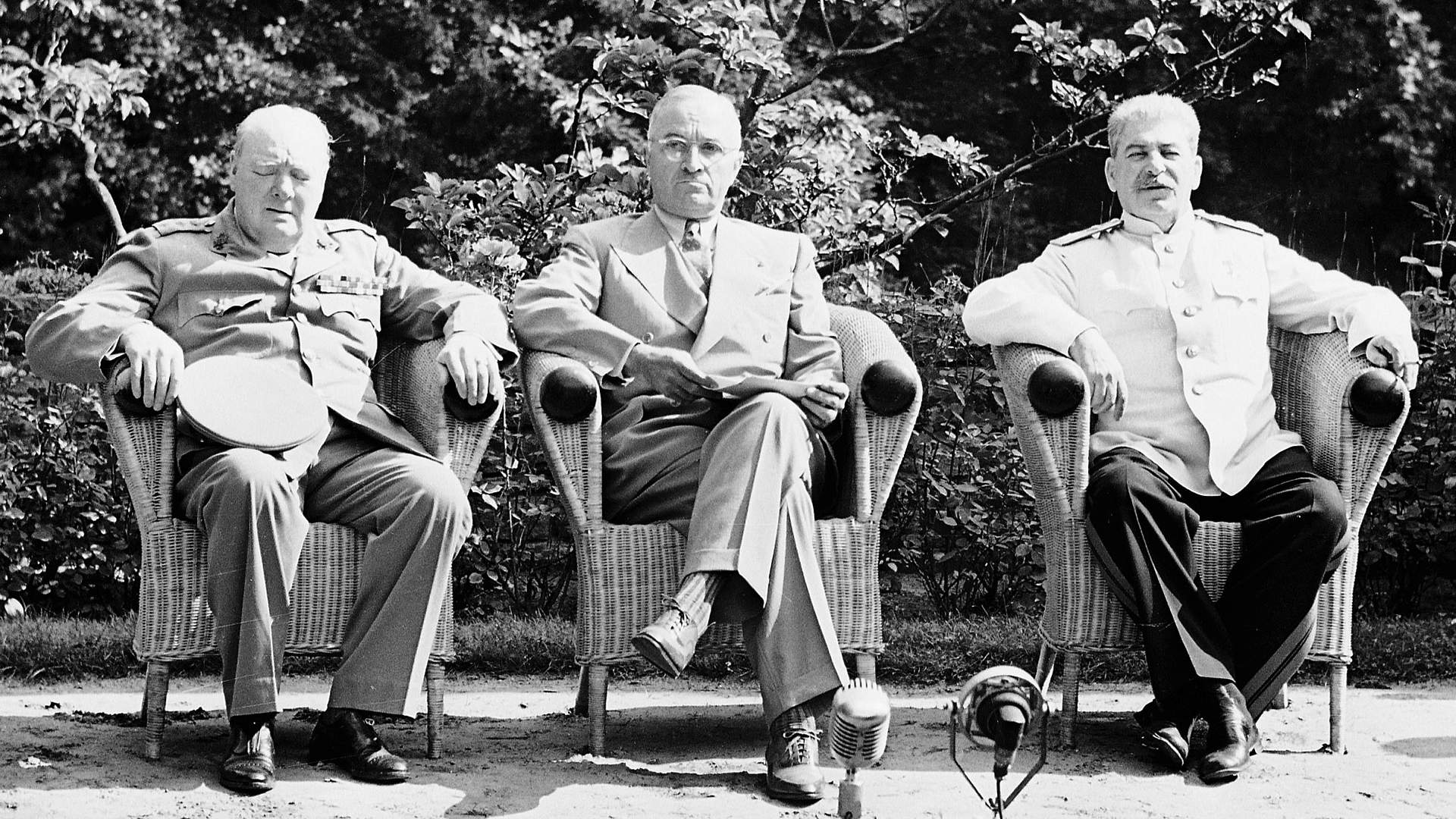
On July 17, 1945, the Potsdam Conference of the Victorious Powers in World War II began. In the West, it is more often called Berlin, but it was in Potsdam. Izvestia recalled how it was.
The Big Three
In those years, the fate of the post-war world was decided by the three powers that formed the foundations of the anti-Hitler coalition that saved the world from Nazism. The first time they gathered was in Tehran, at the end of 1943. Then there was a meeting in the liberated Yalta, and after the German surrender, the victors gathered in the very lair of the defeated enemy. The USSR was invariably represented at conferences by Joseph Stalin, who at that time was more often represented as the Supreme commander, marshal, and after June 27, 1945, as generalissimo. US President Franklin Roosevelt played an important role in the anti-Hitler coalition, but he died on April 12, 1945, and Harry Truman arrived in Potsdam, becoming the owner of the White House without elections, and without serious political experience. For Winston Churchill, the Potsdam Conference was a double ordeal. On the one hand, he was going to "give battle" to Stalin, preventing the strengthening of Soviet influence in Europe, which was inevitable after the Victory. On the other hand, parliamentary elections were held in the UK. At that time, the vote count took a long time — almost three weeks. The results were expected by July 26.

The 33rd President of the United States, Harry Truman
On the eve of the conference, Churchill wrote to Truman: "The Iron Curtain is falling over their front. We don't know what's going on behind him. There is little doubt that the entire area east of the Lubeck, Trieste, and Corfu lines will soon be completely in their hands... In a very short time, the road will open for the Russians to advance, if it pleases them, to the waters of the North Sea and the Atlantic Ocean." The British prime minister clearly hoped for a unified position with the Americans and was preparing for a confrontation with Stalin. But the US president was not going to block with his British counterpart on all issues. He played an independent game, aspired to world hegemony and perceived not only Moscow, but also London as a competitor. And Stalin got acquainted with this message from London to Washington almost simultaneously with Truman — from intelligence reports.

The Palaces of the Cecilienhof
Contrary to Churchill's efforts, the summit was organized by the Soviet side, which controlled Berlin and its surroundings, as was the case with the conferences in Tehran and Yalta. But it was impossible to hold talks in the German capital: the city had suffered too much during the battles. The meeting place was chosen by the Cecilienhof Palace, the former residence of Crown Prince Wilhelm in Potsdam, 20 km from Berlin.

The Cecilienhof Palace
First of all, the engineering and sapper units of the Red Army took up the task. It was necessary to thoroughly inspect and mine Potsdam and the roads leading to it, restore bridges and airfields, and launch power plants in Potsdam and neighboring Babelsberg. Then it was the turn of the repair workers, furniture makers and gardeners. Thousands of flowers were planted in the flower beds in the garden near the palace, and all the rooms were perfectly equipped for the arrival of distinguished guests.
In a matter of days, 63 villas were prepared in Babelsberg for the participants and guests of the conference. We also had to take care of food: bakeries were opened in Potsdam, poultry farms and vegetable warehouses were set up near the city. Of course, they also took care of the security, for which the People's Commissar of Internal Affairs, Sergei Kruglov, was responsible. Fire trucks with well-trained crews also arrived from Moscow. Even a wide round table for meetings was made at the Lux furniture factory in Moscow. The leaders of the three countries gathered near him on July 17.
Atomic Dialogue
Truman, unlike Roosevelt, considered the participation of the Red Army in the war against Japan problematic for the United States. I hoped to break the samurai with bombing. The US president knew little about military matters, and the generals convinced him that without Moscow's help, the war with the Japanese would turn into a marathon with an unpredictable outcome. And Stalin gave guarantees in Potsdam that he would fulfill his allied duty in the Far East.

ACS ISU-152 crosses the Mulinghe River near the city of Muling in Heilongjiang Province, China
On the eve of the conference, Truman was informed about the successful test of the American atomic bomb. With this trump card, he arrived in Potsdam. Truman was a rather brusque man, but he also felt embarrassed that the United States had implemented such a large-scale military-technical project without dedicating its main ally in the fight against Germany and Japan to it... But even more important to him was another intention — to scare "Uncle Joe", to show him that only the United States would be the leader of the post-war era. On July 24, after the meeting, Truman approached Stalin and, through an interpreter, informed him that "weapons of extraordinary destructive power" had been successfully tested in the United States.
The US president later recalled that Stalin then almost indifferently replied to him.: "We hope that you will be able to successfully use these weapons against the Japanese." This is hardly reliable. Most likely, the American president came up with a phrase that justified an atomic strike on Japan. Witnesses to this conversation, including British Foreign Secretary Anthony Eden, claim that Stalin limited himself to a brief and dry: "Thank you."

Mushroom cloud of atomic bomb over Nagasaki
In any case, Churchill and Truman felt that "Uncle Joe" underestimated the importance of atomic weapons. They were wrong. The Kremlin was well aware of the progress of the Manhattan project from intelligence reports, and it was not the first year that Stalin received reports from scientists and managers who created Soviet nuclear weapons. His cold-blooded reaction to Truman's meaningful remark showed that it was impossible to frighten or defeat the Soviet Union. It was only years later that the West was able to figure it out. Truman ordered the atomic bombing of Hiroshima and Nagasaki from Potsdam.
Questions and answers
What should be the German state that should arise on the ruins of the Third Reich? This was the key topic of the Potsdam debate. The principle of the "four D's" was taken as a basis: denazification, demilitarization, up to the dismantling of the German military industry, democratization, and decentralization. The Allies declared that they "do not intend to destroy" the German people and strive to give them the opportunity to "reconstruct their lives on a democratic and peaceful basis." The future division of Germany into two states was not discussed at the conference. But the parties predetermined the future appearance of Germany and the GDR on the map of Europe, consolidating the existence of occupation zones. The three leaders agreed that there was no political or managerial elite in Germany that could be immediately entrusted with power. Everyone was involved in the crimes of fascism to one degree or another, and everyone had to be checked and rechecked. Both Stalin, Truman, and Attlee had no doubt: at first, power over Germany should be concentrated in the hands of the occupation administrations.

The Polish issue turned out to be the most controversial at the conference. It was not only about the state borders, but also about the political future of this country. The Soviet side insisted that a Polish delegation led by Communist Boleslav Berut arrive in Potsdam. This was an important argument in favor of Poland's rebirth. The USSR was interested in a strong and loyal Slavic state on the western borders and demanded that Poland be given territory up to the Oder and Neisse rivers. After long discussions, Soviet diplomacy managed to break the resistance of the British, and Poland moved far to the west. In these parts, which became Polish voivodeships, 4 million Germans lived, most of whom had to be resettled. Since that time, Breslau (Wroclaw), Gdansk (Danzig) and other industrial cities have become part of Poland.
To Chopin's music
The conference also includes banquets, backstage meetings, and a cultural program... The Americans brought Eugene Liszt, a talented young pianist who had been giving concerts in front of soldiers in the active army for three years. President Truman, who could play music, also sat down at the piano. Soviet virtuoso Emil Gilels, who performed Chopin, one of Stalin's favorite composers, flashed at the conference with an inspired performance. This music went well with the Polish issues that politicians were puzzling over. Well, Churchill brought the Royal Air Force chapel to Potsdam, which performed military songs so beloved by Sir Winston. After lunch on July 25, Churchill left Potsdam: he left for London in the hope of a Conservative victory that would allow him to return to Stalin and Truman. But the Labor Party won, Churchill had to resign, and Clement Attlee, who had already participated in the conference, took the place of Britain's chief negotiator at the round table. London's position did not change, but the new prime minister lacked Churchill's authority and temperament.

Potsdam Results
An important decision of the "big three" was the creation of the Council of Foreign Ministers. Vyacheslav Molotov, American James Byrnes and Briton Anthony Eden (replaced by Ernest Bevin on July 28) negotiated every day in Potsdam. And we agreed to continue consultations. The council faced a difficult task — to prepare peace treaties for the former German satellites, which they had to conclude with the victorious powers. The heads of the great Powers confirmed the high status of the United Nations, which was just being created at that time. They decided not to take forceful decisions without UN approval, and discussed the draft Security Council of this permanent international organization. Stalin opposed the infringement of countries that were allies of Germany, but in 1944-1945 overthrew the pro-fascist governments. This applied to Italy, Hungary, Bulgaria, and Romania. Spain is another matter, where the brown regime of Francisco Franco has been preserved. At the insistence of the USSR, it was decided not to admit this country to the UN.

The borders of European countries have changed. The Soviet Union received one third of East Prussia, along with its capital Konigsberg (now Kaliningrad), as well as part of the Curonian Spit and the city of Klaipeda. Moscow's territorial claims against Turkey could not be satisfied. Our country had grounds to claim Kars and Surmalinsky Uyezd, which once belonged to the Russian Empire. In addition, the Soviet side intended to get a military base with access to the Dardanelles Strait. But these positions were not included in the final minutes of the conference. The fact that Ankara wisely refrained from providing extensive assistance to the Germans during the war years played a role here. Another factor is the triumph of Stalin's position on the Polish question. I had to pay for it in the Turkish direction.
"A just and lasting peace"
There were many more controversial issues and stones in the bosom in Potsdam than in Tehran and Yalta. Previously, for Moscow, Washington, and London, the main thing was to advance on the fronts, to put military and political pressure on Nazi Germany. The frontline brotherhood has been replaced by contradictions that will soon escalate into confrontation. But a major war in Europe will not break out, and this is the indisputable merit of the Potsdam negotiators.

A press release following the conference said that the meeting "strengthened ties between the three Governments and expanded the scope of their cooperation and understanding with renewed confidence that their Governments and peoples, together with other United Nations, will ensure the creation of a just and lasting peace." It is not uncommon to hear that a world order has developed in Yalta and Potsdam, which basically remained unchanged until the early 1990s. This is not entirely true. In Germany, in the summer of 1945, the allies gathered, who had recently defeated a common enemy. A year will pass and they will turn into irreconcilable antagonists.
On August 2, the three leaders, saying goodbye, expressed their readiness to continue the meetings of the "big three". But the Potsdam meeting turned out to be the last in this series of historic conferences. Britain will soon lose its status as a great power, and the fate of the world will be decided at meetings between representatives of the USSR and the United States, which have already become Cold War opponents. The memory of Potsdam will help countries with different systems to find a common language for a long time.
The author is the deputy editor—in-chief of the magazine "Historian"
Переведено сервисом «Яндекс Переводчик»
